
Direct answer
What is Copyleaks?
Copyleaks scans written text and digital images to identify AI-generated content, copyright infringement, and plagiarism across more than 30 languages for AI detection and 100 languages for plagiarism matching.
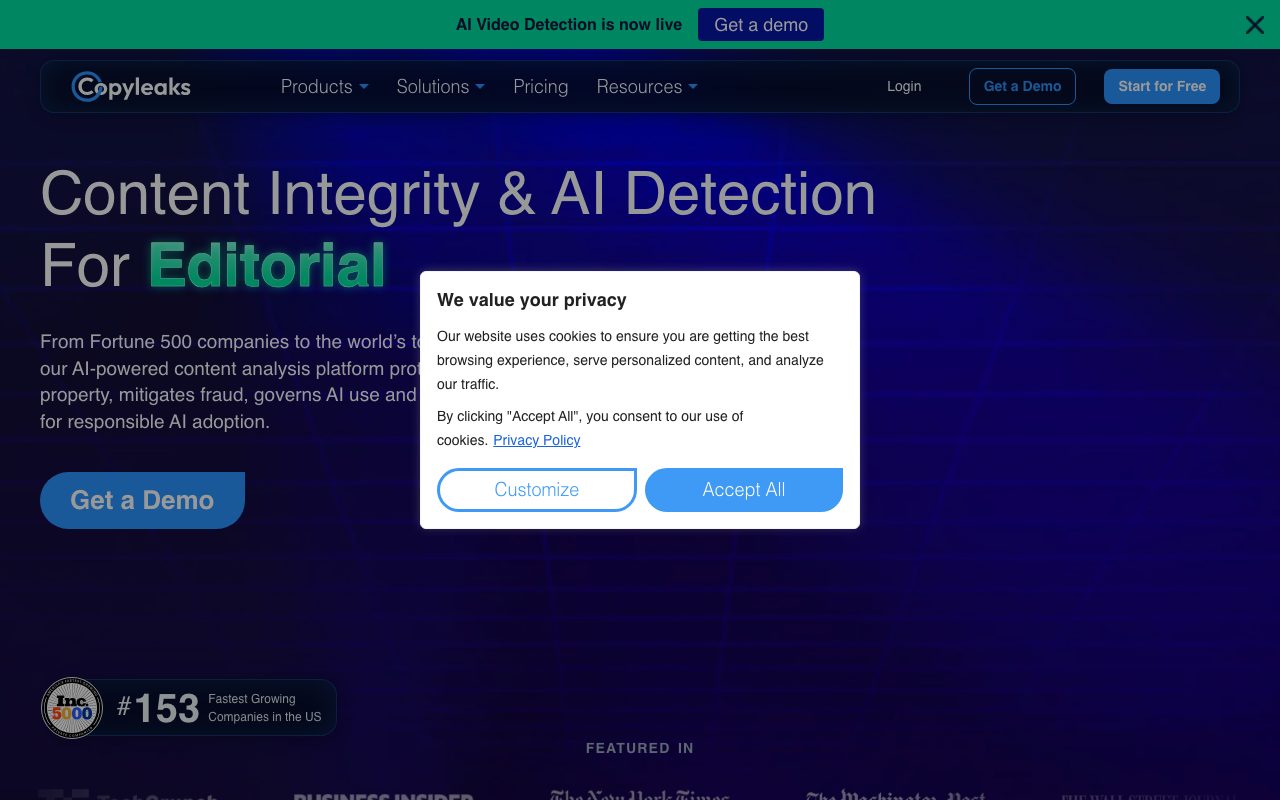
Copyleaks provides content authenticity and plagiarism screening across text, images, and code. Built for higher education institutions, publishers, and enterprises, the system analyzes text to detect passages generated by large language models—including ChatGPT, Gemini, Claude, and DeepSeek—while simultaneously matching against billions of web pages, journals, and private repositories for copied phrasing. Beyond basic text analysis, Copyleaks identifies obfuscation techniques such as paraphrasing and character manipulation designed to bypass traditional plagiarism filters. Detection outputs are integrated into a single report when analyzing text, showing human, AI, and matched source distributions. Dedicated image scanning inspects digital graphics for AI generation artifacts. Organizations can access Copyleaks through a cloud interface, browser extensions, a Google Docs add-on, API integrations, and direct Learning Management System (LMS) connectors including Moodle and Instructure.
Copyleaks combines GenAI detection across major language models with broad multi-language plagiarism scanning and image authenticity checks in one reporting ecosystem, backed by standard LMS and API integrations.
Product capabilities
Key features
Unified AI and Plagiarism Reporting
Scans submitted text documents for both AI generation markers and conventional plagiarism in a single combined report.
Extensive Model Coverage
Evaluates text against writing signatures from leading foundation models, including ChatGPT, Claude, Gemini, and DeepSeek.
Paraphrase and Manipulation Detection
Uncovers hidden copying techniques including paraphrased rewrites and deceptive character manipulation.
AI Image Detection
Inspects uploaded images at the pixel and signal level to identify and visually map the presence of AI-generated components.
Broad Language Support
Supports AI content detection in over 30 languages and standard plagiarism matching across more than 100 languages.
Extensive Source Repositories
Compares text against a repository covering more than 60 trillion web pages, 16,000 open-access journals, and 20 code repositories.
Flexible Workflow Integrations
Provides native LMS integrations for education, developer APIs for business automation, browser extensions, and a Google Docs add-on.
Privacy and Security Controls
Complies with GDPR and FERPA requirements, runs on SOC 2 and SOC 3 compliant infrastructure, and provides a Hide Sensitive Data feature for text.
Workflow
How Copyleaks works
- Upload text, images, or files via the web app, browser extension, API, or LMS connector.
- Copyleaks parses the content and isolates text strings or pixel artifact layers.
- The detection engine runs probabilistic AI attribution checks alongside comparison against trillions of web pages and proprietary academic databases.
- A unified dashboard report flags AI-written phrases, paraphrasing, source matches, and confidence percentages.
Practical fit
Who should use Copyleaks?
Academic Assignment Integrity
Universities and schools embed detection into LMS workflows like Moodle to monitor student submissions for unauthorized AI writing and copied source material.
Editorial and Publishing Verification
Publishers and content managers scan contributed articles and freelance submissions to ensure originality and protect against copyright infringement.
Corporate GenAI Governance
Enterprises scan internal documentation, incoming copy, and source code to prevent IP leakage and enforce responsible AI usage policies.
Website and Translation Audits
Marketing and SEO teams scan published domains or translated content using cross-language detection to protect search rankings and original copy.
Editorial assessment
Pros and limitations
Where it is strong
- Simultaneous reporting of AI markers and copied web sources in a single scan
- Broad language coverage across 30+ languages for AI detection and 100+ for plagiarism
- Seamless LMS and enterprise API integrations alongside a Google Docs add-on
- Dedicated privacy settings including 'Hide Sensitive Data' and FERPA-aligned controls
Where to be careful
- AI image detection flags AI presence but does not check for image copyright plagiarism
- Scans consume unified credits, requiring extra credit purchases for heavy volume
- AI detection models can produce false positives that require manual validation
Commercial context
Copyleaks pricing
At the review date (2026-09-08), Copyleaks lists self-serve tiers starting at $13.99 per month for Personal ($167.88 billed annually) and $74.99 per month for Pro ($899.88 billed annually), with custom pricing for enterprise and education LMS deployments. Unified credits determine scanning volumes. Verify current credit structures and pricing on the official pricing page.
| Plan | Price | What it includes |
|---|---|---|
| Personal | $13.99 / month (billed annually at $167.88/year or monthly options available without annual discount discounts listed up to 25%) | |
| Pro | $74.99 / month (billed annually at $899.88/year) |
Pricing, limits, taxes, model access, and regional availability can change. Verify the purchase-critical details on the official pricing page linked under Sources.
Transparent ranking
Why Copyleaks scores 71.7
Each factor is scored on a 100-point scale, then combined using the public ToolsRank weights. Engagement and momentum stay at a neutral baseline until measured signals exist, so no tool can gain or lose position from numbers nobody recorded.
Compatibility
Languages, platforms, and integrations
Languages
- English
- Spanish
- French
- German
- Chinese
- Hindi
Platforms
- Web
- Google Chrome Extension
- Google Docs Add-on
- API
Integrations & surfaces
- Moodle
- Google Docs
- Google Chrome
Community
Reviews and questions
No approved member reviews yet. Editorial factors above are the only rating on this page.
Reviews and questions come from Google-signed members and are checked by an editor before they appear.
Frequently asked
Copyleaks FAQ
Can Copyleaks detect both AI content and plagiarism in the same scan?+
Yes, for text documents. Copyleaks combines AI text detection and web/academic plagiarism matching into a single unified report. However, for image detection, the tool only evaluates whether an image was AI-generated and does not check for image copyright infringement or duplicate images.
Which AI models does Copyleaks flag?+
The platform is engineered to detect content generated by leading models including ChatGPT, Google Gemini, Anthropic Claude, and DeepSeek, with detection updated as newer models are deployed.
How does Copyleaks credit consumption work?+
Copyleaks uses a unified credit model across its plans. On self-serve tiers, credits can be spent on scanning text (for example, up to 300,000 words on the Personal plan) or scanning images (up to 1,200 images), with additional credits available for purchase on demand.
Does Copyleaks use submitted documents to train its AI models?+
By default, Copyleaks may use submitted content without personal identifiers to improve services and train its models. However, direct customers can opt out of model training by contacting customer support, and enterprise customers can elect to opt out administratively.
What security and privacy standards does Copyleaks meet?+
Copyleaks infrastructure is hosted on Google Cloud with data centers in the US and Germany. It adheres to GDPR, acts as a School Official under FERPA for educational institutions, maintains SOC 2, SOC 3, and PCI DSS compliance, and encrypts data at rest using AES-256.

