Direct answer
What is Exa?
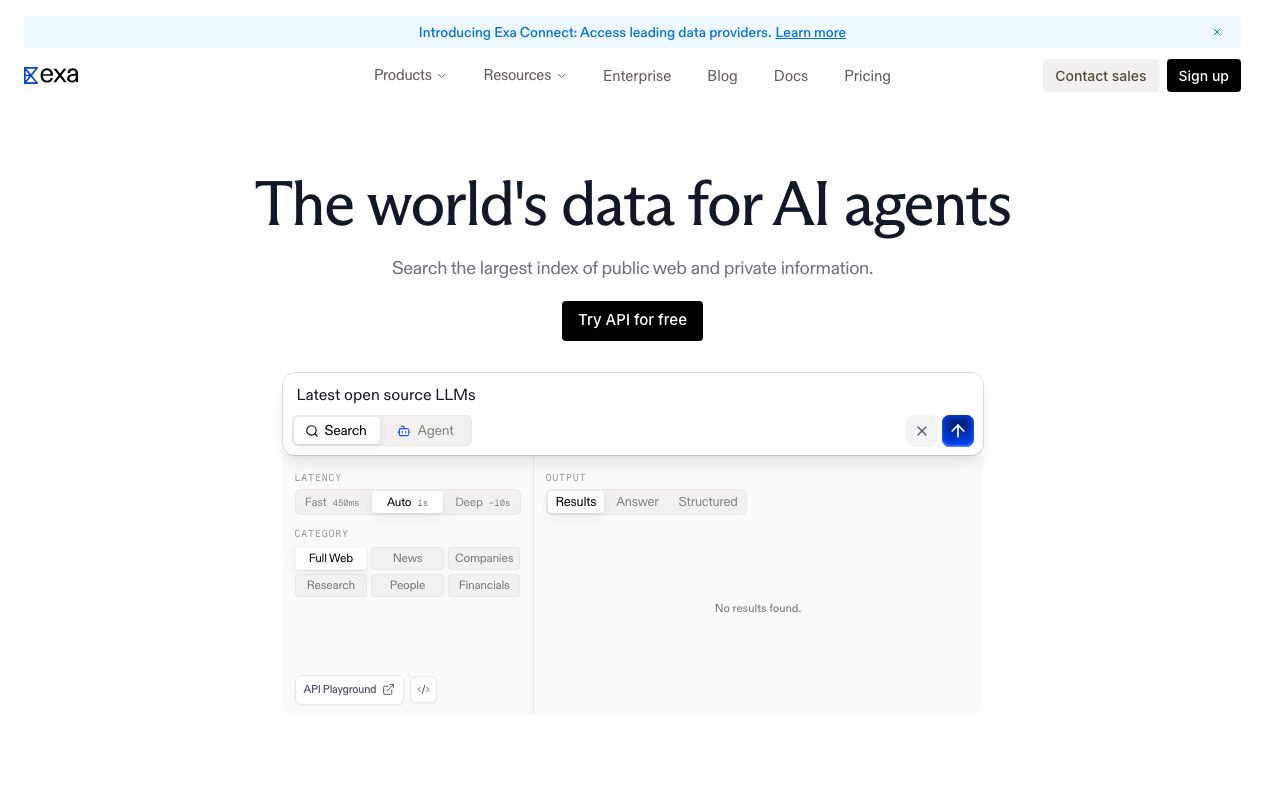
Exa is an AI-native search and content extraction API built for autonomous agents and LLMs. It features semantic search across web, people, and company data with token-efficient highlights and structured JSON extraction.
Exa (built by Exa Labs Inc.) is a specialized web search engine and content retrieval API engineered specifically for AI agents, LLM applications, and developer workflows. Unlike traditional search engines focused on keyword matching and end-user link directories, Exa indexes web content in a proprietary vector database to support natural language queries, semantic discovery, and structured data outputs. The platform provides multiple search modes tailored to latency requirements: instant (~250ms) for real-time voice and chat copilots, auto (~1s) for standard lookups, and deep/deep-reasoning (4 to 40 seconds) for synthesized research and complex reasoning tasks. Specialized category filters narrow queries directly to dedicated indexes covering companies (50M+ profiles), people (1B+ profiles), scholarly publications (350M+ papers), financial filings, and news. Beyond raw link retrieval, Exa includes a Contents API that parses JavaScript-heavy web pages, PDFs, and linked subpages into clean markdown or dense excerpts. Its Highlights and Dynamic Highlights features extract the most relevant passage tokens across target pages, reducing context window usage by up to 90%. Additionally, developers can supply a JSON schema to extract structured objects directly from web sources, or configure recurring Monitors that trigger webhooks with semantic deduplication whenever new topic results emerge.
Exa is built specifically for machine consumers rather than human browsers. It combines semantic embedding retrieval with token-reducing highlights and native JSON schema extraction, letting agents parse clean web context without scraping overhead.
Product capabilities
Key features
Latency-Tiered Search Types
Offers instant (~250ms), fast (~450ms), auto (~1s), deep-lite, deep, and deep-reasoning (12-40s) search modes to balance response speed against research depth.
Vertical Category Indexes
Dedicated retrieval indexes covering 50M+ companies, 1B+ people, 350M+ research publications, financial reports, and news.
Token-Efficient Highlights
Extracts relevant text snippets and excerpts directly from indexed web pages, cutting token consumption by up to 90% before feeding context to LLMs.
Dynamic Highlights
Allocates a single, shared context budget across an entire result set so high-signal pages receive larger excerpts while weaker pages receive fewer tokens.
Contents API with Subpage Crawling
Extracts clean markdown from known URLs, parses PDFs and JS-rendered pages, and traverses linked subpage paths automatically.
Structured JSON Schema Extraction
Accepts standard JSON schemas to synthesize web search results and webpage contents into structured object payloads.
Scheduled Web Monitors
Executes recurring web searches at fixed intervals, applies semantic deduplication, and sends new findings directly to configured webhook endpoints.
Developer Tooling & MCP Support
Provides native Python and TypeScript SDKs, an interactive API playground, code-generator onboarding, and Model Context Protocol (MCP) server integration.
Practical fit
Who should use Exa?
Grounding Coding Agents and Copilots
Supplying real-time code documentation, bug fixes, and library changelogs to developer copilots like Devin with minimal token overhead.
Automated B2B Lead and Company Enrichment
Finding companies matching specific criteria and extracting structured attributes (such as executive names, founding year, and industry) via JSON schemas.
Automated Competitor and News Tracking
Configuring Exa Monitors to track sector funding, regulatory shifts, and competitor releases, delivering deduplicated results to webhooks and Slack.
Agentic Deep Research and RAG Context
Executing multi-step research queries that synthesize data across hundreds of research publications and news sources into grounded summaries.
Editorial assessment
Pros and limitations
Where it is strong
- Specialized API designed specifically for agent consumption rather than human browsing
- Highlights and Dynamic Highlights substantially cut downstream LLM token costs
- Structured output support transforms raw search queries directly into validated JSON schemas
- Includes up to 10 web content extractions per search at no extra charge ($1/1,000 pages thereafter)
- Offers official SDKs in Python and TypeScript, plus Model Context Protocol (MCP) server support
Where to be careful
- Developer-focused platform requiring code integration or API knowledge to implement
- Deep-reasoning search modes take up to 40 seconds, requiring asynchronous or background processing
- Webhook endpoints for Monitors must be direct final destinations and do not follow HTTP redirects
Commercial context
Exa pricing
As of September 2026, Exa offers a free trial tier to test the API. Search queries include up to 10 page content results at no extra charge, followed by $1 per 1,000 pages for additional content extraction. Specific subscription plans and custom rate limits require signing up or contacting enterprise sales.
Pricing, limits, taxes, model access, and regional availability can change. Verify the purchase-critical details on the official pricing page linked under Sources.
Transparent ranking
Why Exa scores 79.7
Each factor is scored on a 100-point scale, then combined using the public ToolsRank weights. Engagement and momentum stay at a neutral baseline until measured signals exist, so no tool can gain or lose position from numbers nobody recorded.
Compatibility
Languages, platforms, and integrations
Languages
- English
Platforms
- Web
- API
Integrations & surfaces
- Slack
- ChatGPT
- OpenAI SDK
- LangChain
- LlamaIndex
- Pydantic AI
- CrewAI
- Vercel AI SDK
- Google Sheets
- Snowflake
- ElevenLabs
- Browserbase
Community
Reviews and questions
No approved member reviews yet. Editorial factors above are the only rating on this page.
Reviews and questions come from Google-signed members and are checked by an editor before they appear.
Frequently asked
Exa FAQ
What is Exa and how does it differ from traditional search engines?+
Exa is a search and content extraction API designed specifically for AI models and autonomous agents. Instead of returning raw blue links optimized for humans, Exa uses custom embedding models, vector search, and token-saving content extraction features like Highlights and structured JSON outputs.
What is the difference between Exa Search API and Contents API?+
The Search API is used when you need Exa to discover web pages based on a natural language query or category filter. The Contents API is used when you already know the URLs and need clean markdown, targeted highlights, subpage crawling, or structured JSON data extracted directly from those pages.
How do Exa Highlights reduce token consumption?+
Instead of passing an entire webpage into an LLM context window, Exa extracts only the sentences and paragraphs directly relevant to your query. The vendor reports that highlights can reduce token usage by up to 90%. In addition, Dynamic Highlights shares a token budget across multiple pages so higher-quality sources get more context.
What are Exa Monitors?+
Monitors are scheduled search tasks that run automatically on fixed recurring intervals (such as daily or weekly). Exa performs semantic deduplication so only newly published results are returned and pushed to your destination webhook.
What enterprise compliance and security standards does Exa support?+
According to official documentation, Exa maintains SOC 2 Type II certification, GDPR and CCPA compliance, HIPAA support with Business Associate Agreements (BAA), and a zero data retention policy ensuring user queries and results are not stored or used for model training.