
Direct answer
What is Fal?
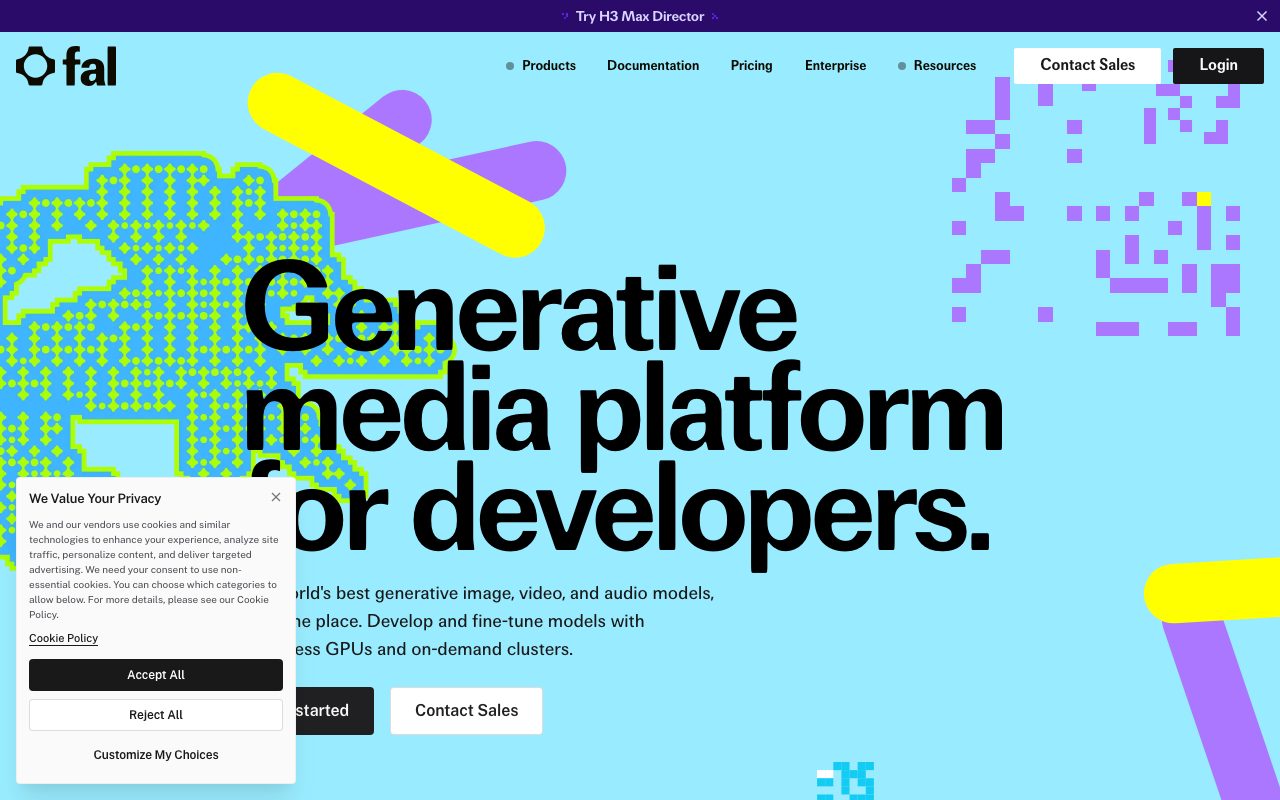
Fal is a cloud platform for generative media developers that provides unified APIs for over 1,000 image, video, audio, and 3D models alongside serverless GPU deployment and dedicated compute.
Fal operates as an infrastructure and API platform designed specifically for generative media workflows. It offers developers unified access to an extensive catalog of over 1,000 production-ready models spanning image generation, video synthesis, audio generation, and 3D assets. Developers can integrate models into client applications using official Python and JavaScript SDKs or direct HTTP and WebSocket requests, supporting synchronous responses, queue-based background processing, and streaming connections. Beyond pre-hosted open models, Fal offers serverless deployment through its Python framework (`fal.App`). Teams can write custom inference code, configure dependencies, bring their own weights or LoRAs, and deploy authenticated endpoints that automatically scale from zero to thousands of GPUs. The platform also provides dedicated compute clusters equipped with modern NVIDIA hardware (including H100, H200, B200, and B300 chips) with full SSH access for model fine-tuning and distributed training.
Fal focuses exclusively on generative media latency and scaling, offering an optimized inference engine that avoids cold starts and autoscaling friction while unifying 1,000+ multimodal models under one API.
Product capabilities
Key features
Model API Gallery
Access over 1,000 ready-to-use image, video, audio, and 3D models via unified Python, JavaScript, and cURL endpoints with async queueing and streaming support.
Serverless Custom Deployments
Deploy custom Python classes and proprietary model weights as auto-scaling endpoints using the fal.App framework with configurable concurrency controls.
Dedicated GPU Compute
Provision dedicated NVIDIA H100, H200, B200, and B300 instances over InfiniBand with root SSH access for distributed training and model fine-tuning.
Real-time Streaming and WebSockets
Serve interactive generative experiences with low-latency streaming inference and WebSocket connections alongside standard queue-based execution.
Observability and Metrics
Monitor deployments with built-in request tracing, latency tracking, Prometheus metrics, and external log drains to custom HTTPS endpoints.
Enterprise Security and Compliance
Meets enterprise security demands with SOC 2 compliance, single sign-on (SSO), private endpoints, and enterprise procurement support.
Practical fit
Who should use Fal?
Application Feature Integration
Adding generative image, video, or voice creation directly into consumer apps using standardized REST and WebSocket APIs.
Custom LoRA and Model Serving
Packaging customized diffusion checkpoints or fine-tuned LoRAs into production-ready endpoints that scale down to zero when idle.
Frontier Training and Fine-Tuning
Spinning up multi-GPU SXM clusters connected via InfiniBand to run parameter-efficient fine-tuning or continuous pre-training.
Editorial assessment
Pros and limitations
Where it is strong
- Unified API across more than 1,000 image, video, audio, and 3D models
- Serverless Python framework allows code and hardware specifications to live in the same repository
- Offers both output-based API billing and discounted hourly GPU instances
- SOC 2 compliant with enterprise support for private endpoints and SSO
Where to be careful
- Requires programming experience (Python/JS/REST) to implement and use effectively
- Output costs can scale rapidly with high-resolution video and compute-heavy generation models
Commercial context
Fal pricing
At the review date (September 2026), Fal charges per output unit for model APIs (such as per second, per video, or per megapixel) and hourly rates for GPU compute (starting from $1.10/h for RTX PRO 6000 and $1.89/h for H100). Verify current rates on the official pricing page.
Pricing, limits, taxes, model access, and regional availability can change. Verify the purchase-critical details on the official pricing page linked under Sources.
Transparent ranking
Why Fal scores 77.4
Each factor is scored on a 100-point scale, then combined using the public ToolsRank weights. Engagement and momentum stay at a neutral baseline until measured signals exist, so no tool can gain or lose position from numbers nobody recorded.
Compatibility
Languages, platforms, and integrations
Languages
- English
Integrations & surfaces
- Python
- JavaScript
- Prometheus
Community
Reviews and questions
No approved member reviews yet. Editorial factors above are the only rating on this page.
Reviews and questions come from Google-signed members and are checked by an editor before they appear.
Frequently asked
Fal FAQ
What kind of models can be called through Fal?+
Fal supports over 1,000 models across image generation (such as Flux, Seedream, and Nanobanana), video synthesis (such as Wan, Kling, and Veo), audio/voice, and 3D generation.
How is Fal billed?+
Fal uses consumption-based billing. Pre-hosted Model APIs are billed per output unit (e.g., per generated image, per megapixel, or per second of video). Custom serverless deployments and dedicated compute instances are billed per execution second or per GPU hour.
Can teams deploy private or fine-tuned models on Fal?+
Yes. Using the fal Python library, developers define a fal.App class to bring their own weights, LoRAs, or pipelines, deploying them as authenticated, private endpoints with autoscaling.
What hardware options are available on Fal Compute?+
Fal provides access to NVIDIA hardware including RTX PRO 6000, H100 SXM, H200, B200, and B300 instances, available as single-GPU nodes or multi-GPU clusters connected via InfiniBand.

