Direct answer
What is GPTZero?
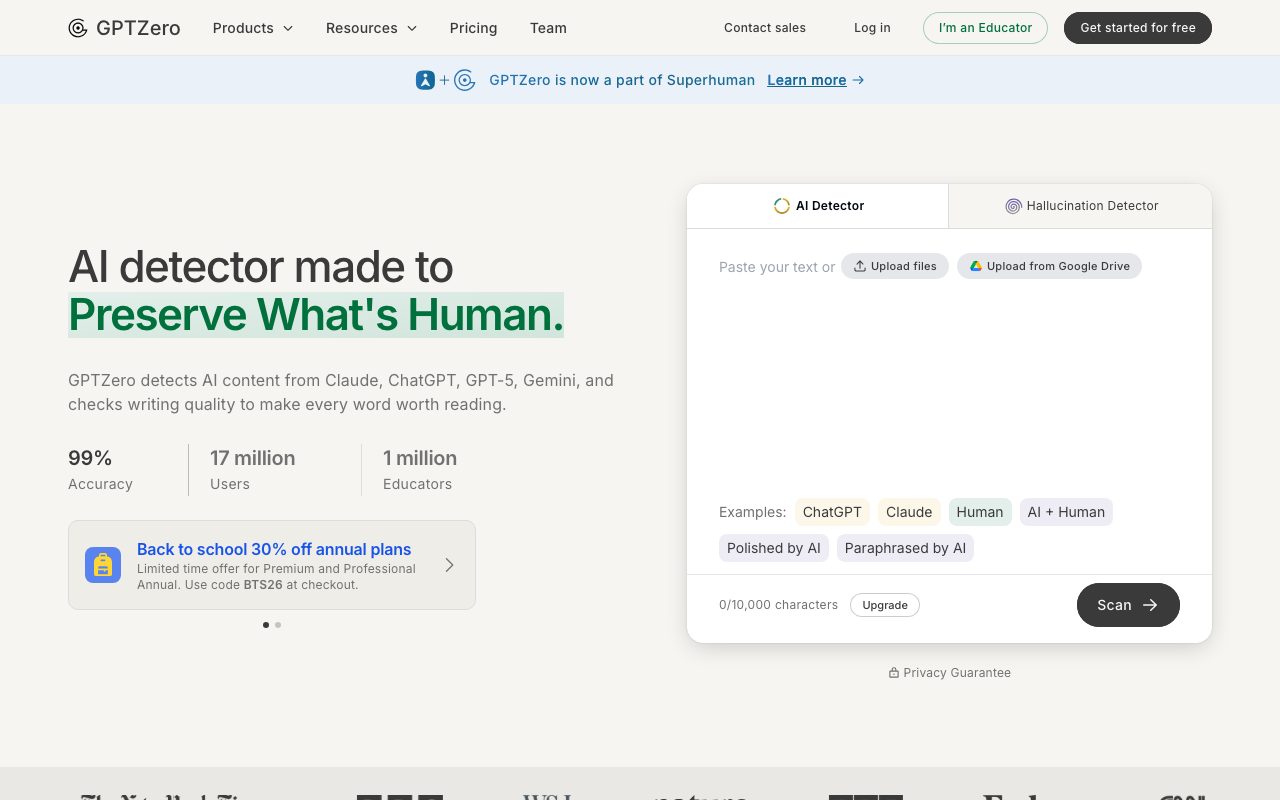
GPTZero is an AI content detection and writing verification tool designed to distinguish human prose from machine-generated text across classrooms, editorial desks, and professional workflows.
GPTZero provides text scanning and authorship analytics designed to identify content generated by large language models, including ChatGPT, Claude, Gemini, Llama, and DeepSeek. The platform evaluates statistical properties such as perplexity and burstiness across a multi-component model to determine AI probability at both the document and sentence level. Beyond basic percentage scores, GPTZero provides color-coded sentence highlighting to flag mixed human and AI drafts, along with integrated plagiarism checking and hallucination detection. To move beyond purely probabilistic detection, it offers a writing report and video replay capability that visualizes typing patterns and the live creation process of a document. GPTZero also integrates directly with educational environments like Canvas and Google Classroom, as well as Google Docs and web browsers via Chrome extensions.
Unlike detectors relying solely on post-hoc statistical scoring, GPTZero combines sentence-level AI classification with a writing replay report that demonstrates the actual drafting process, alongside training specifically de-biased for ESL writers.
Product capabilities
Key features
Multi-Model AI Detection
Scans and identifies text generated by modern LLMs including GPT-4, GPT-5, Gemini, Claude, Llama, and DeepSeek with document- and sentence-level probability scoring.
Writing Report and Video Replay
Enables writers and students to record and visualize their typing history and document editing steps to demonstrate authentic human composition.
ESL De-Biased Modeling
Incorporates training datasets specifically tuned to minimize false positive classifications on essays written by non-native English speakers.
Mixed-Text Detection
Identifies sections where AI and human prose are interwoven, providing line-by-line color-coded highlights of suspected machine generation.
Plagiarism & Hallucination Checking
Evaluates submitted text against web sources for unattributed copy and flags potentially hallucinated facts within AI outputs.
LMS and Browser Integrations
Connects natively with Canvas, Google Classroom, Google Docs, and Chrome to analyze text directly within existing grading and writing surfaces.
Practical fit
Who should use GPTZero?
Academic Integrity & Assignment Review
Teachers scan student essays to identify uncredited AI generation and initiate constructive discussions regarding responsible AI use.
Human Authorship Verification
Writers and students generate writing reports and replay videos to prove authentic authorship before submitting work.
Publishing & Content Screening
Editorial teams and content managers screen freelance submissions to protect editorial standards and check for mixed AI copy.
Editorial assessment
Pros and limitations
Where it is strong
- Offers sentence-by-sentence highlights rather than just an opaque overall document score.
- Provides a video replay feature that proves drafting history independently of AI detection heuristics.
- Specifically de-biases models to reduce false positive flags on non-native English writers.
Where to be careful
- Probabilistic detection cannot guarantee 100% accuracy, creating risk of false positives.
- The static pricing page conceals exact paid tier costs behind dynamic interface elements.
Commercial context
GPTZero pricing
At the review date, GPTZero offers free scans up to 10,000 characters on its web interface. Dedicated professional seats, team plans, and developer API credits are available, but exact dollar amounts are dynamic on the pricing page and should be verified directly with the vendor.
Pricing, limits, taxes, model access, and regional availability can change. Verify the purchase-critical details on the official pricing page linked under Sources.
Transparent ranking
Why GPTZero scores 74
Each factor is scored on a 100-point scale, then combined using the public ToolsRank weights. Engagement and momentum stay at a neutral baseline until measured signals exist, so no tool can gain or lose position from numbers nobody recorded.
Compatibility
Languages, platforms, and integrations
Languages
- English
- German
- Portuguese
- French
- Spanish
Integrations & surfaces
- Google Chrome
- Google Docs
- Google Classroom
- Canvas
- Zapier
Community
Reviews and questions
No approved member reviews yet. Editorial factors above are the only rating on this page.
Reviews and questions come from Google-signed members and are checked by an editor before they appear.
Frequently asked
GPTZero FAQ
How does GPTZero determine if text is written by AI?+
GPTZero uses a multi-component model that analyzes text characteristics such as perplexity (how predictable the wording is) and burstiness (variation in sentence structure and length), evaluating patterns commonly associated with large language models.
Does GPTZero work on AI models other than ChatGPT?+
Yes. GPTZero scans for text originating from multiple major LLM families, including OpenAI models (GPT-3, GPT-4, GPT-5, o3), Google Gemini, Anthropic Claude, Meta Llama, and DeepSeek.
Is GPTZero 100% accurate?+
No. GPTZero states that no AI detector is 100% accurate because language models constantly evolve. The vendor explicitly advises that results should not be used as an absolute final verdict or sole basis for disciplinary punishment.
How does GPTZero handle English as a Second Language (ESL) text?+
GPTZero trains its models to reduce false positives for ESL writing, claiming a reduced false positive rate of 1% for non-native English writers to avoid penalizing standard or repetitive grammar patterns.