
Direct answer
What is Haystack?
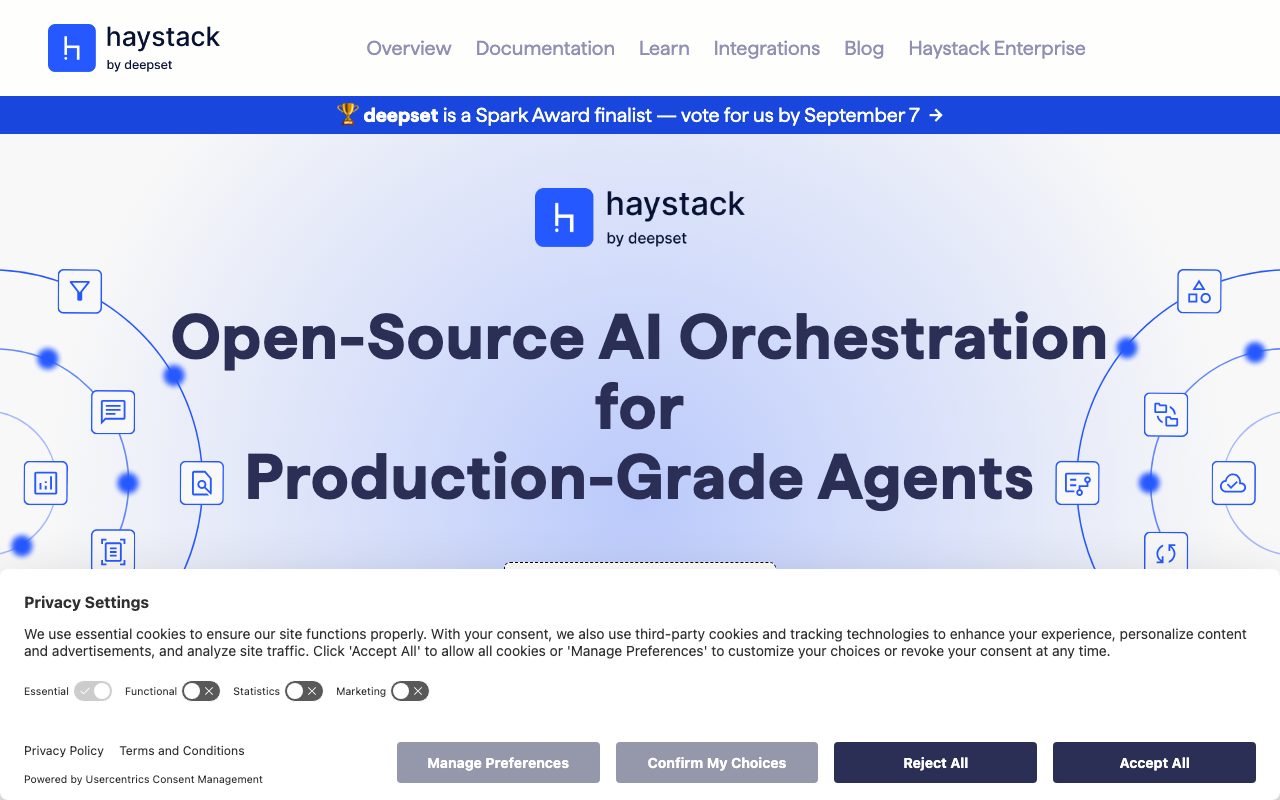
Haystack by deepset is an open-source orchestration framework in Python designed to build, debug, and scale production-ready AI agents and Retrieval-Augmented Generation (RAG) pipelines.
Haystack is an open-source orchestration framework created by deepset for engineering production AI applications. Distributed under the Python package haystack-ai, it equips software engineers with composable building blocks to handle context engineering, search retrieval, agentic reasoning, memory, and tool calling. The architecture relies on serializable, cloud-agnostic pipelines capable of executing complex workflows, including self-correction loops and branched decision logic. It integrates with major model providers such as OpenAI, Anthropic, Mistral, and Hugging Face, as well as vector stores and search systems like Weaviate, Pinecone, and Elasticsearch without vendor lock-in. Beyond basic text retrieval, Haystack supports multimodal workloads including audio transcription and image processing, alongside prompt management using Jinja-2 templates. For enterprise deployments, deepset offers commercial support tiers and an enterprise orchestration platform with visual pipeline design, role-based access controls, and Kubernetes-ready environments.
Haystack emphasizes modular, serializable, and debuggable pipeline graphs with explicit branching and looping, avoiding opaque abstractions and proprietary vendor lock-in across models and vector stores.
Product capabilities
Key features
Modular Pipeline Graph
Orchestrates retrieval, generation, reasoning, memory, and tool use with inspectable, serializable, and cloud-agnostic execution graphs.
Branching and Looping Control
Supports non-linear decision flows, iterative reasoning loops, and self-correction cycles for complex autonomous agent workflows.
Agnostic Model & Database Integrations
Connects natively to OpenAI, Anthropic, Mistral, Hugging Face, Weaviate, Pinecone, Elasticsearch, and other components without platform lock-in.
Standardized Tool Calling
Provides standardized generator interfaces and context engineering utilities to equip agents with custom tools and functions.
Jinja-2 Prompt Templating
Offers composable prompt management using standard Jinja-2 templating syntax to adapt dynamic prompts to diverse workflows.
Multimodal Capabilities
Accommodates non-text modalities across pipelines, enabling native audio transcription and image processing tasks.
Enterprise Platform Tooling
Offers optional visual pipeline design, auditable governance, data testing workflows, and Kubernetes or on-premises deployment support.
Practical fit
Who should use Haystack?
Advanced RAG Systems
Deploying hybrid search and self-correcting retrieval pipelines over enterprise knowledge bases and vector stores.
Autonomous Agent Workflows
Building tool-using agents capable of multi-step reasoning, external API querying, and context evaluation.
Multimodal Content Processing
Transcribing audio, processing images, and transforming unstructured media into structured knowledge.
Dynamic Content Generation
Structuring customized content engines using modular Jinja-2 prompt flow templates and diverse LLM backends.
Editorial assessment
Pros and limitations
Where it is strong
- Open-source core available directly via pip (haystack-ai)
- Supports branching, looping, and self-correcting agent execution
- Broad third-party support across LLMs, embedding models, and vector databases
- Serializable, Kubernetes-ready pipelines designed for production infrastructure
Where to be careful
- Requires Python development skills; not a plug-and-play visual tool for non-developers
- Enterprise support and managed visual platform pricing requires contacting the sales team
Commercial context
Haystack pricing
At the review date (September 2026), the core Haystack framework is free open-source software (installed via pip). deepset provides commercial Enterprise Support with flexible pricing based on company size, alongside a free trial for the Haystack Enterprise Platform. Readers should consult the official pages for current commercial terms.
Pricing, limits, taxes, model access, and regional availability can change. Verify the purchase-critical details on the official pricing page linked under Sources.
Transparent ranking
Why Haystack scores 77.3
Each factor is scored on a 100-point scale, then combined using the public ToolsRank weights. Engagement and momentum stay at a neutral baseline until measured signals exist, so no tool can gain or lose position from numbers nobody recorded.
Compatibility
Languages, platforms, and integrations
Languages
- English
Integrations & surfaces
- OpenAI
- Anthropic
- Mistral
- Hugging Face
- Weaviate
- Pinecone
- Elasticsearch
- Kubernetes
Community
Reviews and questions
No approved member reviews yet. Editorial factors above are the only rating on this page.
Reviews and questions come from Google-signed members and are checked by an editor before they appear.
Frequently asked
Haystack FAQ
What is Haystack?+
Haystack is an open-source AI orchestration framework developed by deepset. It allows developers to build production-ready applications powered by large language models, including advanced RAG and autonomous AI agents.
How is Haystack installed?+
The open-source Haystack framework is installed in Python environments using pip install haystack-ai.
What model providers and databases does Haystack support?+
Haystack features an open architecture that connects with providers such as OpenAI, Anthropic, Mistral, and Hugging Face, as well as vector stores and search engines like Weaviate, Pinecone, and Elasticsearch.
Can Haystack handle multimodal data?+
Yes. Haystack includes components for handling multimodal workflows, including image processing and audio transcription alongside traditional text generation.
What commercial offerings are available for Haystack?+
deepset provides commercial Haystack Enterprise Support with private engineering access and deployment templates, as well as the Haystack Enterprise Platform, which adds visual pipeline design, governance, and on-premises or cloud management.
