
Direct answer
What is Hypotenuse AI?
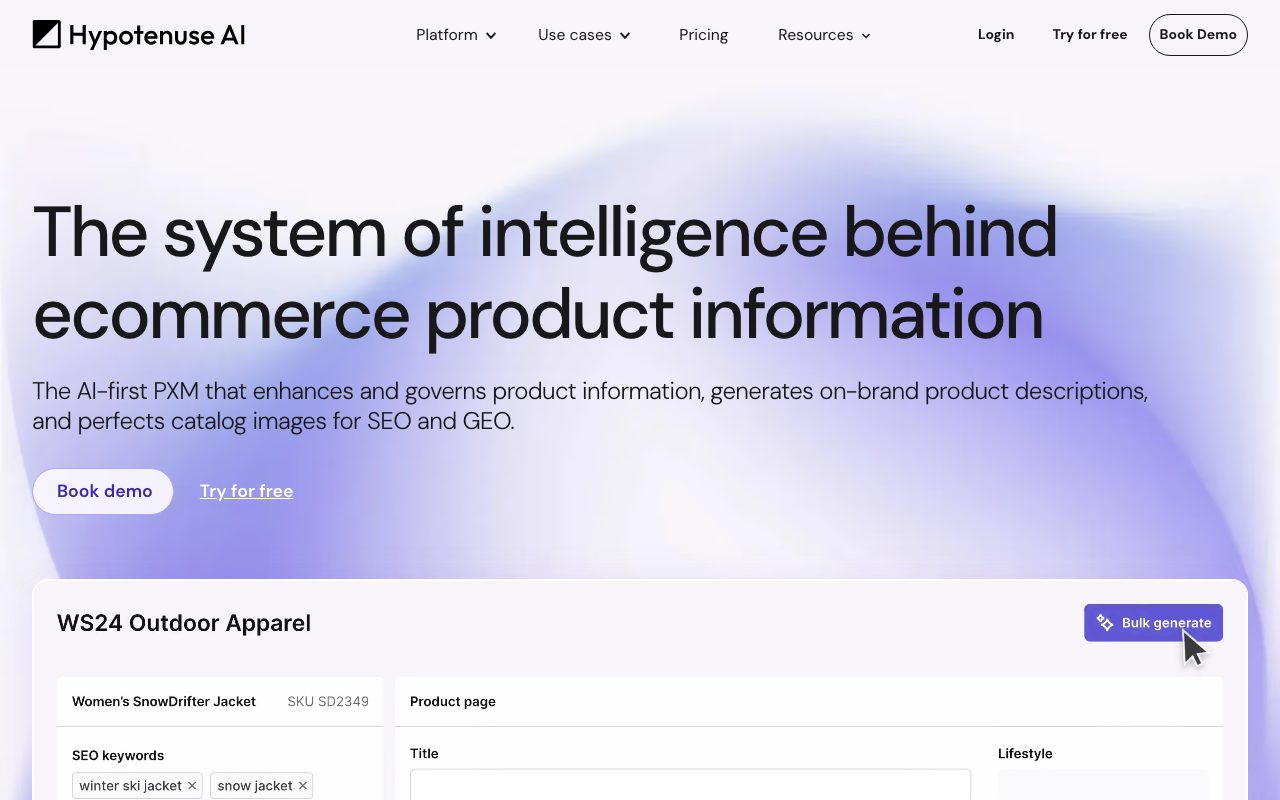
Hypotenuse AI is an AI-first Product Experience Management (PXM) and PIM platform that automates catalog enrichment, brand-aligned product descriptions, and marketplace-ready image editing at scale.
Hypotenuse AI operates as an AI-first product experience management (PXM) and product information management (PIM) system designed for ecommerce businesses managing thousands to millions of SKUs. The platform centralizes product data, unstructured supplier feeds, spec sheets, and product imagery, then uses AI to complete missing attributes, standardize units of measurement, and assign taxonomy-compliant tags and categories. Beyond data hygiene, Hypotenuse AI handles bulk content generation for ecommerce channels. Teams can generate SEO- and GEO-optimized product descriptions, category copy, and meta tags grounded in bespoke brand guidelines. The platform includes computer vision capabilities to extract attributes straight from raw product photos and batch-edit images by cleaning backgrounds, resizing, boosting resolution, or generating lifestyle placements. Hypotenuse AI can serve as a standalone PIM or sync bi-directionally with existing systems like Shopify, Akeneo, and Salsify.
Unlike generic AI copywriting tools or static PIM databases, Hypotenuse AI combines automated multi-source attribute enrichment (from images, web searches, UPCs, and spec sheets) with native bulk content generation and studio image editing inside a single governed catalog workflow.
Product capabilities
Key features
AI-First PIM & Centralized Repository
Unifies SKUs, attributes, and assets across the ecommerce stack with flexible data models, variant relationships, and granular governance workflows.
Multi-Source Product Data Enrichment
Fills missing product attributes automatically by analyzing supplier feeds, UPC/EAN lookups, PDF spec sheets, web crawls, and product photos.
Data Cleansing and Normalization
Standardizes measurement units, corrects casing and attribute names, sorts unstructured values into structured fields, and flags anomalies with confidence scores.
Automated Product Tagging and Categorization
Assigns descriptive tags and sorts SKUs into internal taxonomies or marketplace categories compliant with Google Shopping, Amazon, Walmart, and Target.
Bulk On-Brand Description Generation
Generates thousands of unique, SEO- and GEO-tailored product descriptions and metadata aligned with custom brand voice guidelines.
AI Image Studio and Compliance Checker
Extracts visual attributes, removes or replaces backgrounds, upscales resolution, crops with smart padding, and formats photos for marketplace compliance.
Translation and Localization
Translates and localizes product descriptions, attributes, and tags across over 40 languages while maintaining brand voice and formatting.
Marketplace and Commerce Integrations
Connects bi-directionally via API and prebuilt connectors to platforms like Shopify, Salesforce Commerce Cloud, NetSuite, Salsify, Akeneo, and Plytix.
Practical fit
Who should use Hypotenuse AI?
Catalog Onboarding at Scale
Rapidly ingest vendor feeds with sparse data, using AI to extract attributes from images and spec sheets before publishing complete PDPs.
Multichannel Listing & Marketplace Compliance
Format product titles, descriptions, categories, and imagery to match distinct marketplace requirements for Amazon, Walmart, and Target.
Global Catalog Localization
Translate and adapt product specifications, tags, and copy across international locales while preserving consistent brand terminology.
SEO and GEO Optimization
Enrich listings with detailed long-tail attributes and benefits to help products rank in conventional search engines and generative AI answer engines.
Editorial assessment
Pros and limitations
Where it is strong
- Combines data enrichment, copy generation, and image editing within one platform
- Extracts structured specifications directly from images, UPCs, and PDF spec sheets
- Integrates bi-directionally with existing enterprise PIMs, ERPs, and ecommerce platforms
- Supports human-in-the-loop review with confidence scores and batch approval controls
- Handles catalogs spanning from thousands to millions of SKUs with enterprise SOC 2 compliance
Where to be careful
- Specific subscription pricing and tier structures are not transparently published on the primary site pages
- May offer more complex governance and taxonomy features than simple single-product stores need
Commercial context
Hypotenuse AI pricing
Hypotenuse AI offers self-serve free trials ('Try for free') and enterprise demos ('Book demo'). Public plan tiers and specific dollar pricing were not disclosed on the reviewed pages as of September 2026; consult the official pricing page for up-to-date quotes.
Pricing, limits, taxes, model access, and regional availability can change. Verify the purchase-critical details on the official pricing page linked under Sources.
Transparent ranking
Why Hypotenuse AI scores 75.4
Each factor is scored on a 100-point scale, then combined using the public ToolsRank weights. Engagement and momentum stay at a neutral baseline until measured signals exist, so no tool can gain or lose position from numbers nobody recorded.
Compatibility
Languages, platforms, and integrations
Languages
- English
- Multilingual (supports 40+ languages)
Integrations & surfaces
- Shopify
- Salsify
- Salesforce Commerce Cloud
- NetSuite
- Akeneo
- Plytix
- API
- Amazon
- Walmart
- Target
Community
Reviews and questions
No approved member reviews yet. Editorial factors above are the only rating on this page.
Reviews and questions come from Google-signed members and are checked by an editor before they appear.
Frequently asked
Hypotenuse AI FAQ
What is Hypotenuse AI?+
Hypotenuse AI is an AI-first Product Experience Management (PXM) and Product Information Management (PIM) platform that automates the enrichment, standardization, copywriting, and visual asset preparation for ecommerce product catalogs.
Do I have to replace my existing PIM to use Hypotenuse AI?+
No. Hypotenuse AI can operate as a standalone PIM or layer on top of your existing PIM (such as Akeneo, Salsify, Plytix, or Stibo), enriching attributes and generating copy before syncing data back.
How does Hypotenuse AI find missing product data?+
The platform uses multi-source enrichment to pull missing specifications by analyzing supplier data feeds, searching the web, looking up UPC/EAN codes, parsing PDF spec sheets, and using computer vision on product images.
How accurate is the AI-generated catalog data?+
Hypotenuse AI provides confidence scores and ensures AI-suggested values are traceable to their sources. Changes pass through internal human review workflows, allowing teams to approve trusted fields in bulk or inspect individual SKUs before publishing.
What content can Hypotenuse AI generate besides product descriptions?+
In addition to product descriptions, the platform can generate category and collection page copy, SEO meta titles and descriptions, bullet points, image alt text, and marketing copy.
Is Hypotenuse AI compliant with enterprise security standards?+
Yes, Hypotenuse AI is SOC 2 compliant, includes granular access controls, and provides enterprise-grade data privacy and security protections.