Direct answer
What is Kaedim?
Kaedim converts 2D sketches, photos, reference packs, and briefs into production-ready 3D models with an integrated review and revision workflow.
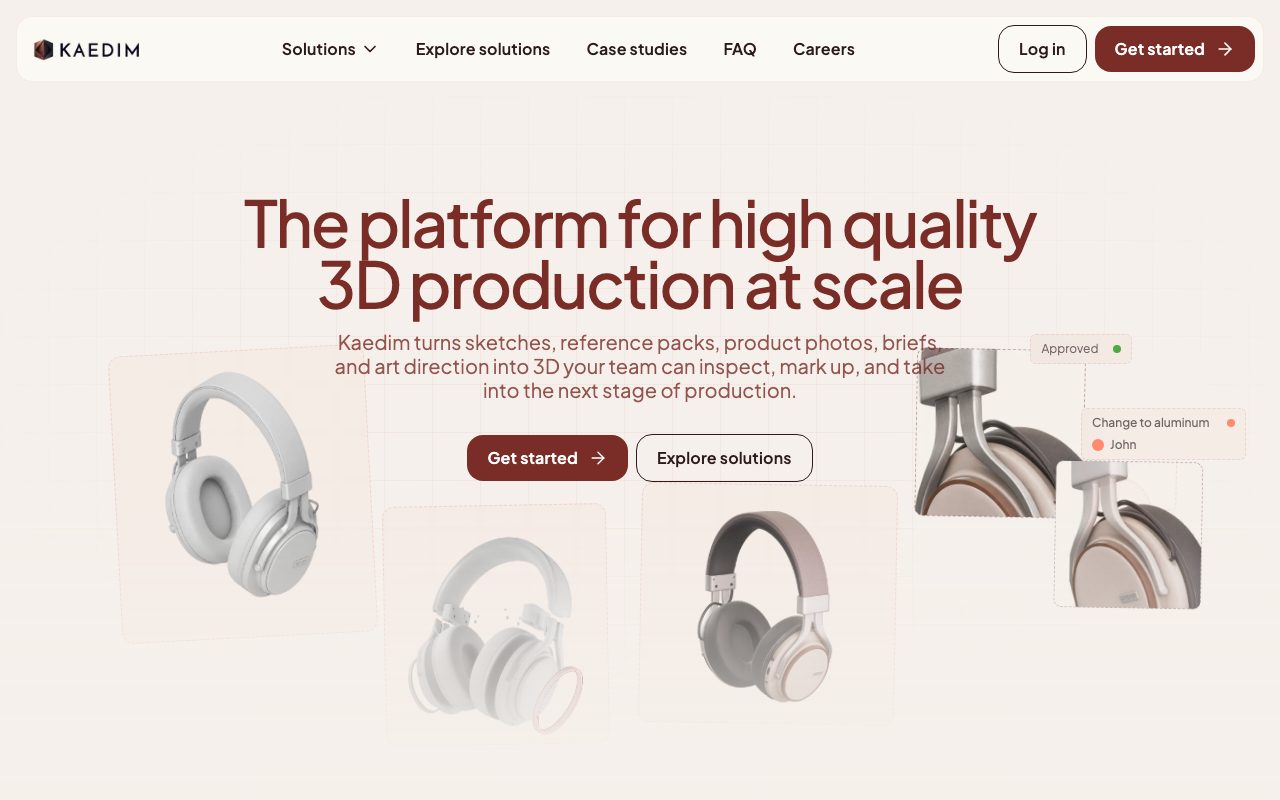
Kaedim is an AI-powered 3D asset production platform built for creative studios, game developers, and hardware brands that require high-fidelity models without bottlenecking human modelers. Rather than operating purely as a prompt-to-mesh experiment, the platform is designed to take multi-angle reference packs, concept art, sketches, product photographs, and formal art direction briefs, returning production meshes within hours. The service emphasizes creative iteration through an in-browser review loop where team members can inspect models, add contextual markups, request changes, and approve final assets. This collaborative feedback loop supports unlimited revisions so assets meet precise art bibles, ambient occlusion rules, and proportion specifications before being pushed downstream into CAD modeling, rigging, or game engine pipelines. From an enterprise governance perspective, the platform guarantees that client inputs and outputs remain isolated and are never repurposed to train shared foundation models. Organizations retain complete commercial ownership and intellectual property rights over all generated assets. Security controls include ISO 27001 certification, encryption at rest and in transit, role-based access management, and logged data-deletion workflows upon request.
Unlike standalone text-to-3D generation models that provide unrefined, single-pass meshes, Kaedim functions as a production pipeline offering turnarounds within hours alongside a full review, markup, and unlimited revision cycle tailored to art bibles and studio specs.
Product capabilities
Key features
Reference and brief ingestion
Accepts sketches, multi-view reference packs, product photos, style guides, and formal creative briefs to establish volume, proportion, and aesthetic direction.
Iterative review and markup loop
Provides an asset review environment enabling team members to inspect models, annotate specific surface areas, request iterative revisions, and approve deliverables.
Rapid turnaround delivery
Delivers production-grade 3D assets back to teams within hours, allowing exploration before CAD handoffs, design reviews, or client pitches.
Proprietary IP and model isolation
Ensures customer concepts, references, and generated outputs are kept strictly isolated per project and never utilized to train shared AI models.
Enterprise security and compliance
Maintains ISO 27001 certification, role-based access control, data encryption at rest and in transit, and complete audit logs for on-demand asset deletion.
Practical fit
Who should use Kaedim?
Game asset production
Ingesting concept art, art bibles, and reference packs to generate environment assets, props, and character concepts that adhere to visual style guides.
Pre-CAD product design
Transforming industrial design sketches and concept art into 3D forms early in the design cycle to evaluate volumes and proportions before committing engineering hours to CAD.
E-commerce visual merchandising
Creating reusable 3D CGI product assets directly from reference photography and design briefs for product detail pages and marketing launches.
Editorial assessment
Pros and limitations
Where it is strong
- Supports multi-turn review, markup, and unlimited revisions directly in the platform
- Explicit contractual guarantee that customer data and inputs will not train public models
- ISO 27001 certified with role-based access and data deletion on request
- Yields tangible turnaround times measured in hours rather than weeks
Where to be careful
- No publicly listed pricing or self-serve trial tiers on the official homepage
- Requires contacting sales and enterprise scoping rather than offering instantaneous generation
Commercial context
Kaedim pricing
At the review date of 8 September 2026, Kaedim does not list self-serve tiers or fixed dollar prices on its public homepage. Prospective users must request access or contact sales to establish asset volume, turnaround requirements, and enterprise licensing terms.
Pricing, limits, taxes, model access, and regional availability can change. Verify the purchase-critical details on the official pricing page linked under Sources.
Transparent ranking
Why Kaedim scores 75.8
Each factor is scored on a 100-point scale, then combined using the public ToolsRank weights. Engagement and momentum stay at a neutral baseline until measured signals exist, so no tool can gain or lose position from numbers nobody recorded.
Compatibility
Languages, platforms, and integrations
Languages
- English
Integrations & surfaces
- Web browser
Community
Reviews and questions
No approved member reviews yet. Editorial factors above are the only rating on this page.
Reviews and questions come from Google-signed members and are checked by an editor before they appear.
Frequently asked
Kaedim FAQ
What inputs does Kaedim accept to generate 3D models?+
Kaedim accepts sketches, concept art, reference packs, product photos, art bibles, specification sheets, and written creative briefs.
Does Kaedim use client assets to train foundation AI models?+
No. The vendor explicitly states that customer concepts, reference images, and 3D outputs are isolated per project and are never used to train shared AI models.
Who owns the intellectual property of the generated 3D files?+
The customer retains full ownership, intellectual property rights, and commercial rights over all custom 3D assets produced for their projects.
How long does it take to receive a generated 3D asset?+
Outputs are delivered back to teams within hours, designed to fit within tight design review schedules and production cycles.
Can teams request revisions to generated models?+
Yes. The platform includes a review, markup, and approval workflow supporting unlimited revisions based on team feedback.