Direct answer
What is Lexis+ AI?
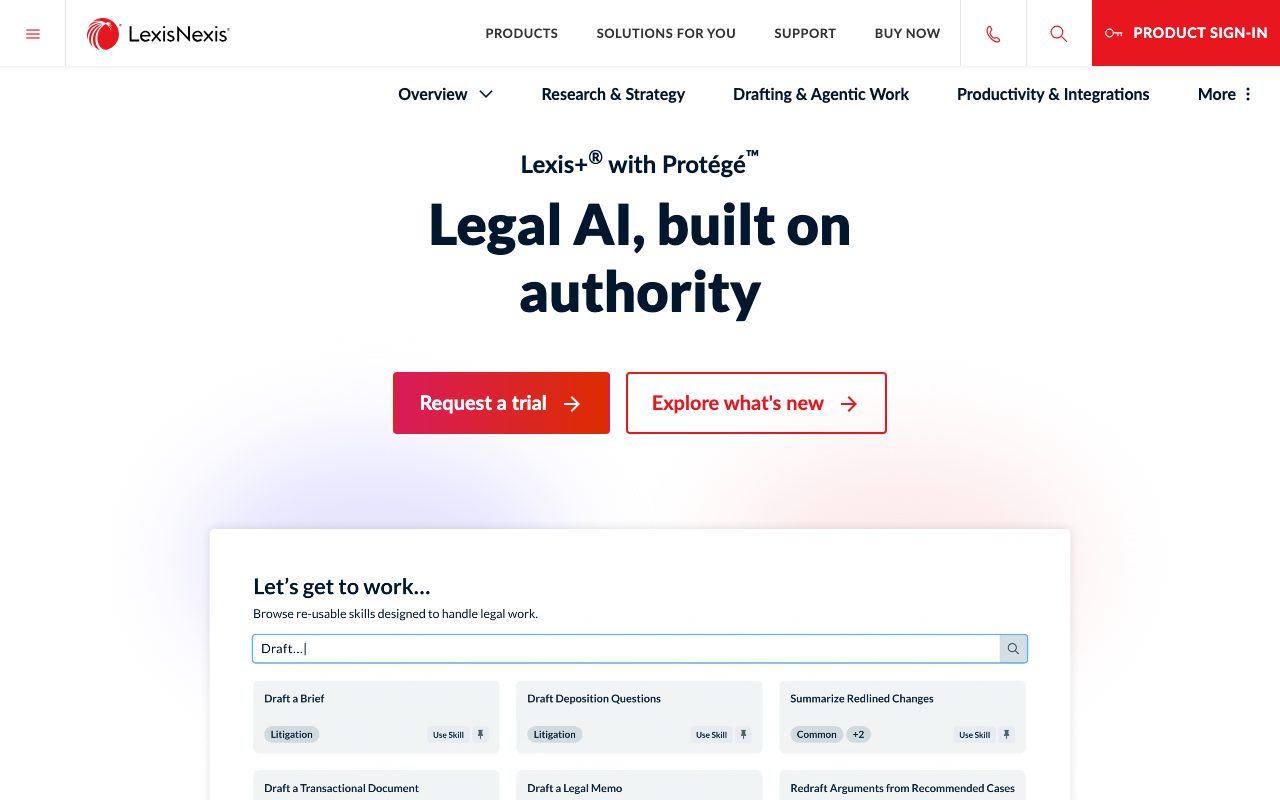
Lexis+ AI (rebranded as Lexis+ with Protégé) connects generative AI to LexisNexis primary legal repositories, Shepard's citations, and firm document management systems to accelerate legal research, litigation drafting, and contract review.
Lexis+ AI is a specialized legal artificial intelligence platform developed by LexisNexis Legal & Professional. In February 2026, the tool was expanded and renamed Lexis+ with Protégé, integrating the Protégé AI assistant into research, drafting, and document review workflows. The system grounds large language model responses in proprietary LexisNexis legal databases, encompassing federal and state primary law, exclusive secondary authorities, and Practical Guidance across 25 practice areas. For litigation, users can produce drafts of complaints, motions, briefs, and client letters. For transactional matters, the tool converts term sheets into agreements and flags missing standard provisions. To ensure citation accuracy, Shepard's Verify analyzes drafts and AI responses to confirm whether cited authorities remain good law and flag unsupported factual or legal assertions. Through Vaults, Review Tables, and Workrooms, legal teams can ingest large discovery or contract sets, run structured queries, and collaborate across matter files with role-based access. LexisNexis operates under the RELX Responsible AI Framework, committing that customer data is neither retained for model training nor shared without authorization.
Unlike generic AI models or ungrounded drafting tools, answers and documents are anchored directly to Shepard's citation validation, Practical Guidance forms across 25 practice areas, and LexisNexis primary case repositories.
Product capabilities
Key features
Shepard's Verify
Validates citations in AI outputs and uploaded legal drafts, checking direct appellate history, treatment status, and flagging unsupported legal statements.
Legal AI Drafting
Generates initial drafts of litigation documents, including complaints and motions, as well as transactional contracts and agreements derived from term sheets.
Grounded Legal Research
Synthesizes cited legal answers grounded in LexisNexis primary case law, statutes, administrative regulations, and secondary analytical sources.
Agent Skills
Enables legal teams to create reusable AI workflows based on internal templates, complemented by a pre-built skills library from LexisNexis and Claude.
AI Review Tables & Secure Vault
Ingests thousands of matter documents into a protected Vault to extract key terms, compare provisions, and organize structured factual summaries.
Workrooms
Shared collaborative spaces where legal teams track ongoing AI interactions, uploaded evidence, and matter-specific discussions with permission controls.
Practical fit
Who should use Lexis+ AI?
Litigation drafting and pleading generation
Litigators input matter facts and client documents to generate initial drafts of complaints, answers, and motion briefs supported by valid jurisdiction-specific authority.
Transactional agreement creation
Corporate attorneys convert structured deal points or term sheets into full contract drafts using annotated Practical Guidance clauses and firm precedents.
Citation verification and brief checking
Appellate lawyers upload opposing or draft briefs to systematically Shepardize citations and catch overruled authorities or questionable treatments.
Multi-document portfolio analysis
Deal and discovery teams upload document batches into secure Vaults to compile comparative Review Tables identifying liabilities, dates, and indemnities.
Editorial assessment
Pros and limitations
Where it is strong
- Direct verification via Shepard's Citations to detect overturned or questioned precedent
- Grounded in verified LexisNexis case law, statutes, and Practical Guidance across 25 practice areas
- Customer data is excluded from model training under the RELX Responsible AI Framework
- Native connectivity to legal document management systems such as iManage and NetDocuments
Where to be careful
- Pricing is not published publicly and requires negotiation with enterprise sales representatives
- Standard trial period offered on the official page is limited to two days
- Core functionality depends on having existing access to LexisNexis proprietary content databases
Commercial context
Lexis+ AI pricing
At the review date in September 2026, LexisNexis does not publish flat-rate subscription fees online. Prospective clients can request a custom quote or apply for an introductory 2-day trial on the vendor website.
Pricing, limits, taxes, model access, and regional availability can change. Verify the purchase-critical details on the official pricing page linked under Sources.
Transparent ranking
Why Lexis+ AI scores 76.2
Each factor is scored on a 100-point scale, then combined using the public ToolsRank weights. Engagement and momentum stay at a neutral baseline until measured signals exist, so no tool can gain or lose position from numbers nobody recorded.
Compatibility
Languages, platforms, and integrations
Languages
- English
Integrations & surfaces
- iManage
- NetDocuments
- SharePoint
- Microsoft 365
Community
Reviews and questions
No approved member reviews yet. Editorial factors above are the only rating on this page.
Reviews and questions come from Google-signed members and are checked by an editor before they appear.
Frequently asked
Lexis+ AI FAQ
What is the difference between Lexis+ AI and Lexis+ with Protégé?+
As of February 2026, LexisNexis officially rebranded Lexis+ AI as Lexis+ with Protégé. The rebranding reflects the integration of the Protégé AI assistant across broader drafting, multi-document analysis, and agentic legal workflows.
Does LexisNexis use customer inputs to train AI models?+
No. Under the RELX Responsible AI Framework, LexisNexis states that customer data and search queries are not used to train machine learning or AI models, and identifying details are removed from AI service telemetry.
Can Lexis+ AI integrate with internal law firm document management systems?+
Yes. Lexis+ AI connects with legal document management systems (DMS) including iManage, NetDocuments, and Microsoft SharePoint, allowing users to query and draft against internal work product alongside LexisNexis legal authorities.
What does Shepard's Verify do?+
Shepard's Verify analyzes citations in generated text and uploaded legal documents. It indicates current legal treatment, confirms whether cases remain valid precedent, and flags ungrounded assertions.