Direct answer
What is Lingo.dev?
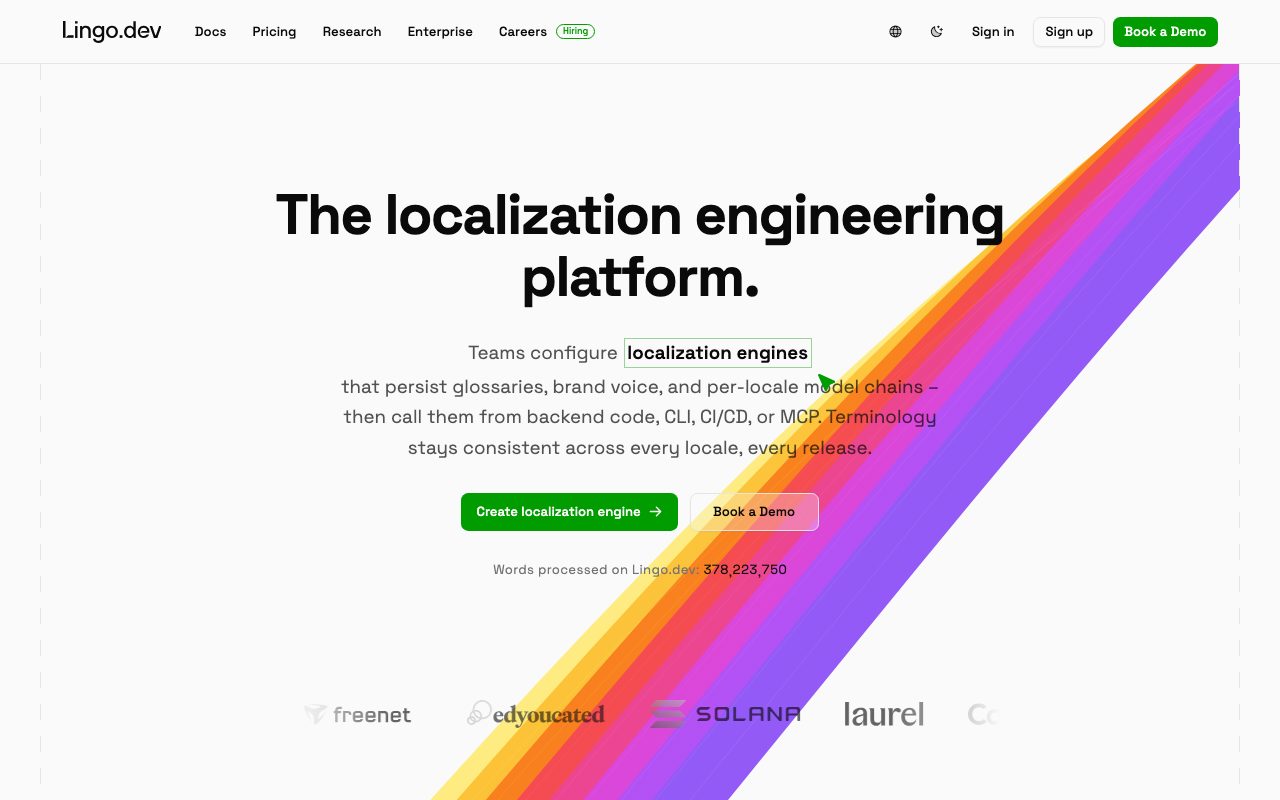
Lingo.dev is an AI-powered localization engineering platform that replaces manual translation handoffs with stateful, developer-first localization engines embedded into CI/CD, CLI, and APIs.
Lingo.dev (by Replexica, Inc.) provides infrastructure to treat software localization as an engineering workflow rather than a project management handoff. Instead of sending files to external agencies or calling raw, ungrounded LLMs, engineering teams configure stateful "localization engines." Each engine encapsulates target-locale model chains, glossaries, brand voice tone preferences, and locale-specific grammatical rules. The system relies on Retrieval Augmented Localization (RAL). Rather than re-translating an entire application on every change or sending changed strings in total isolation, Lingo.dev decomposes modified strings, extracts matching glossary terms via vector similarity search, and injects only relevant context into the LLM prompt at inference time. This prevents terminology drift while keeping token overhead controlled. Developers interact with the platform through REST APIs (both synchronous single-round-trip and asynchronous multi-locale background jobs), a command-line interface (CLI) supporting 14 file formats, a build-time React compiler, and Model Context Protocol (MCP) integrations for coding assistants such as Cursor, Claude Code, and GitHub Copilot. For enterprise governance, Lingo.dev supports automated cross-model quality reviews (scoring GEMBA-MQM dimensions like fluency, accuracy, and terminology), optional human post-editing behind the API, role-based access control, SOC 2 Type II compliance, and zero-markup LLM pass-through pricing.
Unlike traditional translation management systems or one-off LLM translation calls, Lingo.dev uses Retrieval Augmented Localization (RAL) and stateful engines to programmatically lock terminology, isolate per-locale fallbacks, and run translations directly inside developer git workflows and MCP-enabled IDEs.
Product capabilities
Key features
Stateful Localization Engines
Configure engines that persist glossaries, brand voice, locale rules, and ranked fallback model chains across multiple API, CLI, or CI/CD requests.
Retrieval Augmented Localization (RAL)
Uses cosine similarity across vector embeddings to inject only relevant glossary terms and context into the prompt, reducing terminology drift on changed strings.
Multi-Surface Developer Access
Enables translation execution via synchronous and asynchronous REST APIs, a dedicated CLI, GitHub Actions, GitLab CI, Bitbucket Pipelines, and a React compiler.
Model Context Protocol (MCP) Support
Provides localization awareness and engine configuration directly inside AI coding assistants like Claude Code, Cursor, and GitHub Copilot.
Cross-Model AI Quality Scoring
Uses independent secondary LLMs to score fluency, accuracy, terminology, and formatting against GEMBA-MQM and BERTScore benchmarks.
Integrated Human Review Behind the API
Enables optional human post-editing triggers when quality drops below configured thresholds, managed directly through the API without vendor handoffs.
Zero-Markup LLM Pass-Through
Passes through underlying LLM provider model tokens at zero markup while billing a flat infrastructure rate ($2/MTok output) and optional review runs.
Practical fit
Who should use Lingo.dev?
Automated Pull Request Localization
Trigger localized string updates across dozens of languages on every GitHub push, ensuring translations ship alongside feature code.
Multi-Tenant App Localization
Provision dedicated localization engines per customer account via API, isolating custom glossaries, voice settings, and usage tracking.
Content Management and Headless CMS Localization
Connect headless CMS content (such as Payload CMS) to async localization jobs that automatically fan out to multiple target locales with webhooks.
IDE-Assisted Translation via MCP
Configure and test locale engines directly inside code editors using MCP connections with Claude Code or Cursor.
Editorial assessment
Pros and limitations
Where it is strong
- Native developer toolchain integration via CLI, GitHub Actions, MCP, and REST APIs.
- Retrieval Augmented Localization minimizes token usage while maintaining consistent domain terminology.
- Transparent billing with LLM token costs passed through at zero markup.
- Built-in quality assurance with cross-model MQM scoring and optional integrated human review.
Where to be careful
- Primarily designed for software and engineering workflows, offering limited appeal to non-technical translators.
- Free Sandbox tier has strict daily token throughput limits (100K tokens/day) and 7-day data retention.
Commercial context
Lingo.dev pricing
Pricing as of September 2026 includes a free Sandbox tier ($0 base, pay-as-you-go), a Production tier at $99/month base, and Enterprise custom tiers. Both standard tiers charge $0.50/engine/month, $2/MTok for infrastructure, $0.01 per AI review run, and pass-through LLM model costs at zero markup.
Pricing, limits, taxes, model access, and regional availability can change. Verify the purchase-critical details on the official pricing page linked under Sources.
Transparent ranking
Why Lingo.dev scores 75.5
Each factor is scored on a 100-point scale, then combined using the public ToolsRank weights. Engagement and momentum stay at a neutral baseline until measured signals exist, so no tool can gain or lose position from numbers nobody recorded.
Compatibility
Languages, platforms, and integrations
Languages
- English
Integrations & surfaces
- GitHub
- GitLab
- Bitbucket
- Cursor
- Claude Code
- GitHub Copilot
- Jira
- Payload CMS
Community
Reviews and questions
No approved member reviews yet. Editorial factors above are the only rating on this page.
Reviews and questions come from Google-signed members and are checked by an editor before they appear.
Frequently asked
Lingo.dev FAQ
What is Retrieval Augmented Localization (RAL)?+
Retrieval Augmented Localization (RAL) is Lingo.dev's method of localizing only the strings that changed while retrieving matching context per request. Using cosine similarity over vector embeddings, the engine searches your glossary and injects only the relevant terminology, brand voice, and formatting rules into the prompt. In published evaluations, this reduced terminology errors by 17% to 45% compared to generic LLM translation.
How are LLM costs billed on Lingo.dev?+
Lingo.dev passes through underlying LLM token costs from model providers at zero markup. Customers pay for platform infrastructure ($2 per million output tokens), engine instances ($0.50 per engine per month), and quality review runs ($0.01 per run), alongside plan base fees where applicable.
Does Lingo.dev support human post-editing?+
Yes. Lingo.dev offers an optional human post-editing stage managed behind the API. Teams can define quality thresholds so translations with low automated scores are automatically routed to a network of qualified translators without manual handoffs.
What developer integrations are supported out of the box?+
Lingo.dev supports Git integrations (GitHub App/Action, GitLab CI, Bitbucket Pipelines), a CLI supporting 14 file formats, Model Context Protocol (MCP) for tools like Cursor and Claude Code, REST APIs (sync and async), WebSockets, and build-time React compilation.