
Direct answer
What is Luminance?
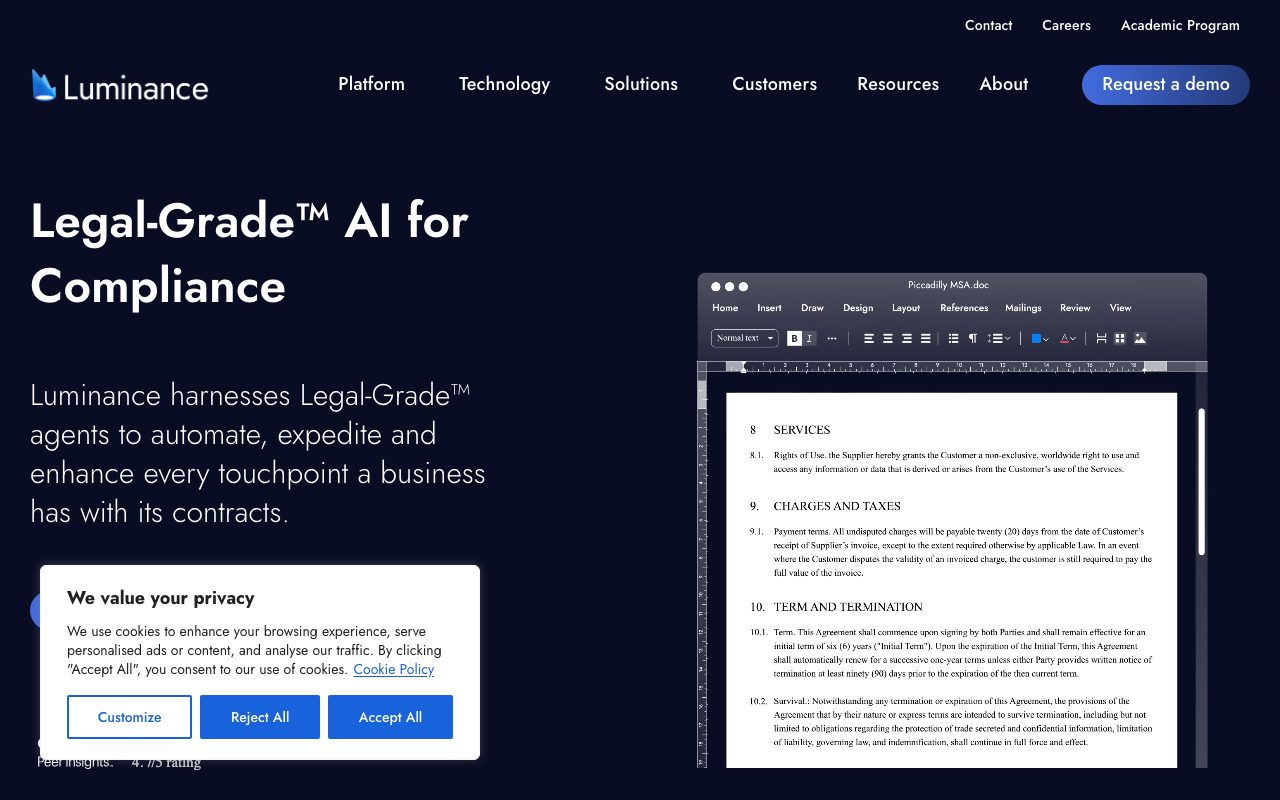
Luminance is an enterprise AI platform that assists legal and commercial teams across the full contract lifecycle, from automated generation and Microsoft Word negotiations to repository analytics and discovery.
Founded by mathematicians in 2015, Luminance provides proprietary legal AI designed to automate and augment organizational contract workflows. Rather than relying solely on general-purpose foundation models, Luminance deploys a multi-model architecture—including its Luna Crescent proprietary legal intelligence model and a 'Panel of Judges' Mixture of Experts approach that uses probabilistic consensus to maximize legal precision. The platform supports six primary workflows across commercial agreements: Draft, Negotiate, Analyze, Comply, Investigate, and Collaborate. During contract creation, automated generation tools assemble standard agreements to reduce turnaround times. For negotiations, Luminance integrates directly into Microsoft Word, surfacing playbook-aligned suggestions, flagging deviations, and speeding up contract markups. Across existing agreement portfolios, Luminance indexes obligations, monitors evolving regulatory requirements, and surfaces contractual insights in response to natural-language business questions. For contentious matters and disputes, its investigation modules accelerate discovery across large document sets. From a technical and security perspective, Luminance isolates enterprise data by provisioning dedicated single-tenant AWS instances for each customer with AES-256 encryption at rest and TLS 1.2+ encryption in transit. The company holds ISO 27001:2022 and SOC 2 Type 2 certifications, adheres to the EU-U.S. Data Privacy Framework, and maintains security oversight guided by an independent Security Advisory Board.
Luminance uses a proprietary multi-model architecture, including its Luna Crescent model and a 'Panel of Judges' Mixture of Experts consensus method, rather than a single third-party LLM wrapper, paired with dedicated single-tenant AWS deployments.
Product capabilities
Key features
Microsoft Word Contract Negotiation
Automates and augments contract negotiations directly within Microsoft Word, highlighting non-standard terms and suggesting playbook-approved language.
Automated Contract Drafting
Accelerates time to signature by generating compliant contracts from standard organizational clauses and pre-approved parameters.
Portfolio Contract Analysis
Provides enterprise-wide visibility across legacy and active contracts to track obligations and answer commercial queries.
Compliance Monitoring
Monitors contractual landscapes against newly introduced regulatory standards to mitigate legal, operational, and financial risks.
E-Discovery and Investigation Tools
Expedites investigations, arbitrations, and litigation by analyzing large document sets to surface relevant evidence and anomalies.
Panel of Judges Architecture
Applies a Mixture of Experts approach using probabilistic consensus across specialized models to maximize accuracy on legal text.
Single-Tenant AWS Isolation
Deploys each customer into a dedicated virtual cloud instance on AWS, ensuring complete data isolation with no cross-tenant data pooling.
Practical fit
Who should use Luminance?
Third-Party Agreement Markup
Reviewing inbound supplier or vendor agreements against corporate negotiation playbooks directly within Microsoft Word.
Regulatory Portfolio Audits
Scanning thousands of existing agreements to locate non-compliant clauses when regulations change.
Litigation and Internal Investigations
Sifting through evidentiary documents and correspondence to identify key facts for legal disputes.
Routine Contract Generation
Empowering commercial and procurement teams to assemble standard NDAs and MSAs without legal department bottlenecks.
Editorial assessment
Pros and limitations
Where it is strong
- Dedicated single-tenant cloud architecture ensures customer data is never co-mingled
- Direct integration with Microsoft Word keeps negotiation workflows within standard legal software
- Broad lifecycle coverage including drafting, negotiation, repository analysis, and investigation discovery
- Strong security credentials including ISO 27001:2022, SOC 2 Type 2, and Darktrace threat detection
Where to be careful
- No transparent or entry-level self-serve pricing published online; requires sales engagement
- Feature depth and enterprise architecture may represent excessive complexity for sole practitioners
Commercial context
Luminance pricing
Luminance does not publish public pricing tiers or self-serve rates on its website as of the review date (September 2026). Access is provided via custom enterprise agreements and guided demonstrations. Prospective buyers should contact the Luminance sales team directly for licensing terms.
Pricing, limits, taxes, model access, and regional availability can change. Verify the purchase-critical details on the official pricing page linked under Sources.
Transparent ranking
Why Luminance scores 72.1
Each factor is scored on a 100-point scale, then combined using the public ToolsRank weights. Engagement and momentum stay at a neutral baseline until measured signals exist, so no tool can gain or lose position from numbers nobody recorded.
Compatibility
Languages, platforms, and integrations
Languages
- English
Integrations & surfaces
- Microsoft Word
- Amazon Web Services (AWS)
Community
Reviews and questions
No approved member reviews yet. Editorial factors above are the only rating on this page.
Reviews and questions come from Google-signed members and are checked by an editor before they appear.
Frequently asked
Luminance FAQ
How does Luminance host and secure customer contract data?+
Luminance hosts customer data in Amazon Web Services (AWS) environments using managed, segregated virtual clouds. Each customer receives a dedicated single-tenant instance to avoid data co-mingling. Data is encrypted at rest using AWS KMS with AES-256 bit keys and encrypted in transit using TLS 1.2 or higher protocols.
What independent security audits and certifications does Luminance hold?+
Luminance maintains ISO 27001:2022 certification for its Information Security Management System and has completed a SOC 2 Type 2 examination covering security, availability, and confidentiality. It also undergoes regular third-party penetration testing.
Can Luminance staff access confidential customer documents?+
Luminance staff cannot view customer documents without explicit customer authorization granted directly through the user interface. All internal access is tracked, audited, and secured with multi-factor authentication under principles of least privilege.
How does Luminance operate inside existing legal workflows?+
Luminance integrates into Microsoft Word so legal professionals can review, redline, and negotiate contracts without leaving their primary word processor, while also providing a central platform for repository search, obligation tracking, and investigations.
What is the 'Panel of Judges' approach used by Luminance?+
Luminance uses a Mixture of Experts architecture where multiple legal-grade models evaluate legal language and reach a probabilistic consensus, designed to ensure higher legal precision and minimize errors compared to single generic models.