
Direct answer
What is Replicate?
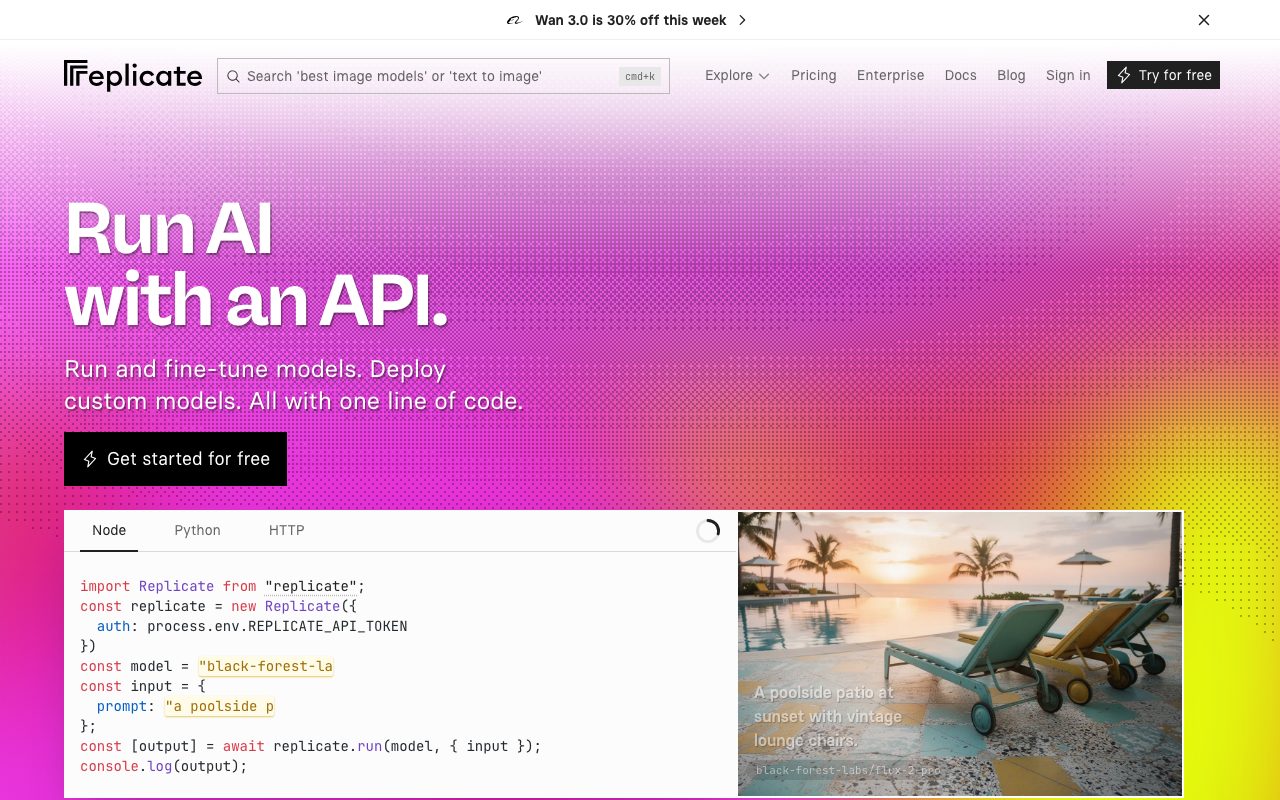
Replicate provides hosted cloud APIs to run, fine-tune, and deploy machine learning models. Developers can run community models or package custom weights using Docker and Cog.
Replicate is an AI infrastructure platform that exposes machine learning models through cloud APIs. Instead of managing GPU clusters, CUDA drivers, API servers, and scaling pipelines manually, developers can invoke public and proprietary models with minimal client-side code in languages like Python and JavaScript. The catalog includes thousands of community and official models covering text-to-image (such as FLUX variants and Recraft), video synthesis, audio generation, speech, and large language models (such as DeepSeek-R1). Public models run in a shared environment billed either per unit of output or strictly by the execution seconds consumed on specific hardware, scaling automatically down to zero when idle. Beyond pre-hosted models, Replicate offers an end-to-end deployment path for custom architectures via Cog, an open-source tool that wraps ML models in Docker containers. Engineers define dependencies in cog.yaml, write input-output bindings in predict.py, and push the container to Replicate's registry. Custom models gain an interactive web GUI, OpenAPI schema, and dedicated auto-scaling cloud infrastructure.
Replicate eliminates GPU ops through Cog containerisation, allowing teams to run thousands of open-source models or deploy bespoke weights as managed APIs that scale to zero.
Product capabilities
Key features
Extensive Model Registry
Access thousands of community and official models spanning image generation, video creation, audio, music, transcription, and large language models via unified APIs.
Cog Container Packaging
Package custom models with Docker using Cog, mapping Python dependencies and prediction interfaces to production-ready cloud endpoints.
Fine-Tuning Workflows
Train and fine-tune models such as FLUX on custom datasets via training APIs, producing versioned private or public models.
Automatic Scaling
Infrastructure scales up dynamically during traffic spikes and down to zero when idle for public models and fast-booting fine-tunes.
Flexible Hardware Selection
Choose from small CPUs up to multi-GPU clusters including Nvidia T4, L40S, A100 (80GB), H100, and H200 accelerators.
Webhooks & Streaming
Receive webhook notifications on completed predictions or stream model tokens and intermediate outputs over HTTP.
Practical fit
Who should use Replicate?
Image & Video Generation in Apps
Embed models like FLUX, Recraft, or Wan into consumer and enterprise applications via single-line Python or Node.js requests.
Deploying Proprietary ML Models
Bundle custom PyTorch code and weights using Cog to publish autoscaling private cloud inference APIs.
Fine-Tuning Style or Subject Models
Train LoRA checkpoints on company imagery to generate custom assets adhering to brand style or specific products.
LLM Inference & Reasoning
Query open reasoning and chat models like DeepSeek-R1 with per-token billing without renting permanent dedicated servers.
Editorial assessment
Pros and limitations
Where it is strong
- No GPU cluster configuration, CUDA management, or API server scaffolding required
- Open-source Cog framework facilitates reproducible local testing before cloud deployment
- Pay-as-you-go pricing scales down to zero when public models are idle
- Broad selection of multimodal models including image, video, speech, and text
Where to be careful
- Dedicated private model deployments incur charges for setup and idle standby time unless using fast-booting fine-tunes
- Cold starts can introduce latency on unprimed model instances
- High-end multi-GPU tiers (like H200s or 8x A100s) require committed spend contracts
Commercial context
Replicate pricing
Pricing is pay-as-you-go based on hardware execution time or per-token/per-image unit rates at the review date of 2026-09-08. Verify exact model costs on the official pricing page.
Pricing, limits, taxes, model access, and regional availability can change. Verify the purchase-critical details on the official pricing page linked under Sources.
Transparent ranking
Why Replicate scores 77.4
Each factor is scored on a 100-point scale, then combined using the public ToolsRank weights. Engagement and momentum stay at a neutral baseline until measured signals exist, so no tool can gain or lose position from numbers nobody recorded.
Compatibility
Languages, platforms, and integrations
Languages
- Python
- JavaScript
- TypeScript
Integrations & surfaces
- Docker
- Next.js
- Cloudflare
- Google Colab
- Hugging Face
- GitHub Actions
- SwiftUI
- Discord
Community
Reviews and questions
No approved member reviews yet. Editorial factors above are the only rating on this page.
Reviews and questions come from Google-signed members and are checked by an editor before they appear.
Frequently asked
Replicate FAQ
How does Replicate bill for usage?+
Replicate charges on a pay-as-you-go basis. Many models are billed strictly by the second based on the hardware tier used (for example, $0.000225/sec on an Nvidia T4 or $0.001400/sec on an Nvidia A100 80GB). Other models, such as specific FLUX variants or DeepSeek-R1, are billed per output image or token count.
What is Cog and why is it used?+
Cog is an open-source tool created by Replicate that packages machine learning models into standard Docker containers. It automatically configures CUDA, Python environments, and web servers from a simple cog.yaml file, allowing local testing and seamless cloud deployment.
Do I pay for idle time on Replicate?+
For public models and fast-booting fine-tunes, you only pay for the active processing time of your request, scaling to zero when idle. For standard private custom models running on dedicated hardware, you pay for the entire time instances are online, including setup, idle waiting time, and active inference.
Which programming languages and SDKs are supported?+
Replicate offers official client libraries for Python and Node.js / JavaScript. You can also interact with any model directly using raw HTTP requests, OpenAPI tooling, or standard curl commands.