Direct answer
What is Rodin?
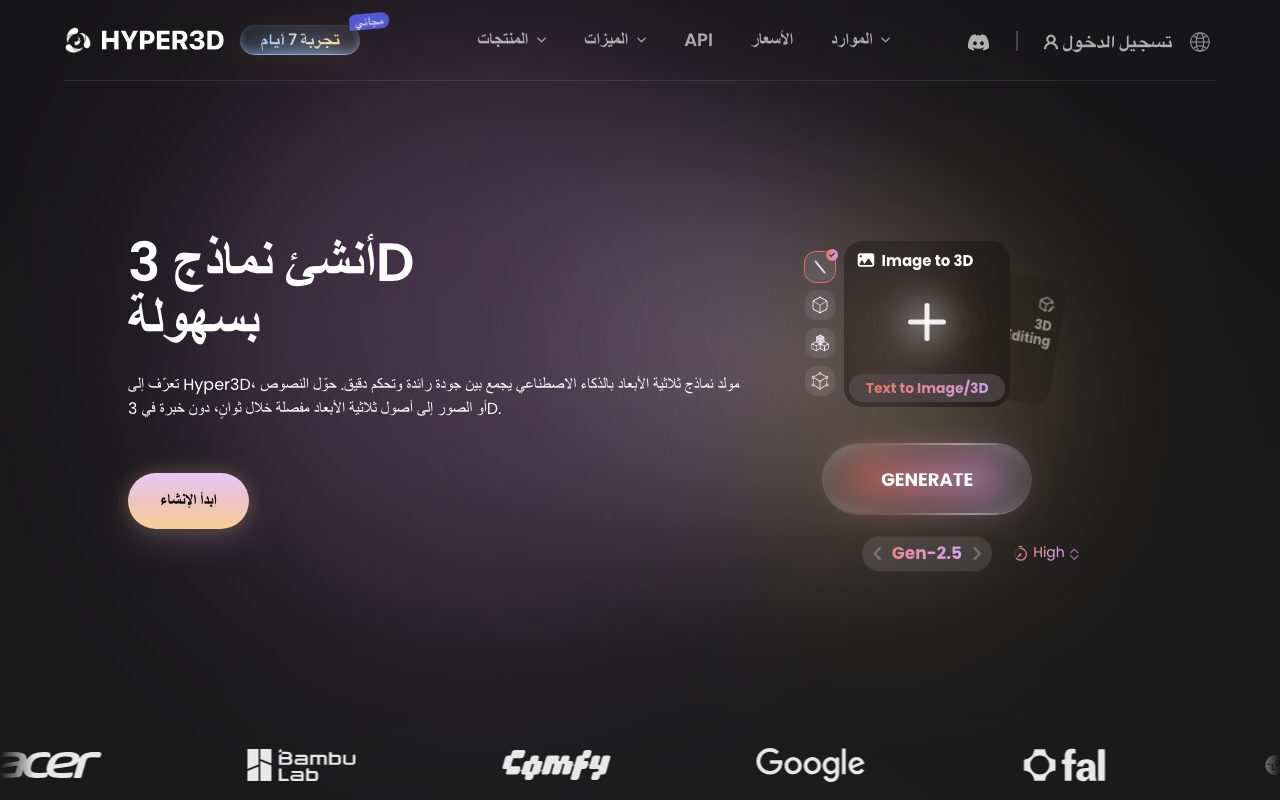
Rodin by Hyper3D generates textured, production-oriented 3D meshes from text prompts or single 2D images, with optional multi-view inputs, DCC engine plugins, and broad 3D file export support.
Hyper3D Rodin is a generative 3D modeling platform built to streamline the conversion of 2D images and natural-language text descriptions into solid, textured 3D meshes. Developed by Deemos Corporation and grounded in research behind CLAY and CAST, the system produces detailed geometry alongside PBR materials (including albedo, roughness, and metalness maps) for game development, AR/VR, product visualization, and digital manufacturing. The system supports single-image inputs as well as optional multi-view guidance, eliminating the need for rigid camera poses or overlapping photogrammetry capture sets. For spatial fidelity and downstream editing, the platform provides tools such as 3D ControlNet (bounding box, voxel, and point cloud guidance), BANG partial region editing, Smart Low-Poly decimation, and polygon target controls up to 10 million polygons with optional LOD generation. In addition to the core 3D generation capabilities, Hyper3D includes auxiliary creative tools such as AI video generation from stills, texture generation, HDRI environment map synthesis, and dedicated avatar workflows via ChatAvatar. Users can integrate the platform into existing digital content creation (DCC) pipelines using official plugins for Blender, Unity, Unreal Engine, Godot, Maya, and 3ds Max, or manage programmatic generations via its REST API.
Rodin combines single-image and text generation with research-backed geometry (CLAY/CAST), offering built-in spatial conditioning via 3D ControlNet (bounding box, voxel, and point cloud) alongside direct exports in formats like STL, USDZ, FBX, and GLB.
Product capabilities
Key features
Image-to-3D Conversion
Reconstructs textured 3D geometry from a single JPG, PNG, or WebP reference image, with optional multi-view inputs for added spatial guidance.
Text-to-3D Generation
Transforms descriptive natural language prompts into textured 3D models with prompt-guided material and style definitions.
3D ControlNet Conditioning
Guides mesh generation using spatial structures including bounding boxes, voxels, and point clouds to influence shape and layout.
BANG Partial Editing
Allows targeted editing and refinement of specific regions of an existing 3D asset without re-generating the entire mesh.
PBR Texture Generation
Applies UVs and physically based rendering texture maps, including albedo, roughness, and metalness channels.
Smart Low-Poly and LODs
Offers mesh optimization controls to produce clean low-poly models, with selectable target polygon counts up to 10 million and optional LOD generation.
DCC and Engine Plugins
Provides native integrations and add-ons for Blender, Unreal Engine, Unity, Godot, Autodesk Maya, and 3ds Max.
Broad Export Support
Exports models into industry-standard 3D formats including STL, 3MF, OBJ, FBX, GLB, glTF, USDZ, and DXF.
Practical fit
Who should use Rodin?
Game Asset Prototyping
Convert 2D concept art or descriptions into game-ready props and background assets ready for Unity or Unreal Engine.
E-Commerce AR and Web Previews
Generate interactive 3D assets in GLB or USDZ from flat product photographs for web viewers and Apple Quick Look.
3D Printing and Collectibles
Produce watertight, manifold geometry from reference art and export directly to STL or 3MF for slicer software.
Image-to-Video Motion References
Animate static visual concepts or 3D renders into short motion clips using prompt-driven camera movements for pitch decks and social posts.
Editorial assessment
Pros and limitations
Where it is strong
- Operates in modern web browsers without requiring local DCC software installation
- Includes PBR maps (albedo, roughness, metalness) with automatic UV unwrapping
- Outputs manifold, watertight geometry compatible with 3D print slicing (STL, 3MF)
- Offers spatial control mechanisms including Bounding Box, Voxel, and Point Cloud ControlNet
- Provides native plugins across popular tools including Blender, Unity, and Unreal
Where to be careful
- Specific monthly or annual plan prices are not transparently detailed on the general product overview pages
- Complex non-standard shapes may still require multi-view image guidance to ensure high silhouette fidelity
Commercial context
Rodin pricing
At the review date (September 2026), Hyper3D provides free credits with no subscription required to start generating and exporting models. Paid and enterprise tiers add higher resolution, increased generation volume, and commercial licensing, though specific tier prices are not detailed on the supplied pages.
Pricing, limits, taxes, model access, and regional availability can change. Verify the purchase-critical details on the official pricing page linked under Sources.
Transparent ranking
Why Rodin scores 71.3
Each factor is scored on a 100-point scale, then combined using the public ToolsRank weights. Engagement and momentum stay at a neutral baseline until measured signals exist, so no tool can gain or lose position from numbers nobody recorded.
Compatibility
Languages, platforms, and integrations
Languages
- English
- Chinese
- German
- Japanese
- Korean
- Russian
Integrations & surfaces
- Blender
- Unreal Engine
- Unity
- Godot
- Autodesk Maya
- Autodesk 3ds Max
- Cinema 4D
- ComfyUI
- NVIDIA Omniverse / Isaac
Community
Reviews and questions
No approved member reviews yet. Editorial factors above are the only rating on this page.
Reviews and questions come from Google-signed members and are checked by an editor before they appear.
Frequently asked
Rodin FAQ
Can I use Rodin for free?+
Yes. Hyper3D provides free credits to test the generation and export features without requiring an upfront subscription or credit card.
What 3D file formats can be exported?+
Rodin supports multiple export formats, including GLB, glTF, FBX, OBJ, STL, USDZ, 3MF, and DXF, catering to game engines, web 3D, AR, and 3D printing.
Does Rodin require multiple photographs or photogrammetry rigs?+
No. The system generates 3D geometry from a single 2D image without requiring prescribed poses or lighting conditions. Optional additional views can be uploaded when extra visual precision is needed.
Are the generated models watertight for 3D printing?+
Yes. The platform generates manifold, solid geometry suitable for export to STL or 3MF, allowing models to slice cleanly without holes or non-manifold mesh errors.
Can generated 3D models be used commercially?+
Yes. Hyper3D grants commercial licensing on its paid and enterprise plans for use in commercial games, e-commerce, advertising, and client work according to its terms.