Direct answer
What is Secureframe?
Secureframe automates compliance frameworks like SOC 2, ISO 27001, HIPAA, and CMMC 2.0 with continuous tests, AI remediation, and policy tools.
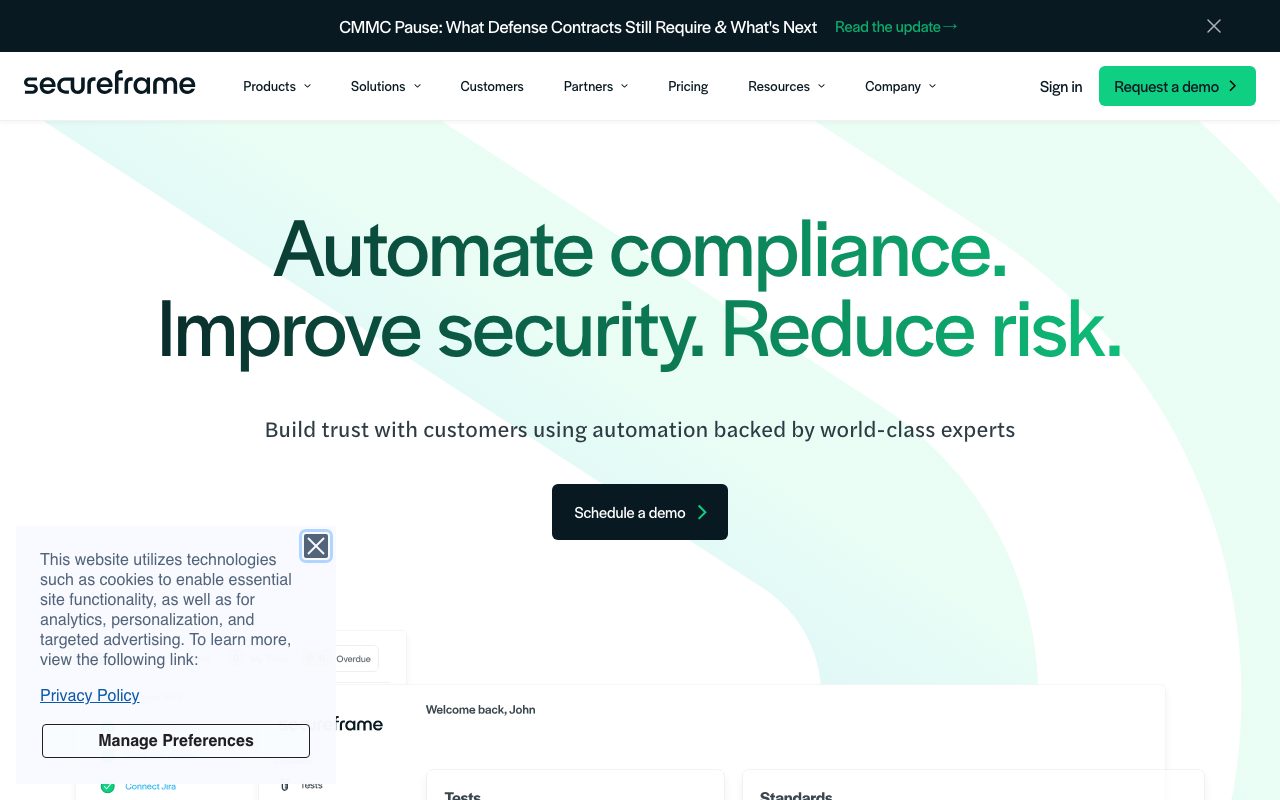
Secureframe is an automated compliance and security operations platform designed to streamline audit readiness across standards such as SOC 2, ISO 27001, HIPAA, PCI DSS, GDPR, CCPA, and CMMC 2.0. By connecting with cloud infrastructure, identity providers, and business tools through more than 300 native integrations, it continuously monitors assets, personnel, and configurations while gathering audit evidence automatically. The platform integrates specialized machine learning tools under the Comply AI banner. Comply AI for Remediation generates code fixes for infrastructure-as-code misconfigurations and provides console instructions to resolve failed compliance tests. Comply AI for Risk produces inherent risk ratings, treatment plans, and residual risk scores from plain descriptions. In addition, Comply AI for Policies drafts and refines organizational policies, Comply AI for TPRM parses vendor documents like SOC 2 reports to accelerate third-party reviews, and AI Evidence Validation inspects uploaded files to catch missing items or outdated timestamps before formal audits begin. Beyond technical control testing, Secureframe equips organizations with a Trust Center and automated security questionnaire workflows that draw from existing compliance data to resolve customer RFPs. Dedicated features for defense contractors include System Security Plans (SSP), Plan of Action & Milestones (POA&M) management, and SPRS score tracking.
Secureframe blends continuous automated evidence collection with Comply AI, producing infrastructure-as-code remediation scripts and auto-populating risk assessments, vendor reviews, and security questionnaires.
Product capabilities
Key features
Automated Evidence Collection & Continuous Tests
Monitors controls across infrastructure, code repositories, and personnel in real time using pre-built and custom tests, with bulk JSON evidence exports.
Comply AI for Remediation
Generates infrastructure-as-code patches and step-by-step console guidance to correct misconfigurations that cause failed tests.
Comply AI for Risk
Evaluates risk descriptions to automatically calculate inherent risk scores, suggest treatment plans, and estimate residual risk scores.
Comply AI for Policies
Provides an AI-assisted text editor and pre-built templates to draft, revise, and track employee acceptance of organizational security policies.
Third-Party Risk Management (TPRM)
Extracts answers and security posture data directly from vendor documents like SOC 2 reports using AI to speed up vendor evaluations.
AI Evidence Validation
Pre-screens uploaded audit files to detect missing attachments, outdated timestamps, and mismatched evidence before auditor review.
Trust AI & Questionnaire Automation
Draws answers from internal policies and past responses to complete incoming customer RFPs and security questionnaires automatically.
Secureframe Defense for CMMC
Purpose-built module for defense contractors offering SPRS score tracking, System Security Plans (SSP), POA&M, and CUI enclave management.
Workflow
How Secureframe works
- Connect your cloud providers, developer platforms, and identity tools via Secureframe's 300+ native integrations.
- Map platform controls and pre-built automated tests against frameworks like SOC 2, ISO 27001, or CMMC 2.0.
- Resolve failing tests using auto-generated Comply AI remediation code fixes or manual console instructions.
- Draft and track organizational security policies and review third-party vendor reports using AI extraction.
- Validate audit evidence files automatically and share clean readiness reports with vetted third-party auditors.
Practical fit
Who should use Secureframe?
Accelerating SOC 2 and ISO 27001 Audits
Centralize framework controls, continuously monitor cloud assets, and hand over pre-validated evidence packages to certified auditors.
Defense Industrial Base Compliance
Implement CMMC 2.0 controls, maintain System Security Plans (SSP), and track SPRS scores to satisfy defense contracting requirements.
Automating Security Questionnaires and RFPs
Eliminate manual spreadsheet security questionnaires by populating answers using platform evidence and past repository records.
Vendor Risk and Access Oversight
Review third-party vendors by auto-extracting findings from SOC 2 reports and tracking employee access to external tools.
Editorial assessment
Pros and limitations
Where it is strong
- Over 300 native integrations for automated evidence gathering across cloud, identity, and developer tools
- Generative AI generates infrastructure-as-code patches directly for failing tests
- Dedicated defense tier with CMMC 2.0, SSP, and POA&M workflows
- Includes pre-screening of audit documents via AI Evidence Validation to minimize audit exceptions
- Backed by in-house network of over 30 compliance specialists and former auditors
Where to be careful
- High baseline pricing starting at $7,000 per year excludes casual or hobbyist projects
- Higher tiers such as Complete and Defense require contacting sales for quotes
- Advanced questionnaire automation and advanced TPRM are withheld from the Fundamentals plan
Commercial context
Secureframe pricing
Pricing verified as of September 2026. Secureframe packages start at $7,000 annually for the Fundamentals plan, while the Complete and Defense tiers require requesting a custom quote. Verify terms on the official pricing page.
| Plan | Price | What it includes |
|---|---|---|
| Fundamentals | $7,000 / year visual starting rate (custom quote for final terms) | |
| Complete | Contact sales / custom quote | |
| Defense | Contact sales / custom quote |
Pricing, limits, taxes, model access, and regional availability can change. Verify the purchase-critical details on the official pricing page linked under Sources.
Transparent ranking
Why Secureframe scores 75.9
Each factor is scored on a 100-point scale, then combined using the public ToolsRank weights. Engagement and momentum stay at a neutral baseline until measured signals exist, so no tool can gain or lose position from numbers nobody recorded.
Compatibility
Languages, platforms, and integrations
Languages
- English
- German
- Spanish
- French
Platforms
- Web
- macOS
- Windows
- Linux
Integrations & surfaces
- AWS
- Google Cloud Platform
- Microsoft Azure
- GitHub
- GitLab
- Okta
- Google Workspace
- Microsoft 365
- Jira
- Slack
Community
Reviews and questions
No approved member reviews yet. Editorial factors above are the only rating on this page.
Reviews and questions come from Google-signed members and are checked by an editor before they appear.
Frequently asked
Secureframe FAQ
Which compliance frameworks does Secureframe support?+
Secureframe supports major security and privacy frameworks including SOC 2, ISO 27001, HIPAA, PCI DSS, GDPR, CCPA, CMMC 2.0, and NIST, among others. The Fundamentals plan includes one framework, while higher plans permit additional frameworks.
What is Comply AI for Remediation?+
Comply AI for Remediation is an automated capability that identifies failing infrastructure tests and generates code fixes for infrastructure-as-code templates, allowing engineers to copy, paste, and deploy configuration fixes directly to their cloud environments.
How does questionnaire automation work in Secureframe?+
Trust AI for Questionnaire Automation uses machine learning to answer customer security questionnaires and RFPs by retrieving verified responses from your Secureframe Comply data repository and past questionnaire answers stored in your Knowledge Base.
Can Secureframe manage defense contractor compliance?+
Yes. The Secureframe Defense package provides specific tooling for CMMC 2.0 compliance, including an SPRS score tracker, System Security Plan (SSP) automation, Plan of Action & Milestones (POA&M) management, and managed CUI enclaves.
What does AI Evidence Validation do?+
AI Evidence Validation reviews uploaded compliance files prior to an audit to detect missing documents, outdated timestamps, or mismatched submissions, reducing exceptions on final audit reports.