
Direct answer
What is Semantic Kernel?
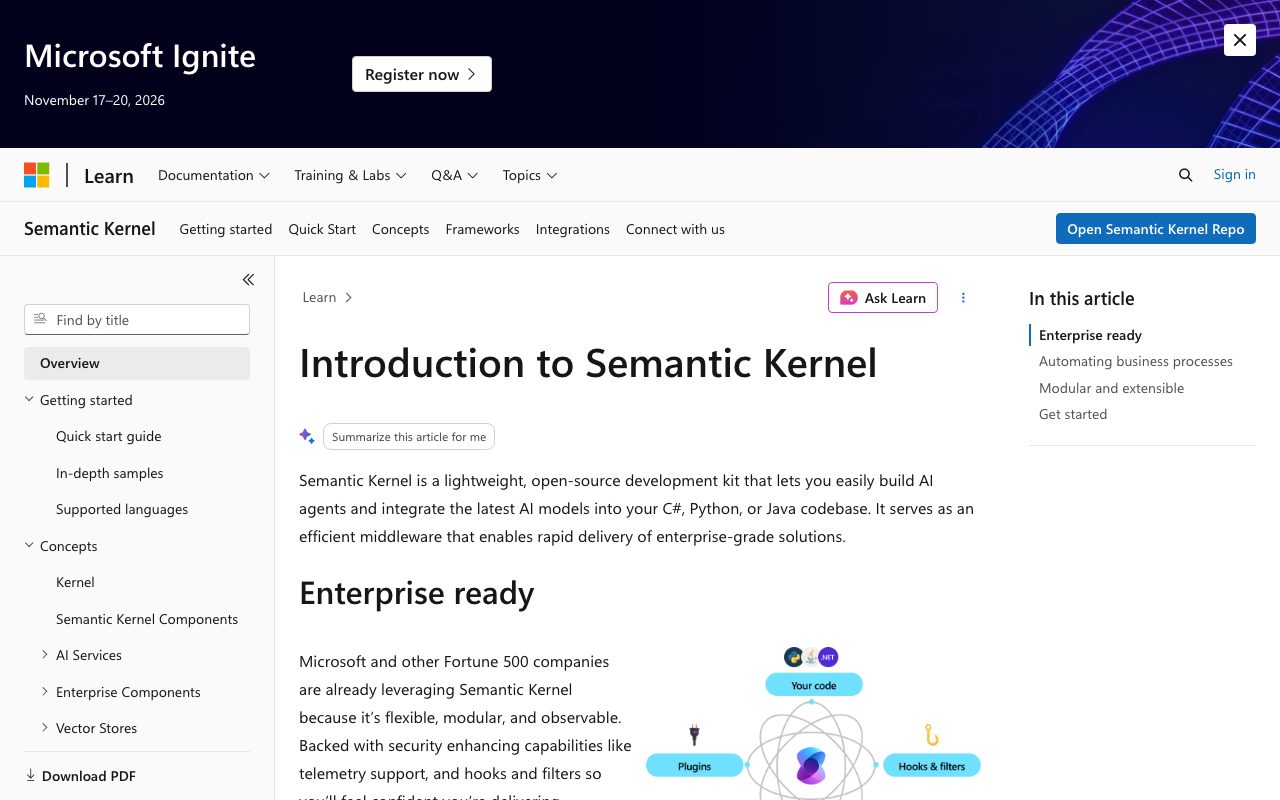
Semantic Kernel is an open-source middleware SDK by Microsoft that connects AI models to C#, Python, and Java codebases to automate business processes with agents and plugins.
Semantic Kernel is an open-source software development kit designed to act as an efficient middleware layer between modern AI models and enterprise application code. Maintained by Microsoft, it enables engineering teams to build modular AI agents and integrate large language models directly into C#, Python, or Java environments. The framework coordinates function calling by translating model prompts and requests into executable code against existing APIs, then returning structured results back to the model. Rather than locking applications into a single vendor or model architecture, it allows developers to swap out underlying AI models as technology advances without refactoring entire application codebases. Semantic Kernel incorporates enterprise features such as telemetry support, execution hooks, and filters to monitor performance and enforce responsible AI boundaries. It also supports OpenAPI specifications, allowing teams to expose existing corporate systems as standardized plugins that can be shared across pro-code developers and low-code environments.
Semantic Kernel delivers production-ready Version 1.0+ API stability across C#, Python, and Java, combining function calling middleware with native OpenAPI plugin support compatible with Microsoft 365 Copilot.
Product capabilities
Key features
Middleware Function Calling
Translates language model requests into function calls against existing APIs and feeds execution results back to the model.
Multi-Language v1.0+ Stability
Provides committed non-breaking API stability across C#, Python, and Java codebases.
Model Swapping
Decouples application logic from specific models, allowing developers to upgrade or change AI providers without rewriting code.
OpenAPI Plugin Ecosystem
Packages existing APIs into modular plugins using standard OpenAPI specifications, enabling reuse across enterprise tools.
Telemetry and Observability
Includes built-in telemetry, hooks, and filters to monitor agent execution and apply responsible AI safeguards.
Multimodal Expansion
Enables existing chat-based endpoints to expand into additional interaction modalities like voice and video.
Practical fit
Who should use Semantic Kernel?
Automating API Workflows
Exposing internal enterprise APIs as plugins so AI models can orchestrate multi-step business transactions.
Enterprise Agent Orchestration
Developing reliable AI agents inside existing C#, Python, or Java enterprise systems with logging and filters.
Cross-Team Extension Sharing
Standardizing AI skills via OpenAPI so pro-code plugins can be consumed by other teams and copilots.
Editorial assessment
Pros and limitations
Where it is strong
- Committed v1.0+ non-breaking API stability across C#, Python, and Java
- Open-source development kit with no software licensing fees
- Native support for telemetry, security filters, and hooks
- OpenAPI standard alignment facilitates plugin reuse
Where to be careful
- Requires professional software development experience to deploy and maintain
- Visual workflow management is not provided in the core SDK
Commercial context
Semantic Kernel pricing
At the review date, Semantic Kernel is an open-source SDK distributed without software license fees. Cloud compute and third-party model inference usage incur separate provider costs.
Pricing, limits, taxes, model access, and regional availability can change. Verify the purchase-critical details on the official pricing page linked under Sources.
Transparent ranking
Why Semantic Kernel scores 78.7
Each factor is scored on a 100-point scale, then combined using the public ToolsRank weights. Engagement and momentum stay at a neutral baseline until measured signals exist, so no tool can gain or lose position from numbers nobody recorded.
Compatibility
Languages, platforms, and integrations
Languages
- en
Integrations & surfaces
- OpenAPI
- Microsoft 365 Copilot
- C#
- Python
- Java
Community
Reviews and questions
No approved member reviews yet. Editorial factors above are the only rating on this page.
Reviews and questions come from Google-signed members and are checked by an editor before they appear.
Frequently asked
Semantic Kernel FAQ
What programming languages does Semantic Kernel support?+
Semantic Kernel provides official Version 1.0+ support with non-breaking API commitments for C#, Python, and Java.
Is Semantic Kernel free to use?+
Yes. Semantic Kernel is a lightweight, open-source development kit. Users do not pay software license fees for the SDK, though model API calls and hosting infrastructure incur independent costs.
How does Semantic Kernel connect code to AI models?+
Semantic Kernel acts as middleware: it describes existing code and APIs to the model, intercepts the model's requested function calls, executes the code, and passes the output back to the model.
Does Semantic Kernel support plugins from other tools?+
Yes. Semantic Kernel supports OpenAPI specifications, allowing developers to create plugins that can be shared with other developers or integrated with copilots like Microsoft 365 Copilot.
