
Direct answer
What is Sentry Seer?
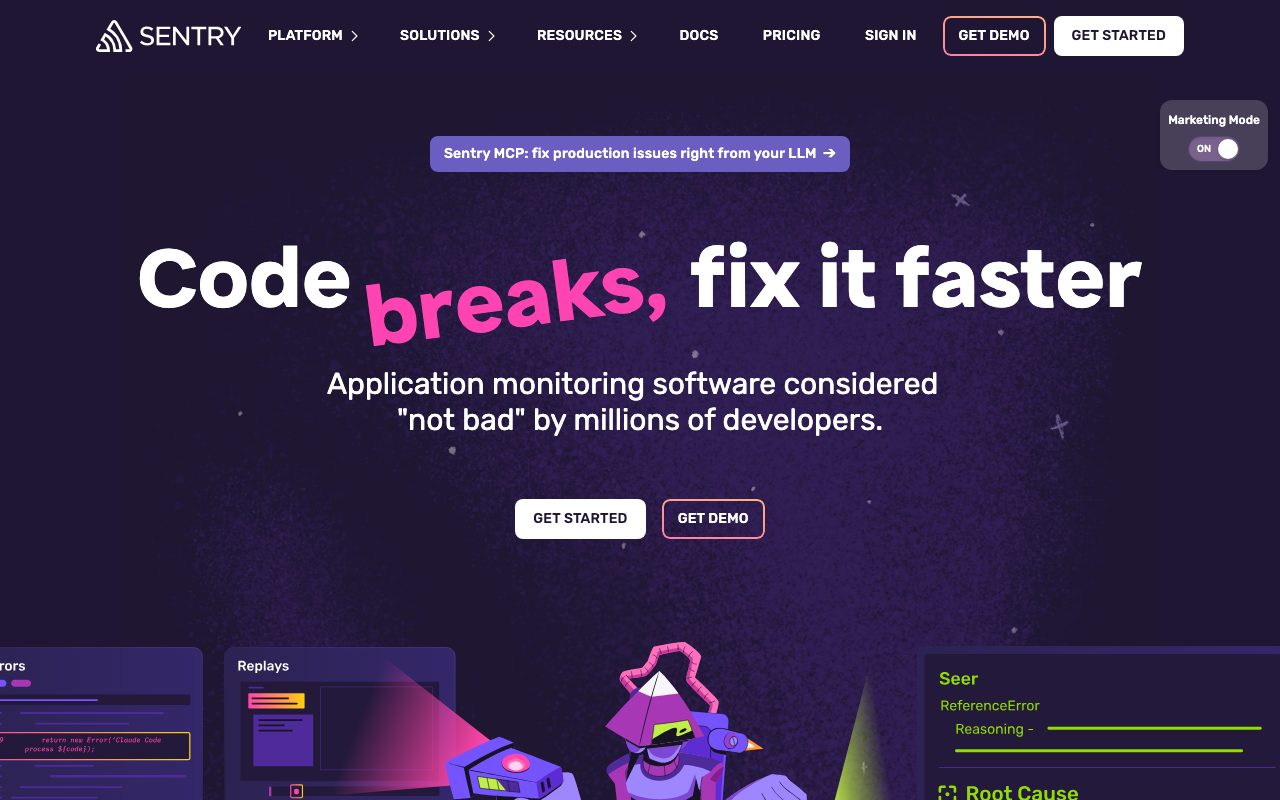
Sentry Seer is an AI-powered debugging agent and code reviewer that correlates production stack traces, logs, and commit history to identify root causes and generate merge-ready code fixes.
Sentry Seer is the AI debugging and automated code review extension integrated into the Sentry application monitoring platform. Instead of analyzing errors in isolation, Seer taps into Sentry's end-to-end telemetry—including runtime stack traces, breadcrumbs, logs, spans, replays, and commit histories—to determine why an application failed rather than merely pinpointing where the breakdown occurred. The tool operates across the development and release lifecycle. In pre-merge workflows, Seer reviews pull requests and checks incoming code against historical error patterns and performance baselines to catch regressions before deployment. In production, Seer performs root cause analysis on incoming exceptions and automatically drafts pull requests containing precise fixes for identified bugs. Beyond automated fixes, Seer connects directly into developer workflows through integrations with GitHub, Slack, Jira, Linear, and an official Model Context Protocol (MCP) server. The MCP server allows external coding assistants and LLMs to query production errors and application context directly within local environments. Built on Sentry's SOC 2 Type II and ISO 27001-certified infrastructure, Seer benefits from platform-level data scrubbing and PII filtering rules.
Unlike standalone AI code assistants that inspect source files in a vacuum, Seer derives its context directly from live production traces, releases, and crash telemetry to produce fixes based on real execution state.
Product capabilities
Key features
Automated Root Cause Analysis
Examines stack traces, commit histories, logs, and spans to explain the underlying mechanisms causing code failures.
Fix Generation and Autofix
Generates precise, merge-ready pull request patches to resolve verified application exceptions.
AI Code Review and Error Prediction
Correlates code changes in pull requests against historical production issues to catch regressions before deployment.
Sentry MCP Server Integration
Exposes production error context and traces to local LLMs and AI coding agents via the Model Context Protocol.
Integrated Workflow Sync
Maps incidents, commits, and fixes across GitHub, Linear, Jira, and Slack with automatic code owner assignment.
Practical fit
Who should use Sentry Seer?
Triage and Remediation of Production Errors
Automatically diagnose sudden HTTP 500 exceptions in production and review generated patch PRs to expedite fixes.
Pull Request Regression Guardrails
Evaluate inbound pull requests against historical error spikes to stop recurring defects prior to merging.
AI Agent Debugging Context
Supply local AI coding agents with production stack traces and context using the Sentry MCP server.
Editorial assessment
Pros and limitations
Where it is strong
- Grounds AI suggestions in actual production traces, logs, and release commits rather than guessing from code alone.
- Integrated directly into Sentry's established monitoring dashboards, issue lists, and notification channels.
- Offers an MCP server that lets external LLMs query live telemetry directly from local editors.
- Backed by enterprise compliance standards including SOC 2 Type II, ISO 27001, and automated PII scrubbing.
Where to be careful
- Requires an active Sentry deployment and SDK instrumentation to generate actionable context.
- Seer is excluded from the free Developer tier and carries an additional subscription and usage fee on paid plans.
Commercial context
Sentry Seer pricing
At the review date, Seer is offered as an AI debugging agent requiring an active paid Sentry subscription (Team starting at $26/month billed annually) plus additional usage costs. Verify official rates on the Sentry pricing page.
Pricing, limits, taxes, model access, and regional availability can change. Verify the purchase-critical details on the official pricing page linked under Sources.
Transparent ranking
Why Sentry Seer scores 76
Each factor is scored on a 100-point scale, then combined using the public ToolsRank weights. Engagement and momentum stay at a neutral baseline until measured signals exist, so no tool can gain or lose position from numbers nobody recorded.
Compatibility
Languages, platforms, and integrations
Languages
- English
Platforms
- Web
- CLI
Integrations & surfaces
- GitHub
- Slack
- Jira
- Linear
- Sentry CLI
- Model Context Protocol (MCP)
Community
Reviews and questions
No approved member reviews yet. Editorial factors above are the only rating on this page.
Reviews and questions come from Google-signed members and are checked by an editor before they appear.
Frequently asked
Sentry Seer FAQ
What is Sentry Seer?+
Sentry Seer is Sentry's AI-powered debugging agent and code reviewer. It uses telemetry data such as stack traces, logs, and commit logs to perform root cause analysis, predict potential regressions in pull requests, and generate code patches.
Is Sentry Seer included in the free Developer plan?+
No. The official pricing documentation specifies that Seer is not available on the free Developer tier and requires a paid Team, Business, or Enterprise subscription, where it is billed as an AI Debugging Agent at an additional cost.
How does Seer help during pull request reviews?+
Seer correlates pull requests against an organization's historical error and performance telemetry to predict regressions and identify issues before the code is merged into production.
What is the Sentry MCP server?+
Sentry provides a Model Context Protocol (MCP) server integration that allows coding agents and LLMs to query live production error contexts, traces, and metrics directly inside developer workflows.
How does Sentry protect sensitive application data analyzed by Seer?+
Sentry provides server-side and client-side PII scrubbing filters that strip out secrets, credit card numbers, authorization headers, and session cookies. Data is protected with AES-256 encryption at rest and TLS in transit under SOC 2 Type II and ISO 27001 compliance standards.