Direct answer
What is Supabase?
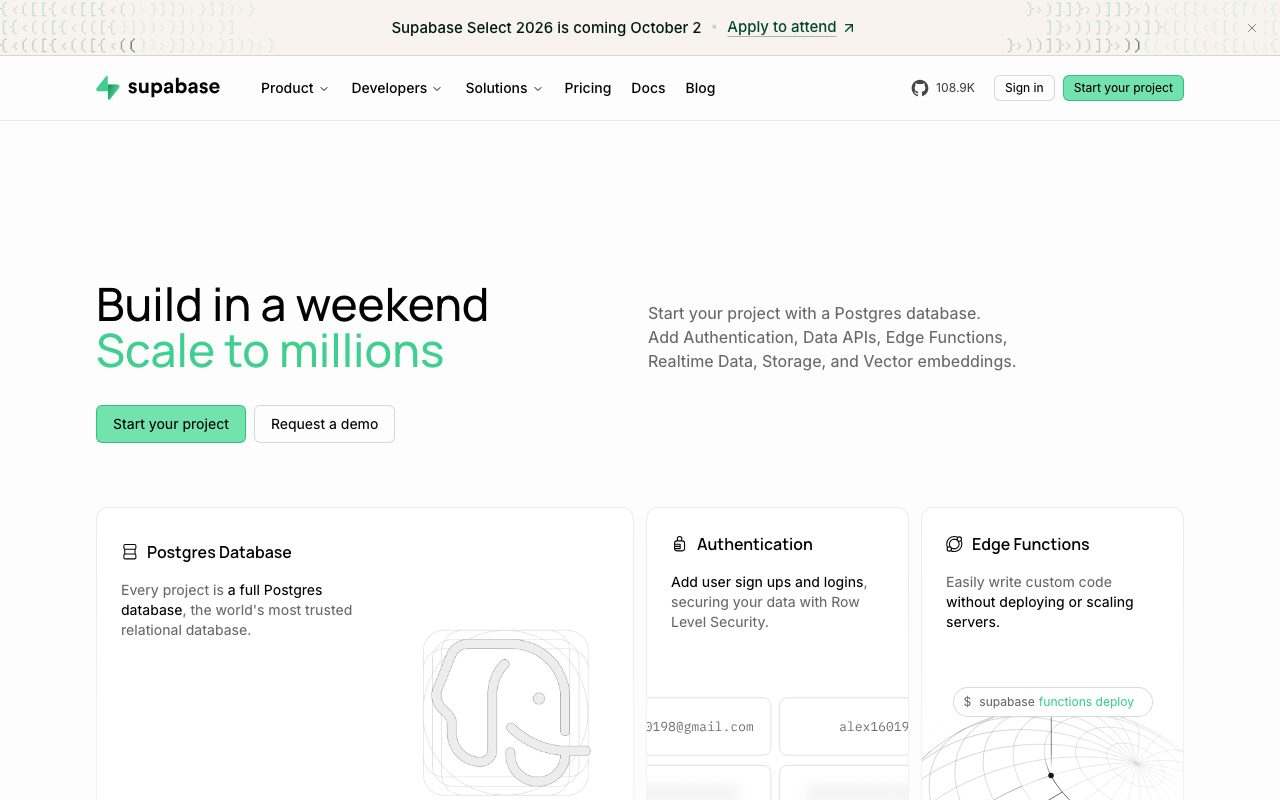
Supabase is an open-source Postgres development platform providing a dedicated PostgreSQL database, auto-generated REST and GraphQL APIs, authentication with Row Level Security, Edge Functions, file storage, and vector embeddings.
Supabase provides developers with an integrated backend suite built around a full PostgreSQL database. Rather than locking users into a proprietary document store, every project receives an inspectable, portable Postgres instance with support for extensions, database triggers, and advanced disk configurations scaling up to 60 TB and 80,000 IOPS. The platform auto-generates RESTful endpoints directly from your schema using PostgREST, allowing client applications to query nested relations and perform CRUD operations directly from the browser without custom boilerplate. Security is handled natively in the database through PostgreSQL Row Level Security (RLS) policies and role-based access controls. In addition to database management, Supabase bundles authentication (passwords, social OAuth, passwordless, and phone MFA), file storage with basic CDN delivery, Realtime change data capture, globally distributed serverless Edge Functions, and pgvector embeddings for retrieval-augmented generation (RAG) and machine learning workloads. Developers can interact with Supabase via dashboard editors, client libraries across JavaScript, Python, Flutter, Swift, and Kotlin, the Supabase CLI, or AI tooling including MCP servers.
Supabase is built directly on full, portable PostgreSQL rather than proprietary NoSQL data stores. It marries low-code developer ergonomics—auto-generated REST APIs and integrated auth—with native Postgres features like Row Level Security and pgvector embeddings.
Product capabilities
Key features
Full Dedicated Postgres Database
Every project includes an inspectable PostgreSQL database with portable schemas, extensions, connection poolers, and support for up to 60 TB disk configurations.
Auto-Generated REST & GraphQL APIs
Automatically generates secure RESTful and GraphQL endpoints based on schema changes using PostgREST, resolving requests directly through single SQL statements.
Built-In Auth with Row Level Security
Supports email/password, social OAuth providers, anonymous sign-ins, and SAML 2.0, enforcing permission checks directly via PostgreSQL RLS policies.
Integrated Vector Support
Stores, indexes, and searches vector embeddings directly in Postgres alongside application data for AI chatbot and retrieval-augmented generation workflows.
Realtime Data Synchronization
Listens to PostgreSQL changes and broadcasts real-time updates and user states across subscribed clients for collaborative or multiplayer apps.
Globally Distributed Edge Functions
Allows developers to execute server-side custom logic close to end users without deploying dedicated application servers.
File Storage with CDN
Stores and serves large assets like images and videos, secured by Row Level Security access policies and integrated with image transformation options.
Practical fit
Who should use Supabase?
AI Application Backend
Storing document vector embeddings with pgvector while managing user authentication, metadata tables, and real-time streaming.
SaaS Web & Mobile Apps
Building full-stack web applications on React, Next.js, Flutter, or React Native using client libraries and Row Level Security.
Firebase Alternative Migration
Moving existing document data and auth users from Firebase to a relational schema backed by open-source Postgres tooling.
Serverless API Layer
Generating instant CRUD APIs for mobile or frontend clients without standing up a bespoke Node.js or Python backend server.
Editorial assessment
Pros and limitations
Where it is strong
- Every project provides standard, portable PostgreSQL with no vendor lock-in.
- Auto-generated REST APIs reduce backend boilerplate for frontend and mobile teams.
- Native vector support allows combining relational data and embeddings in a single database.
- Generous free plan with up to 50,000 monthly active users and 500 MB database storage.
Where to be careful
- Free projects are automatically paused after one week of inactivity.
- Configuring secure Row Level Security (RLS) rules requires solid understanding of Postgres SQL permissions.
Commercial context
Supabase pricing
Verified on 2026-09-08. Free tier includes up to 2 active projects with 500 MB database storage and 50,000 MAUs (pauses after 1 week of inactivity). Paid tiers start at $25/month for Pro and $599/month for Team, plus usage-based compute add-ons.
Pricing, limits, taxes, model access, and regional availability can change. Verify the purchase-critical details on the official pricing page linked under Sources.
Transparent ranking
Why Supabase scores 77.4
Each factor is scored on a 100-point scale, then combined using the public ToolsRank weights. Engagement and momentum stay at a neutral baseline until measured signals exist, so no tool can gain or lose position from numbers nobody recorded.
Compatibility
Languages, platforms, and integrations
Languages
- en
Integrations & surfaces
- Next.js
- React
- Flutter
- Python
- Vercel
- Stripe
- OpenAI
- Hugging Face
- Expo
- Swift
- Kotlin
Community
Reviews and questions
No approved member reviews yet. Editorial factors above are the only rating on this page.
Reviews and questions come from Google-signed members and are checked by an editor before they appear.
Frequently asked
Supabase FAQ
What is Supabase?+
Supabase is an open-source development platform built around PostgreSQL. It packages a full Postgres database with user authentication, auto-generated REST and GraphQL APIs, Edge Functions, real-time message broadcasting, vector search, and file storage.
Is Supabase open source and self-hostable?+
Yes. Supabase is open source from day one and can be self-hosted on your own infrastructure or run locally using Docker and the Supabase CLI.
How does Supabase handle security and API access?+
Supabase exposes APIs through PostgREST behind an API gateway with key-based authentication. Data access and permissions are enforced natively at the database layer using PostgreSQL Row Level Security (RLS) policies.
What happens to inactive free projects?+
Projects on the Free tier are paused after one week of inactivity. Paid plans (Pro, Team, Enterprise) do not pause inactive projects.
Does Supabase support AI and vector search?+
Yes. Supabase includes pgvector support directly inside Postgres, allowing you to store, index, and query embeddings alongside your relational tables without running a separate dedicated vector database.