Direct answer
What is Typeface?
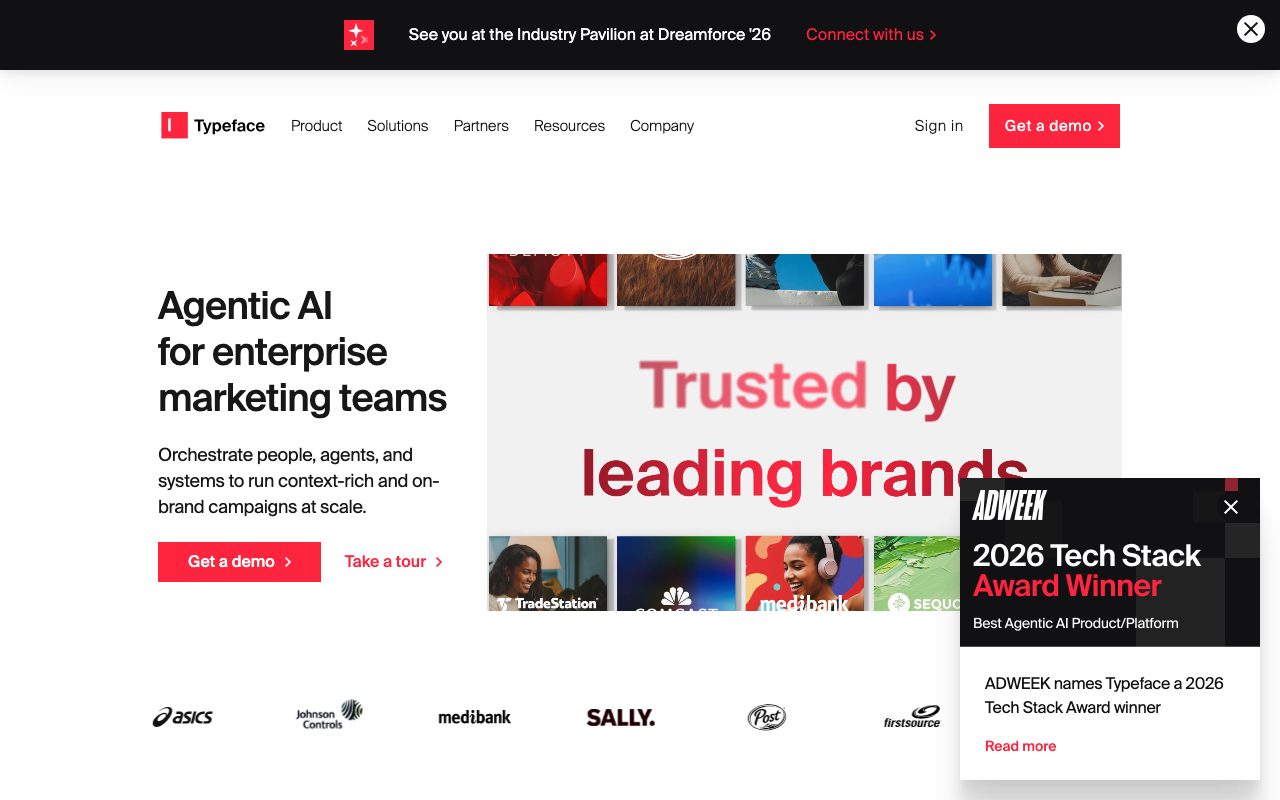
Typeface is an enterprise marketing platform that uses agentic AI to plan, generate, approve, and localize on-brand marketing campaigns and digital shelf assets at scale.
Typeface is an enterprise-oriented marketing orchestration platform designed to streamline brand-governed content creation and campaign management. Built around the Typeface Arc orchestration engine, the platform structures generative AI workflows across four main components: Arc Graph, Arc Agents, Arc Spaces, and Arc Forge. Arc Graph grounds output in company brand guidelines, approved visual layouts, and audience context, preventing off-brand generative drift across multi-brand and regional teams. Arc Agents automate production tasks across different formats and channels, while Arc Spaces provides a collaborative visual workspace for managing planning, drafting, multi-stakeholder reviews, approvals, and distribution in a single environment. For advanced operational requirements, Arc Forge allows IT and operations teams to turn specific human workflows into custom agents, integrating with external systems via MCP, APIs, and third-party integrations. Typeface integrates directly into standard creative software like Adobe Photoshop, Illustrator, and Figma, allowing design teams to produce brand assets without leaving their core design environments. Enterprise governance features include SOC 2 Type II and ISO 27001 certifications, tenant data isolation, AES-256 encryption at rest, TLS 1.2+ encryption in transit, role-based access controls, and single sign-on (SSO).
Unlike general-purpose generative AI tools, Typeface is architected as an enterprise orchestration system (Typeface Arc) that combines brand graph governance, agent builder tooling via Arc Forge, and native extensions into professional creative apps like Figma, Photoshop, and Illustrator.
Product capabilities
Key features
Arc Graph
Grounds generated content in approved brand guidelines, distinct portfolio identities, audience insights, and verified design layouts.
Arc Agents
Multi-modal agents that handle complex marketing production tasks across different creative formats, digital shelf channels, and regional markets.
Arc Spaces
A centralized visual workspace for orchestrating marketing workflows, including planning, creative previews, team reviews, approvals, and publishing.
Arc Forge
Tooling to convert specialized marketing processes into reusable custom agents, extensible using MCP, REST APIs, and system integrations.
Creative App Integrations
Enables creative and design personnel to generate and adapt brand-aligned visual variations directly inside Figma, Adobe Photoshop, and Adobe Illustrator.
Enterprise Security and Isolation
Maintains dedicated tenant isolation, AES-256 encryption at rest, TLS 1.2+ encryption in transit, and adherence to SOC 2 Type II and ISO 27001 standards.
Practical fit
Who should use Typeface?
Digital Shelf and E-Commerce Content
Converts product data catalogs into retailer-ready product descriptions and marketing assets automatically for digital channels.
Global-to-Local Campaign Scaling
Enables regional marketing groups to generate localized campaign variations from a centralized global brand system.
Multi-Brand Portfolio Governance
Maintains strict separation of visual styles, tone of voice, and guidelines across multiple sub-brands in one enterprise platform.
Custom Agent Workflow Deployment
Allows marketing engineers and IT teams to automate repetitive cross-system marketing processes via Arc Forge and MCP connections.
Editorial assessment
Pros and limitations
Where it is strong
- Comprehensive enterprise compliance with SOC 2 Type II and ISO 27001 certifications.
- Integrated creative app workflows for Adobe Photoshop, Illustrator, and Figma.
- Granular brand governance through Arc Graph to protect distinct brand rules.
- Extensible agent creation using Arc Forge, MCP, and developer APIs.
Where to be careful
- No transparent public pricing or self-serve trial available on the official website.
- Requires significant enterprise implementation and organizational change management.
Commercial context
Typeface pricing
At the review date (September 2026), Typeface does not display self-serve plans or transparent pricing tiers on its official website. Access is granted through scheduled enterprise demos and direct sales discussions. Prospective buyers should contact Typeface directly for pricing quotes.
Pricing, limits, taxes, model access, and regional availability can change. Verify the purchase-critical details on the official pricing page linked under Sources.
Transparent ranking
Why Typeface scores 72.5
Each factor is scored on a 100-point scale, then combined using the public ToolsRank weights. Engagement and momentum stay at a neutral baseline until measured signals exist, so no tool can gain or lose position from numbers nobody recorded.
Compatibility
Languages, platforms, and integrations
Languages
- English
Platforms
- Web
- Microsoft Teams
Integrations & surfaces
- Figma
- Adobe Photoshop
- Adobe Illustrator
- Microsoft Teams
- Google Cloud
- Microsoft Azure
Community
Reviews and questions
No approved member reviews yet. Editorial factors above are the only rating on this page.
Reviews and questions come from Google-signed members and are checked by an editor before they appear.
Frequently asked
Typeface FAQ
What is Typeface Arc?+
Typeface Arc is the platform's marketing orchestration engine. It consists of Arc Graph for brand context, Arc Agents for multi-modal campaign execution, Arc Spaces for reviews and publishing workflows, and Arc Forge for turning manual processes into custom agents.
Does Typeface offer a free trial or self-serve tier?+
The vendor does not list self-serve tiers or self-service free trials on its official pages. Prospective customers are prompted to request a demo or take a tour to discuss business needs with sales.
What security and compliance certifications does Typeface have?+
According to official documentation, Typeface is certified under SOC 2 Type II and ISO 27001 standards. It supports tenant isolation, AES-256 data encryption at rest, and TLS 1.2+ encryption in transit.
Does Typeface claim ownership over customer inputs or generated assets?+
No. Typeface's security documentation explicitly confirms that customers retain full ownership of all prompts, creative inputs, and generated outputs produced on the platform.
Where is customer data hosted in Typeface?+
Typeface operates in a multi-cloud, multi-tenant infrastructure leveraging public cloud infrastructure hosted in the United States, including Microsoft Azure and Google Cloud.