
Direct answer
What is Undermind?
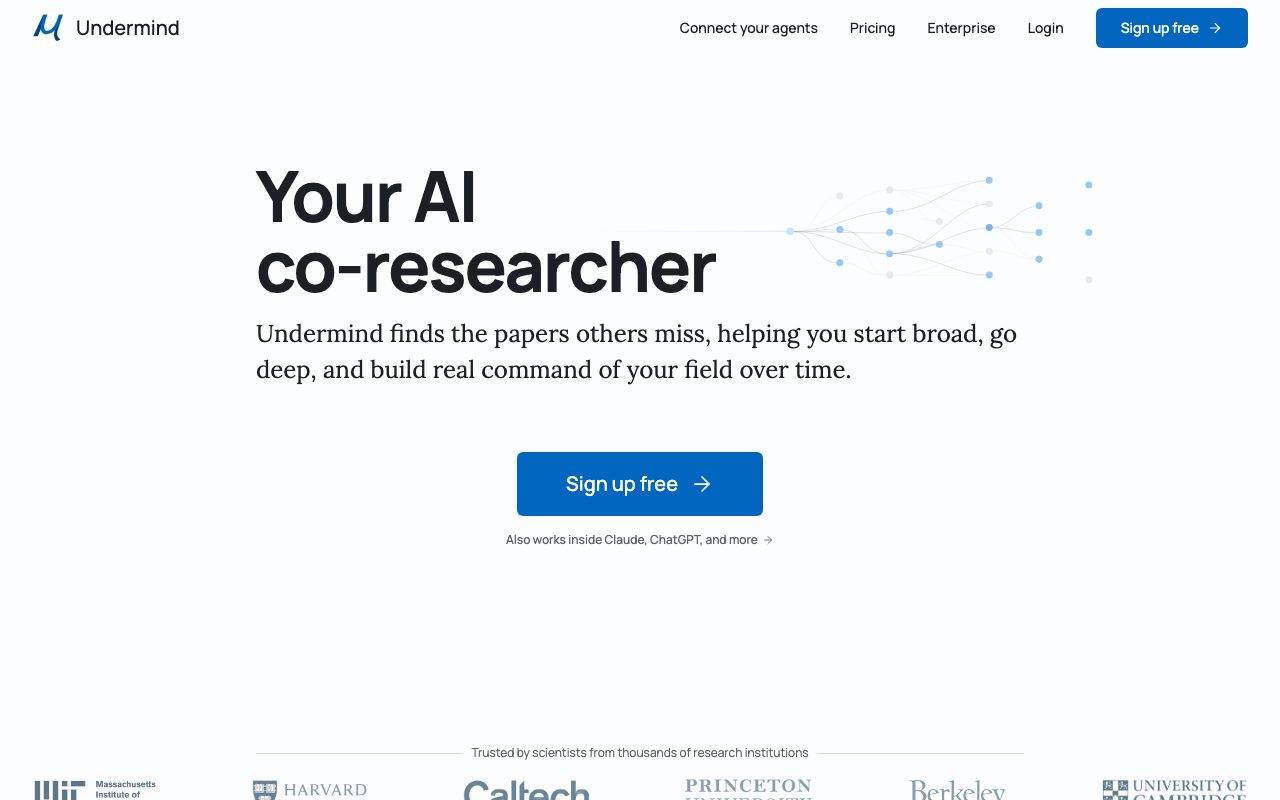
Undermind is an AI literature exploration tool built by MIT quantum physics PhDs. It traverses scientific citation networks and reads full texts to surface obscure papers, trace claims, and synthesise technical topics.
Undermind acts as an autonomous co-researcher for scientific and technical literature. Rather than performing a standard keyword search that returns a static list of hyperlinks, the platform engages in an iterative discovery workflow. Upon receiving an initial research question, Undermind asks clarifying follow-up questions to pinpoint scope, navigates citation trails across hundreds of candidate papers, and performs deep evaluation of full-text papers to surface pertinent findings. Originally benchmarked to outperform standard academic search engines in comprehensive recall, the system builds synthesised research reports with inline citations linked directly back to source documents. Researchers can generate comparison tables across papers, gauge specific relevance to nuanced technical inquiries, and set up automated alerts to track emerging literature in their specialty. In addition to its web platform, Undermind connects directly to custom agents and chat environments such as Claude and ChatGPT. Enterprise deployments include data isolation commitments, confirming that proprietary R&D data remains unindexed and is never used to train foundational AI models.
Unlike typical search tools that only scan abstracts with keyword matches, Undermind asks clarifying questions, parses full text across hundreds of papers, and traces iterative citation networks to surface obscure papers.
Product capabilities
Key features
Iterative Literature Exploration
Reads and evaluates candidate papers across citation trails to surface foundational and obscure research that keyword queries miss.
Interactive Research Clarification
Asks follow-up questions upon prompt submission to establish exact technical scope and criteria before initiating searches.
Inline Source Verification
Every synthesis statement links directly back to inline citations, allowing researchers to trace claims to original source papers.
Custom Data Tables
Extracts technical variables, methods, and results across multiple papers into custom-generated comparative tables.
External Agent Integrations
Connects Undermind search workflows directly into chat assistants and developer agents including Claude and ChatGPT.
Automated Literature Alerts
Monitors specified research areas of interest and sends automated notifications when new relevant papers are published.
Workflow
How Undermind works
- Describe your research topic or question in plain language.
- Answer interactive follow-up questions to refine specific search criteria.
- Undermind traverses citation networks and reads relevant full-text papers.
- Review a synthesised report with inline citations, relevance ratings, and custom comparison tables.
Practical fit
Who should use Undermind?
Novelty Assessment
Determine if a proposed scientific concept or experimental idea has been addressed previously in peer-reviewed literature.
Scoping Complex Domains
Conduct deep, systematic literature reviews into nuanced technical domains such as targeted drug delivery or hard-tech engineering.
Finding Prior Methodologies
Identify established experimental protocols, benchmark datasets, and technical solutions for scientific bottlenecks.
Cross-Disciplinary Discovery
Uncover hidden conceptual connections and methodology overlaps between differing scientific disciplines.
Editorial assessment
Pros and limitations
Where it is strong
- Deep full-text evaluation rather than simple keyword abstract matching.
- Traces in-line citations to verify factual provenance back to original papers.
- Enterprise data guarantee ensuring proprietary user inputs are never used for AI model training.
- Integrates directly with agents in ChatGPT and Claude.
Where to be careful
- Searches take several minutes to run due to multi-paper iterative citation reading.
- Free tier is subject to standard usage and rate limits.
Commercial context
Undermind pricing
Pricing snapshot as of September 2026. The vendor offers a Free tier with standard rate limits, Pro at $16/month (billed annually), Team at $15/user/month (billed annually), and custom Enterprise plans. Verify current rates on the official website.
| Plan | Price | What it includes |
|---|---|---|
| Free | $0 / ongoing free tier with standard rate limits on chats and searches; includes shared workspaces and agent connectors | |
| Pro | $16 / per month, billed annually ($20 billed monthly); includes 10x usage limits, full-text analysis, and unlimited workspaces | |
| Team | $15 / per person per month, billed annually; adds centralized billing and team management | |
| Enterprise | Custom / custom annual contract with dedicated compute, custom SLA, and admin dashboard |
Pricing, limits, taxes, model access, and regional availability can change. Verify the purchase-critical details on the official pricing page linked under Sources.
Transparent ranking
Why Undermind scores 79.5
Each factor is scored on a 100-point scale, then combined using the public ToolsRank weights. Engagement and momentum stay at a neutral baseline until measured signals exist, so no tool can gain or lose position from numbers nobody recorded.
Compatibility
Languages, platforms, and integrations
Languages
- English
Platforms
- Web
- Browser Extension
Integrations & surfaces
- Claude
- ChatGPT
Community
Reviews and questions
No approved member reviews yet. Editorial factors above are the only rating on this page.
Reviews and questions come from Google-signed members and are checked by an editor before they appear.
Frequently asked
Undermind FAQ
How does Undermind differ from Google Scholar or standard search engines?+
Rather than running a quick keyword query that matches title and abstract terms, Undermind reads full texts across citation networks, evaluates relevance to your specific research question, and generates structured reports with traceable citations.
Why does an Undermind search take several minutes?+
Undermind conducts an autonomous multi-step exploration that reads, parses, and cross-references hundreds of scientific papers and follows citation paths rather than delivering instant indexed database matches.
Is proprietary research data safe from AI model training?+
Yes. According to Undermind's enterprise and privacy documentation, user R&D data remains isolated, is encrypted in transit and at rest, and is never used to train AI models.
Can I use Undermind inside other AI assistants?+
Yes. Undermind includes agent connectors that allow users to invoke its literature discovery capabilities directly from environments like Claude and ChatGPT.