Direct answer
What is Augment Code?
Augment Code is an agentic software development platform that connects specialized AI experts across the development lifecycle, automating tasks from ticket triage and coding to automated PR reviews and CVE remediation.
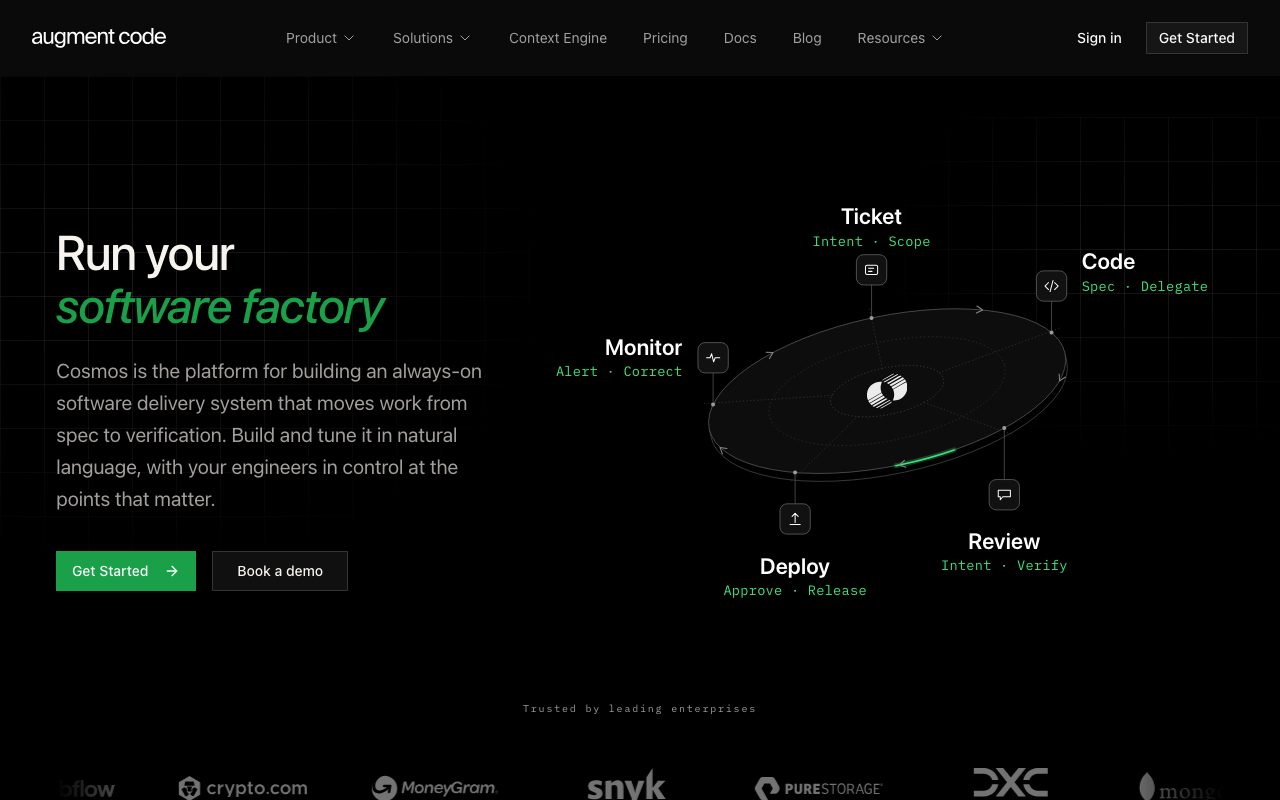
Augment Code centers on Cosmos, an agent orchestration platform designed to operate software development tasks in continuous loops. Rather than acting solely as an in-line autocomplete tool, it organizes development into modular, multi-step agent workflows. Teams configure or deploy built-in 'Experts'—specialized agents designed for discrete software lifecycle duties such as work dispatch, pull-request authoring, comprehensive code review, test verification, and automated vulnerability remediation. Cosmos connects triggers from systems like GitHub, GitLab, Jira, Linear, and CI platforms to initiate end-to-end task flows. For instance, when a ticket or CVE alert arrives, the agent can examine codebase context via Augment's Context Engine, verify reachability, generate fixes or implementations in managed sandboxes or self-hosted compute, and submit pull requests with full audit trails. Models can be routed dynamically via Prism across Claude and Gemini, or configured directly per expert. Human engineers retain approval gates at critical checkpoints before code is merged or released into production.
Unlike developer-centric auto-completion plugins, Augment Code coordinates full lifecycle agent fleets across entire engineering departments, offering flat 50-seat base pricing with shared team usage pools and multi-agent loops that feed directly into one another.
Product capabilities
Key features
Cosmos Agent Orchestration
Runs configurable AI expert fleets across managed cloud sandboxes, developer environments, or self-hosted infrastructure.
Context Engine
Indexes and reasons across large monorepos and distributed services to understand codebase architecture and dependencies.
Automated Security Remediation
Ingests CVE and SAST reports, verifies vulnerable path reachability, updates dependencies, resolves breaking changes, and files reviewed PRs.
Code Review Fleet
Performs multi-pass PR evaluations covering logic, edge cases, team standards, security surface, and test coverage before human sign-off.
Prism Model Routing
Automatically balances cost and performance between models such as Claude Sonnet, Claude Opus, and Gemini 2.5 Pro on each turn.
Human-in-the-Loop Quality Gates
Pauses automated workflows at predefined checkpoints, requiring human engineer approvals before merges or deployments proceed.
Practical fit
Who should use Augment Code?
Ticket-to-PR Automation
Dispatches open issues from Linear or Jira to agents that draft code changes, run tests, and open ready-to-review pull requests.
Vulnerability Backlog Reduction
Ingests Dependabot, Snyk, or Semgrep alerts, tests for code reachability, and issues verified pull requests to patch CVEs.
CI Failure Investigation
Detects failing GitHub Actions runs, parses logs, diagnoses root causes, and posts remediation instructions directly on the PR.
Automated PR Code Review
Provides instant, substantive first-pass architectural, security, and test-completeness feedback on pull requests across teams.
Editorial assessment
Pros and limitations
Where it is strong
- Flat team pricing covering up to 50 seats on Standard and Business tiers without per-seat charges.
- Comprehensive SDLC loop orchestration spanning ticket intake, coding, testing, and PR review.
- Explicit enterprise privacy guarantees prohibiting AI training on proprietary code on all paid plans.
- Context Engine specifically built to handle large codebases and complex monorepos.
- Supports model switching and routing across Claude and Gemini architectures.
Where to be careful
- No permanently free tier is advertised on the official pricing page.
- Incurs a flat 40% vendor service surcharge on top of public LLM inference API costs.
- Requires significant team process alignment to establish quality gates and workflow triggers.
Commercial context
Augment Code pricing
At the review date (2026-09-08), standard pricing is billed as a flat team rate ($20 or $100 per month for up to 50 seats) with pooled usage allowances, plus a 40% service fee on underlying LLM API usage. Verify the latest rates on the official pricing page.
| Plan | Price | What it includes |
|---|---|---|
| Standard | $20 / month flat, up to 50 seats with $20 usage included | |
| Business | $100 / month flat, up to 50 seats with $100 usage included | |
| Enterprise | Custom / billed annually or custom |
Pricing, limits, taxes, model access, and regional availability can change. Verify the purchase-critical details on the official pricing page linked under Sources.
Transparent ranking
Why Augment Code scores 79.2
Each factor is scored on a 100-point scale, then combined using the public ToolsRank weights. Engagement and momentum stay at a neutral baseline until measured signals exist, so no tool can gain or lose position from numbers nobody recorded.
Compatibility
Languages, platforms, and integrations
Languages
- English
Platforms
- Web
- CLI
- Cloud Sandboxes
- Self-Hosted / Hybrid Cloud
Integrations & surfaces
- GitHub
- GitLab
- Jira
- Linear
- Slack
- PagerDuty
- Snyk
- Semgrep
- GitHub Actions
- AWS
- GCP
Community
Reviews and questions
No approved member reviews yet. Editorial factors above are the only rating on this page.
Reviews and questions come from Google-signed members and are checked by an editor before they appear.
Frequently asked
Augment Code FAQ
How does pricing work on Augment Code?+
Augment Code offers flat monthly plans for up to 50 seats: Standard costs $20 per month (including $20 in pooled usage), and Business costs $100 per month (including $100 in pooled usage). Enterprise plans require contacting sales. Usage covers LLM inference billed at public API rates plus a 40% platform service fee, plus compute time.
Does Augment Code train AI models on customer data?+
No. Under Augment Code's commercial terms for paid plans, customer proprietary data and code are explicitly excluded from being used for AI training.
What is Cosmos?+
Cosmos is Augment Code's agent orchestration platform. It runs autonomous workflows, called loops, that move engineering tasks from requirements to implementation, review, testing, and deployment using specialized software experts.
What compliance standards and security features does Augment Code offer?+
Augment Code maintains SOC 2 Type II certification and ISO/IEC 42001 compliance. It supports Customer-Managed Encryption Keys (CMEK), Proof-of-Possession authorization, SIEM integrations, and comprehensive audit logging.