Direct answer
What is Databricks?
Databricks is a cloud data and AI platform unifying ETL pipelines, SQL analytics, data notebooks, and generative AI agent deployment on an open lakehouse architecture.
Databricks delivers an integrated platform that runs analytical, machine learning, and operational workloads on an open data foundation. Combining data engineering pipelines (Lakeflow) for batch and streaming ingest with serverless data warehousing, it allows teams to query and transform large-scale datasets using SQL, Python, and open formats like Delta Lake and Apache Iceberg. For machine learning and generative AI workflows, Databricks provides collaborative environments, model training and serving, and Agent Bricks for building data-grounded AI agents. Business intelligence is extended through Databricks Genie, a conversational interface that answers natural-language questions with visualizations and tabular data. Operational data and agent backends are supported by Lakebase, a serverless Postgres database. Access control, spend tracking, observability, and compliance across models, tools, and data assets are centralized via Unity Catalog and Unity Gateway.
Databricks connects data engineering, serverless warehousing, interactive notebooks, and production AI agents across multi-cloud environments on an open lakehouse architecture governed by Unity Catalog.
Product capabilities
Key features
Lakeflow Pipelines and Orchestration
Builds and manages reliable batch and streaming ETL pipelines with Lakeflow Jobs, Lakeflow Pipelines, and Lakeflow Connect.
Databricks Genie Conversational BI
Provides a natural-language conversational analytics interface that generates answers, tables, and visualizations from enterprise data without requiring manual SQL coding.
Agent Bricks and Foundation Model Serving
Enables engineering teams to design, evaluate, train, and deploy production AI agents and foundation models grounded in corporate data.
Unity Catalog and Unity Gateway
Delivers unified governance, access policies, spending observability, and guardrails across data assets, models, dashboards, and agent tools.
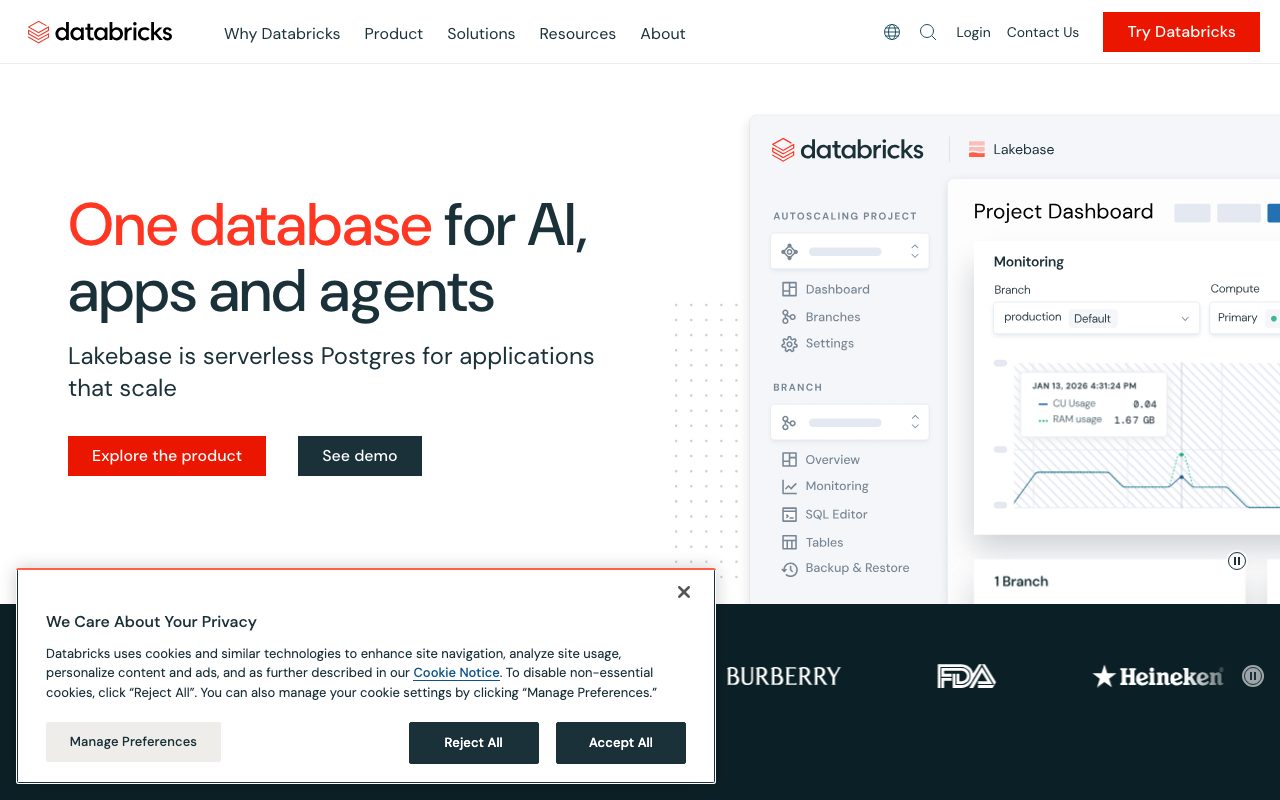
Lakebase Serverless Database
Integrates serverless Postgres directly with the lakehouse to power transactional data apps and operational backends for AI agents.
Serverless Data Warehousing
Runs serverless SQL analytics directly on open lakehouse formats, eliminating proprietary warehouse lock-in while maintaining ACID transactions.
Workflow
How Databricks works
- Connect your preferred cloud provider storage and compute resources (AWS, Azure, or GCP) to the Databricks platform.
- Ingest and orchestrate batch or streaming data using Lakeflow pipelines into Delta Lake or Iceberg open table formats.
- Query data directly via serverless SQL warehouses, interactive collaborative notebooks, or conversational prompts with Databricks Genie.
- Build, test, and deploy machine learning models or generative AI agents with Agent Bricks under Unity Catalog governance.
Practical fit
Who should use Databricks?
Enterprise ETL and Streaming Ingestion
Ingesting, transforming, and orchestrating batch and real-time streaming data into governed Delta Lake tables.
Collaborative Data Science and Model Training
Running machine learning experiments, distributed data analysis, and model deployment inside interactive notebooks.
Natural-Language Business Analytics
Empowering business stakeholders to query company data and receive visualizations through conversational questions via Databricks Genie.
Data-Grounded AI Agent Deployment
Building and governing production-ready AI agents and generative tools connected to proprietary databases and Unity Gateway guardrails.
Editorial assessment
Pros and limitations
Where it is strong
- Unifies batch and streaming data engineering, SQL analytics, and generative AI on one platform
- Built on open data formats such as Delta Lake and Apache Iceberg to prevent vendor storage lock-in
- Provides unified governance and access controls across models, tools, and tables via Unity Catalog
- Offers per-second pay-as-you-go billing with multi-cloud availability on AWS, Azure, and GCP
Where to be careful
- Requires cloud infrastructure management and understanding of DBU compute metrics
- Cloud provider storage and compute instance fees are billed separately from Databricks unit costs
Commercial context
Databricks pricing
At the review date, Databricks charges through a pay-as-you-go model measured at per-second granularity via Databricks Units (DBUs) and Databricks Storage Units (DSUs), alongside underlying cloud infrastructure costs. Volume discounts are accessible through Committed Use Contracts. Databricks also provides a free trial and a free Community Edition for learning Spark. Verify current rates on the official Databricks pricing calculator.
| Plan | Price | What it includes |
|---|---|---|
| Pay-As-You-Go | Usage-based / per second computation and storage consumption billed monthly, plus cloud provider costs for compute and networking infrastructure | |
| Committed Use Contracts | Custom quote / multi-year or annual contract committing to designated usage levels across single or multi-cloud deployments in exchange for discounted rates | |
| Databricks Community Edition | Free / ongoing free access to a limited-functionality learning environment designed specifically for learning Apache Spark |
Pricing, limits, taxes, model access, and regional availability can change. Verify the purchase-critical details on the official pricing page linked under Sources.
Transparent ranking
Why Databricks scores 77.2
Each factor is scored on a 100-point scale, then combined using the public ToolsRank weights. Engagement and momentum stay at a neutral baseline until measured signals exist, so no tool can gain or lose position from numbers nobody recorded.
Compatibility
Languages, platforms, and integrations
Languages
- English
Platforms
- Web
- AWS
- Microsoft Azure
- Google Cloud Platform
Integrations & surfaces
- AWS
- Microsoft Azure
- Google Cloud Platform
- PostgreSQL
- Apache Spark
- Apache Iceberg
- Delta Lake
- SAP
Community
Reviews and questions
No approved member reviews yet. Editorial factors above are the only rating on this page.
Reviews and questions come from Google-signed members and are checked by an editor before they appear.
Frequently asked
Databricks FAQ
How does Databricks pricing work?+
Databricks uses a pay-as-you-go model where processing is measured in Databricks Units (DBUs) with per-second granularity, alongside Databricks Storage Units (DSUs) for storage-related services. Users also pay underlying cloud provider fees (e.g., AWS, Azure, GCP) for compute instances, networking, and storage.
What is a Databricks Unit (DBU)?+
A DBU is a normalized unit of processing power on the Databricks platform used for measurement and billing. The number of DBUs consumed depends on the specific compute resources used and the volume of data processed.
What is Databricks Genie?+
Databricks Genie is a conversational analytics tool within the platform that allows business users to query enterprise data using plain language. It responds with text explanations, data tables, and charts without requiring SQL queries.
Is there a free way to use Databricks?+
Databricks offers a free trial of its Data + AI Platform (cloud infrastructure costs from your cloud provider may still apply during setup). It also offers Databricks Community Edition, a free, limited-functionality environment intended for learning Apache Spark.
What clouds does Databricks run on?+
Databricks is available on Amazon Web Services (AWS), Microsoft Azure (where billing is handled directly through Azure subscriptions), and Google Cloud Platform (GCP).