
Direct answer
What is DataRobot?
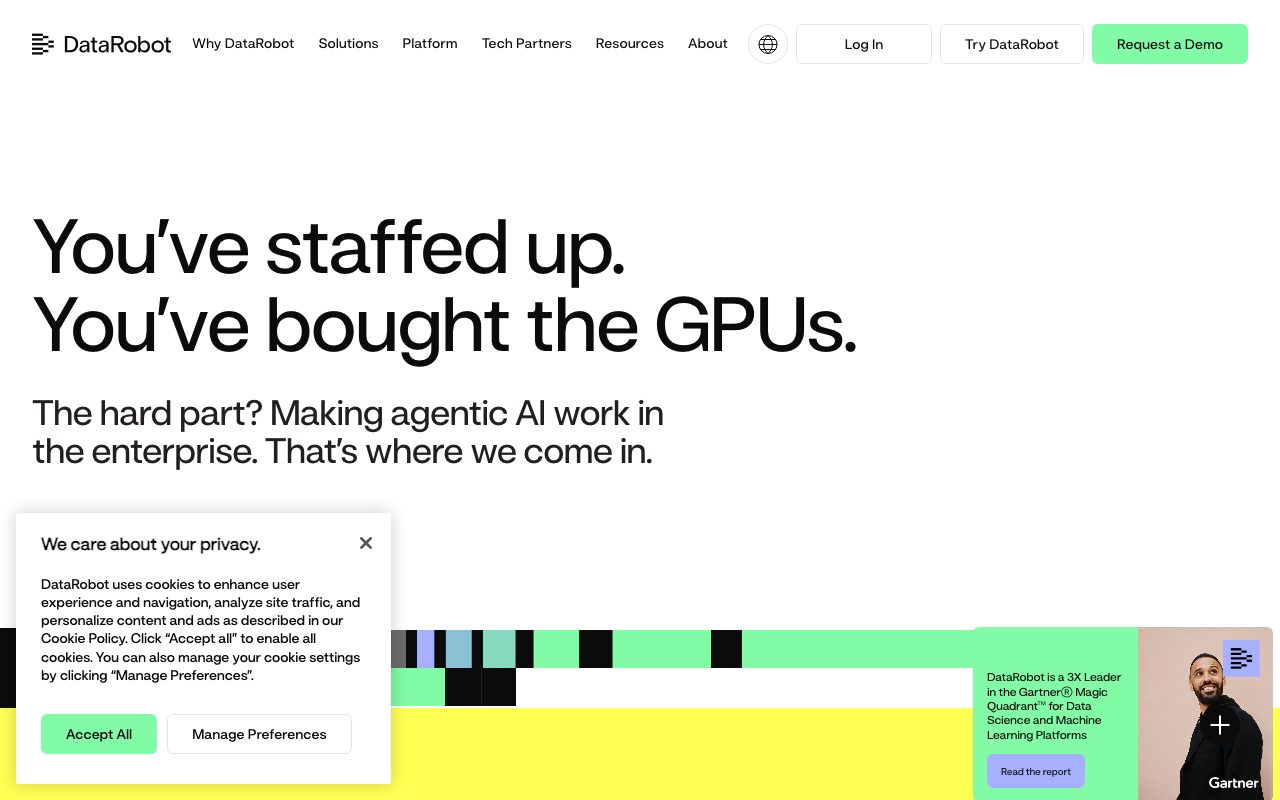
DataRobot is an enterprise platform combining predictive machine learning, generative models, and agentic workflows with unified governance and observability across hybrid, cloud, and on-premises environments.
DataRobot provides an end-to-end enterprise platform designed to develop, deploy, and govern both predictive machine learning models and autonomous agentic systems. It allows organisations to consolidate tooling by integrating predictive AI, generative AI, AI governance, and AI observability into a single operating environment. Teams can build agents and models using customizable blueprints and modular components—including LLMs, embeddings, and machine learning pipelines—either within DataRobot or inside external developer environments. Compute can be dynamically orchestrated across on-premises, cross-cloud, hybrid, and edge architectures to satisfy strict corporate and security policies. For ongoing operations, the platform tracks model accuracy, latency, and drift alongside agent quality in real time. Built-in governance mechanisms enforce approvals, configure granular access controls, and generate automated audit documentation to help organisations satisfy enterprise compliance requirements. Co-engineered integrations with partners such as NVIDIA and SAP allow teams to deploy agentic workloads natively into enterprise workflows and hardware stacks.
DataRobot unites classical predictive machine learning with modern autonomous agent workforces under a single enterprise governance layer certified for hybrid, on-premises, and cross-cloud environments.
Product capabilities
Key features
Agent Lifecycle Management
Enables engineering and business teams to build, test, and run enterprise agents using customizable blueprints and built-in integration points.
Unified AI Governance
Enforces access controls, approval workflows, testing frameworks, and automated audit trails to prevent unmonitored deployments across the organisation.
AI Observability & Monitoring
Monitors model accuracy, latency, compute cost, and agent operational quality in real time with continuous alerting on performance issues.
Predictive & Generative AI Co-location
Combines predictive machine learning pipelines with large language models, embeddings, and agent logic inside the same management console.
Flexible Deployment Architecture
Supports deployment across edge devices, on-premises data centres, hybrid clouds, and multi-cloud environments with dynamic compute orchestration.
Ecosystem Integrations
Integrates directly with data platforms such as Snowflake, SQL, and S3, alongside co-developed enterprise solutions for NVIDIA Enterprise AI and SAP.
Practical fit
Who should use DataRobot?
Automated Demand & Supply Chain Forecasting
Consolidating data across corporate warehouses and cloud stores to automate and accelerate production and inventory forecasts.
Governed Enterprise AI Agents
Deploying production-grade agents with role-based access, data-source authentication, and audit documentation inside business processes.
Operational Risk & Defect Detection
Monitoring operational signals such as equipment status or transactional anomalies across banking, energy, and manufacturing workflows.
Editorial assessment
Pros and limitations
Where it is strong
- Comprehensive governance and compliance audit documentation for regulated industries.
- Native support for on-premises, hybrid, and cross-cloud deployments.
- Co-engineered integrations with enterprise hardware and software ecosystems including NVIDIA and SAP.
- Bridges classical predictive data science with modern generative agent orchestration.
Where to be careful
- No publicly stated self-service pricing; requires going through enterprise sales and demo requests.
- Steep operational and organizational footprint that may be excessive for smaller teams.
Commercial context
DataRobot pricing
DataRobot does not publish fixed public pricing tiers on its website as of review date (2026-09-08). Prospective customers must contact sales to request a demo or arrange enterprise licensing.
Pricing, limits, taxes, model access, and regional availability can change. Verify the purchase-critical details on the official pricing page linked under Sources.
Transparent ranking
Why DataRobot scores 75
Each factor is scored on a 100-point scale, then combined using the public ToolsRank weights. Engagement and momentum stay at a neutral baseline until measured signals exist, so no tool can gain or lose position from numbers nobody recorded.
Compatibility
Languages, platforms, and integrations
Languages
- English
- Japanese
Integrations & surfaces
- NVIDIA
- SAP
- Snowflake
- Amazon S3
- SQL Databases
- Dell
- Nebius
Community
Reviews and questions
No approved member reviews yet. Editorial factors above are the only rating on this page.
Reviews and questions come from Google-signed members and are checked by an editor before they appear.
Frequently asked
DataRobot FAQ
What is DataRobot?+
DataRobot is an enterprise AI platform that enables organisations to build, deploy, operate, and govern predictive machine learning models, generative AI applications, and autonomous agent workforces.
Where can DataRobot be deployed?+
According to the official site, DataRobot supports on-premises, cross-cloud, hybrid, and edge deployments, orchestrating compute dynamically across these infrastructures.
Does DataRobot publish its pricing publicly?+
No, DataRobot does not display pricing tiers or self-serve subscription fees on its public pages. Potential users must request a demo or contact their sales team.
What hardware and software partnerships does DataRobot support?+
DataRobot highlights co-engineered and technology partnerships with NVIDIA (including NVIDIA Enterprise AI integration), SAP, Dell, and Nebius, as well as connectors to data systems like Snowflake, SQL, and Amazon S3.