
Direct answer
What is Decagon?
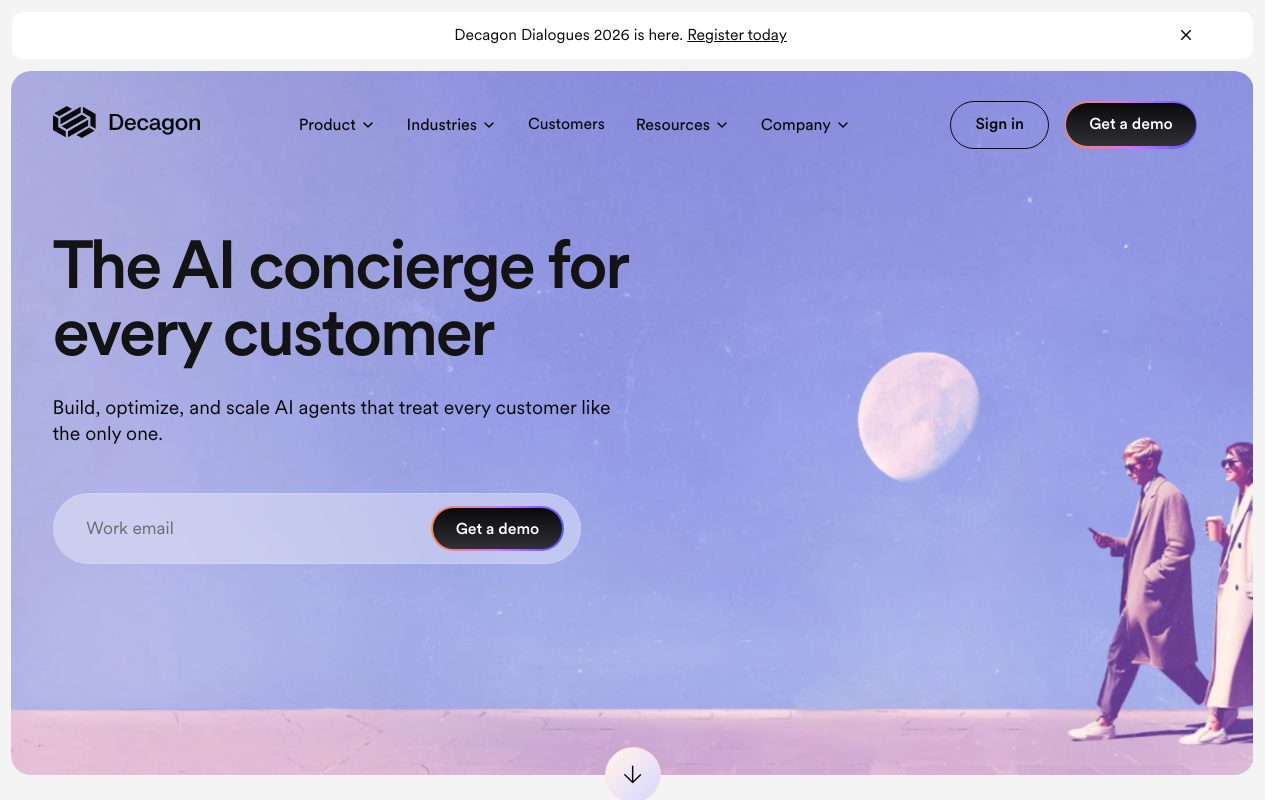
Decagon is an enterprise AI concierge platform that automates customer interactions across voice, chat, and email using natural-language Agent Operating Procedures and built-in quality guardrails.
Decagon is an enterprise-oriented customer service automation platform designed to serve as an AI concierge across chat, voice, and email channels. Instead of requiring developers to write complex logic scripts or code-heavy decision trees, Decagon allows CX teams to configure agent behavior using Agent Operating Procedures (AOPs) defined in natural language. This design enables organizations to quickly adapt workflows, execute multi-step business actions, and iterate on support rules without waiting for software development cycles. The platform unifies all conversational channels under a shared intelligence layer. Its voice component handles spoken phone dialogues with brand voice personalization, while chat and email components resolve text-based tickets empathetically and contextually. Decagon also includes Duet Autopilot, a self-improving capability that aids conversational AI optimization, alongside testing simulations and live A/B experiments to evaluate changes before and during production rollout. For enterprise governance, Decagon incorporates native guardrails such as an automated supervisor model to prevent hallucinations before answers are delivered, bad-actor detection for adversarial prompt deflection, and Watchtower for continuous automated quality assurance. Infrastructure security includes zero-day retention with third-party LLM providers, automated PII redaction via Google DLP, role-based access control, single sign-on, and just-in-time API tokens.
Decagon replaces rigid script builders and heavy code-based bots with natural-language Agent Operating Procedures (AOPs) backed by an active supervisor model that intercepts hallucinations and enforces cross-channel memory across voice, chat, and email.
Product capabilities
Key features
Agent Operating Procedures (AOPs)
Natural-language workflow definitions that allow support teams to establish operational rules, business logic, and escalation paths without engineering sprints.
Omnichannel Unified Architecture
Operates across voice calls, web chat, and email through a single intelligence layer that preserves cross-channel context and customer history.
Supervisor Model & Bad Actor Detection
In-flight safeguards that screen responses for factual accuracy to eliminate hallucinations and flag adversarial prompt injections or policy violations.
Watchtower Always-On QA
Automated conversation evaluation that inspects 100% of interactions against custom criteria to surface compliance risks and outlier dialogues.
Testing & QA Simulations
Pre-deployment simulation environments and live A/B testing frameworks to validate agent performance and evaluate changes safely.
Enterprise Security and Redaction
Enforces zero-day retention with third-party LLMs like OpenAI and Anthropic, alongside Google DLP PII redaction, short-lived JWT tokens, and SSO.
Practical fit
Who should use Decagon?
Cross-Channel Contact Deflection
Automating end-to-end resolutions across chat, voice, and email inquiries to decrease support ticket volume and wait times.
Voice Support Automation
Deploying conversational AI on phone lines to verify callers, answer questions, and execute account adjustments naturally.
Continuous Support Quality Assurance
Auditing automated conversations continuously with Watchtower to detect non-compliant answers, edge cases, and areas needing workflow updates.
Editorial assessment
Pros and limitations
Where it is strong
- Supports true omnichannel orchestration across voice, chat, and email with shared memory
- Workflows are configured in natural language using AOPs rather than code or rigid flowcharts
- Enterprise-grade safety features including supervisor hallucination checks and Google DLP PII masking
- Zero-day LLM data retention guarantees with providers such as Anthropic and OpenAI
Where to be careful
- No publicly available self-service trial or transparent pricing tiers
- Requires enterprise sales engagement and customized implementation
- Too complex and heavy for micro-businesses needing basic contact forms or simple FAQ widgets
Commercial context
Decagon pricing
Decagon does not publish tier prices or usage rates on its public website as of review date (September 2026). Prospective enterprise buyers must book a demo and contact sales for tailored quotes.
Pricing, limits, taxes, model access, and regional availability can change. Verify the purchase-critical details on the official pricing page linked under Sources.
Transparent ranking
Why Decagon scores 76.3
Each factor is scored on a 100-point scale, then combined using the public ToolsRank weights. Engagement and momentum stay at a neutral baseline until measured signals exist, so no tool can gain or lose position from numbers nobody recorded.
Compatibility
Languages, platforms, and integrations
Languages
- English
Platforms
- Web
- Voice / Phone
Integrations & surfaces
- Okta
- Microsoft Entra
- Google Cloud DLP
- OpenAI
- Anthropic
Community
Reviews and questions
No approved member reviews yet. Editorial factors above are the only rating on this page.
Reviews and questions come from Google-signed members and are checked by an editor before they appear.
Frequently asked
Decagon FAQ
What channels does Decagon support?+
Decagon supports voice calls, web chat, and email within a single intelligence platform, allowing customer interactions and context to be shared across channels.
How are workflows built in Decagon?+
Workflows are authored as Agent Operating Procedures (AOPs) written in natural language. This design allows CX and operational teams to update rules and logic without writing code or waiting on engineering backlogs.
How does Decagon handle data privacy and LLM retention?+
Decagon enforces zero-day retention agreements with underlying AI providers such as OpenAI and Anthropic, meaning customer conversations are not stored or used for model training. Sensitive customer data is also redacted via Google Cloud DLP.
How does Decagon prevent AI hallucinations?+
The platform incorporates a built-in supervisor model that evaluates draft responses against verified facts before they are sent, modifying or blocking statements that stray from source documentation.
Can Decagon integrate with existing identity and security tools?+
Yes. Decagon supports enterprise Single Sign-On (SSO) with identity providers such as Okta and Microsoft Entra, uses Role-Based Access Control (RBAC), and issues short-lived JWT tokens for scoped API actions.