Direct answer
What is Firecrawl?
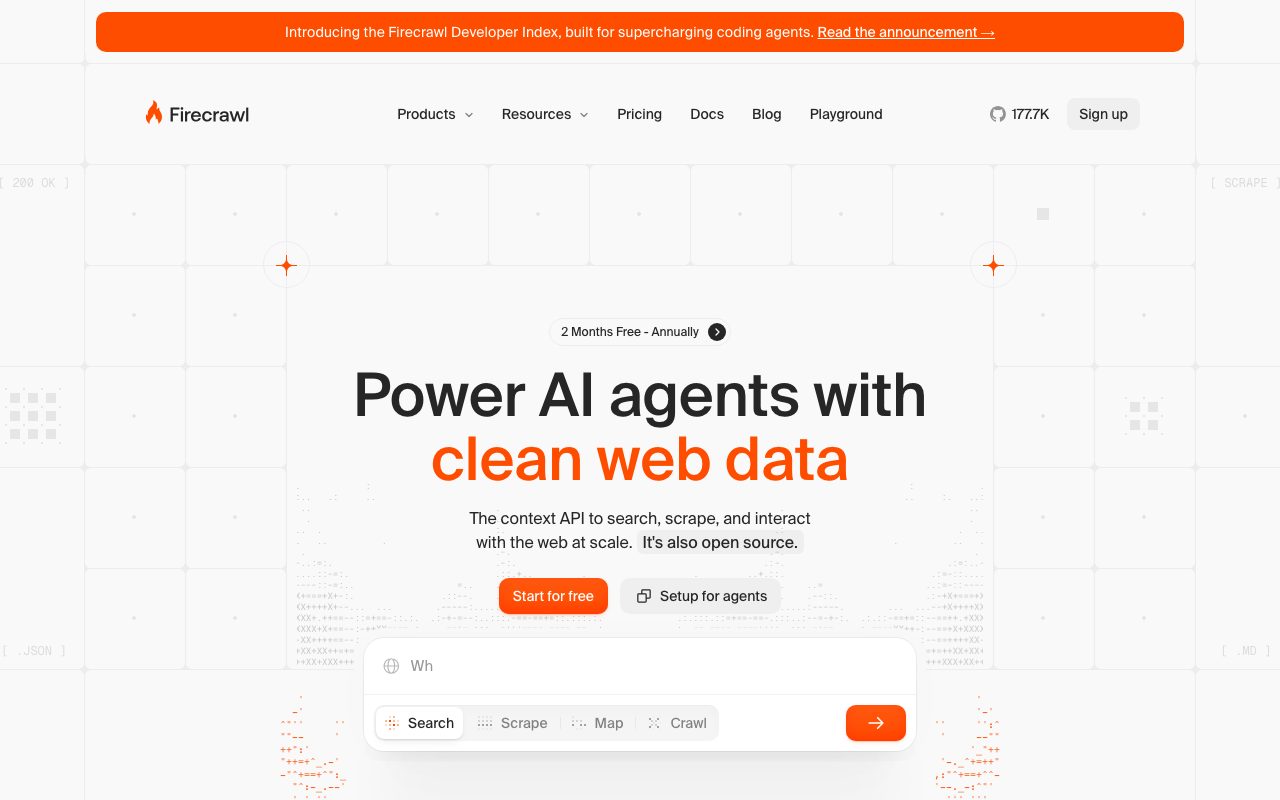
Firecrawl is an open-source web scraping, crawling, and search API that converts dynamic web pages into clean markdown, screenshots, and structured JSON for LLM applications.
Firecrawl is a developer platform designed to turn human-oriented websites into clean, structured context for language models and autonomous agents. Rather than returning bloated raw HTML, Firecrawl strips out navigation, footers, and scripts to output token-efficient markdown, structured JSON matching user schemas, or visual screenshots. The service provides several core endpoints: /scrape extracts single URLs; /search queries the live web and returns search hits pre-populated with full markdown content; /crawl follows links across domains with configurable depth and path rules; /map identifies site URLs; and /interact allows programmatic or prompt-driven browser actions like clicking, typing, and navigating dynamic multi-step flows. JavaScript rendering, proxy rotation, and smart waiting for dynamic single-page applications are handled automatically. Firecrawl is open-source and provides official SDKs in Python, Node.js, Go, Rust, Java, and Elixir, as well as a CLI and Model Context Protocol (MCP) support for direct integration into agentic workflows and coding environments.
Unlike generic scrapers that output raw HTML and require manual parsing, Firecrawl outputs clean markdown optimized for LLM token budgets, extracts data via custom JSON schemas, and offers browser interaction endpoints with native MCP server support.
Product capabilities
Key features
Clean Markdown Extraction
Strips navigation, footers, and ads from web pages to produce token-efficient markdown, reducing input tokens for LLM context windows.
Structured Data via JSON Schema
Extracts structured objects directly from web pages according to user-supplied JSON schemas without requiring separate parsing scripts.
Interactive Browser Actions
Executes clicks, scrolls, form filling, and waiting sequences using AI prompts or code to gather content behind dynamic flows.
Web Search with Pre-Scraped Content
Provides a single /search API call that returns search results alongside full-page markdown, eliminating separate search and scrape cycles.
Automated Crawling and Mapping
Crawls entire sites or sub-paths with custom limits, depth controls, and respect for robots.txt directives for the FirecrawlAgent.
Document and Media Parsing
Parses and extracts content directly from PDF and DOCX files hosted on target URLs into clean text formats.
Agent Onboarding and MCP Support
Includes an official Model Context Protocol (MCP) server, terminal CLI, and automated agent onboarding skills for tools like Cursor, Claude Code, and Windsurf.
Workflow
How Firecrawl works
- Submit a target URL or search query using the Firecrawl API, CLI, or MCP client.
- Firecrawl handles dynamic JavaScript rendering, proxy rotation, and smart waiting automatically.
- Web pages are stripped of boilerplate and formatted into clean markdown, structured JSON, or screenshots.
- Use the /interact endpoint to trigger programmatic actions such as clicks, typing, and navigation.
- Ingest the cleaned, token-efficient output directly into LLM prompts, agent memory, or vector databases.
Practical fit
Who should use Firecrawl?
Retrieval-Augmented Generation (RAG)
Ingest documentation and live web pages as clean markdown into vector databases and knowledge bases for AI chat applications.
AI Coding Agent Research
Equip coding agents in editors like Cursor and Claude Code with the ability to search APIs, read web docs, and scrape code examples.
Competitive Intelligence and Lead Enrichment
Extract structured company profiles, product specifications, and pricing data directly into business workflows.
Deep Research Agents
Automate multi-step research by querying search endpoints, traversing citations, and reading full-page contents autonomously.
Editorial assessment
Pros and limitations
Where it is strong
- Returns LLM-ready markdown and structured JSON rather than raw HTML
- Handles dynamic JavaScript rendering, proxies, and smart wait states automatically
- Offers official SDKs across six languages, a CLI, and direct MCP server integration
- Open-source core with transparent community development on GitHub
- Free plan includes 1,000 monthly credits with no credit card required
Where to be careful
- Requires technical API or developer environment setup rather than a visual no-code interface
- Credit rollover is restricted only to Scale and Enterprise tiers
- Interact sessions and advanced schema extractions consume higher credit multipliers
Commercial context
Firecrawl pricing
At the review date (September 2026), Firecrawl offers a free tier with 1,000 monthly credits. Paid plans start at $16/month (billed annually) for Hobby, $83/month for Standard, $333/month for Growth, and $599/month for Scale, alongside custom Enterprise pricing. Additional usage is charged via $5 pay-as-you-go credit increments. Confirm current rates on the official pricing page.
| Plan | Price | What it includes |
|---|---|---|
| Free | $0 / month-to-month / ongoing free allowance of 1,000 monthly credits with no card required, supporting up to 2 concurrent requests and community support. | |
| Hobby | $16 / month (billed yearly at $16/mo or $19/mo billed monthly), providing 5,000 monthly credits, 5 concurrent requests, and basic support. | |
| Standard | $83 / month (billed yearly at $83/mo or $99/mo billed monthly), providing 100,000 monthly credits, 25 concurrent requests, and standard support. | |
| Growth | $333 / month (billed yearly at $333/mo or $399/mo billed monthly), offering 500,000 monthly credits, 50 concurrent requests, and priority support with Slack access. | |
| Scale | $599 / month (billed yearly at $599/mo or $749/mo billed monthly), offering 1,000,000 monthly credits, 100 concurrent requests, priority support, and one-month credit rollover. | |
| Enterprise | Custom / custom billing period with custom credit volumes, concurrent requests, dedicated SLAs, SSO/SCIM, zero-data retention, and invoiced billing. |
Pricing, limits, taxes, model access, and regional availability can change. Verify the purchase-critical details on the official pricing page linked under Sources.
Transparent ranking
Why Firecrawl scores 77.4
Each factor is scored on a 100-point scale, then combined using the public ToolsRank weights. Engagement and momentum stay at a neutral baseline until measured signals exist, so no tool can gain or lose position from numbers nobody recorded.
Compatibility
Languages, platforms, and integrations
Languages
- Python
- Node.js
- Go
- Rust
- Java
- Elixir
Platforms
- Web API
- CLI
- Docker
Integrations & surfaces
- Cursor
- Claude Code
- Windsurf
- Stripe
- Bugcrowd
- WorkOS
Community
Reviews and questions
No approved member reviews yet. Editorial factors above are the only rating on this page.
Reviews and questions come from Google-signed members and are checked by an editor before they appear.
Frequently asked
Firecrawl FAQ
What is Firecrawl?+
Firecrawl is a context API designed to search, scrape, crawl, and interact with websites at scale. It transforms messy, dynamic web pages into clean, LLM-ready markdown, structured JSON, or screenshots for AI applications.
How does Firecrawl handle JavaScript-heavy websites?+
Firecrawl automatically handles JavaScript rendering and uses smart wait logic to ensure dynamic single-page applications and asynchronously loaded components are fully rendered before content is extracted.
How do API credits work?+
Credits are consumed by endpoint: scraping, crawling, mapping, and monitoring cost 1 credit per page; search costs 2 credits per 10 results; and interact costs 2 credits per browser minute. Failed requests are not charged.
Can Firecrawl extract structured JSON directly?+
Yes. By providing a JSON schema with your scrape request, Firecrawl extracts data that matches your defined schema (such as pricing tables, product details, or contact info) without post-processing.
Is Firecrawl open-source?+
Yes. Firecrawl's core codebase is open-source and hosted on GitHub. In addition to self-hosting, the company provides a managed cloud platform with proprietary proxy rotation, rendering infrastructure, and dashboards.
How can AI agents connect to Firecrawl?+
Firecrawl offers an official MCP (Model Context Protocol) server, a terminal CLI (via npx firecrawl-cli), and dedicated onboarding skills (SKILL.md and auth.md) for automated agent authentication in platforms like Cursor and Claude Code.