
Direct answer
What is Google Agent Development Kit?
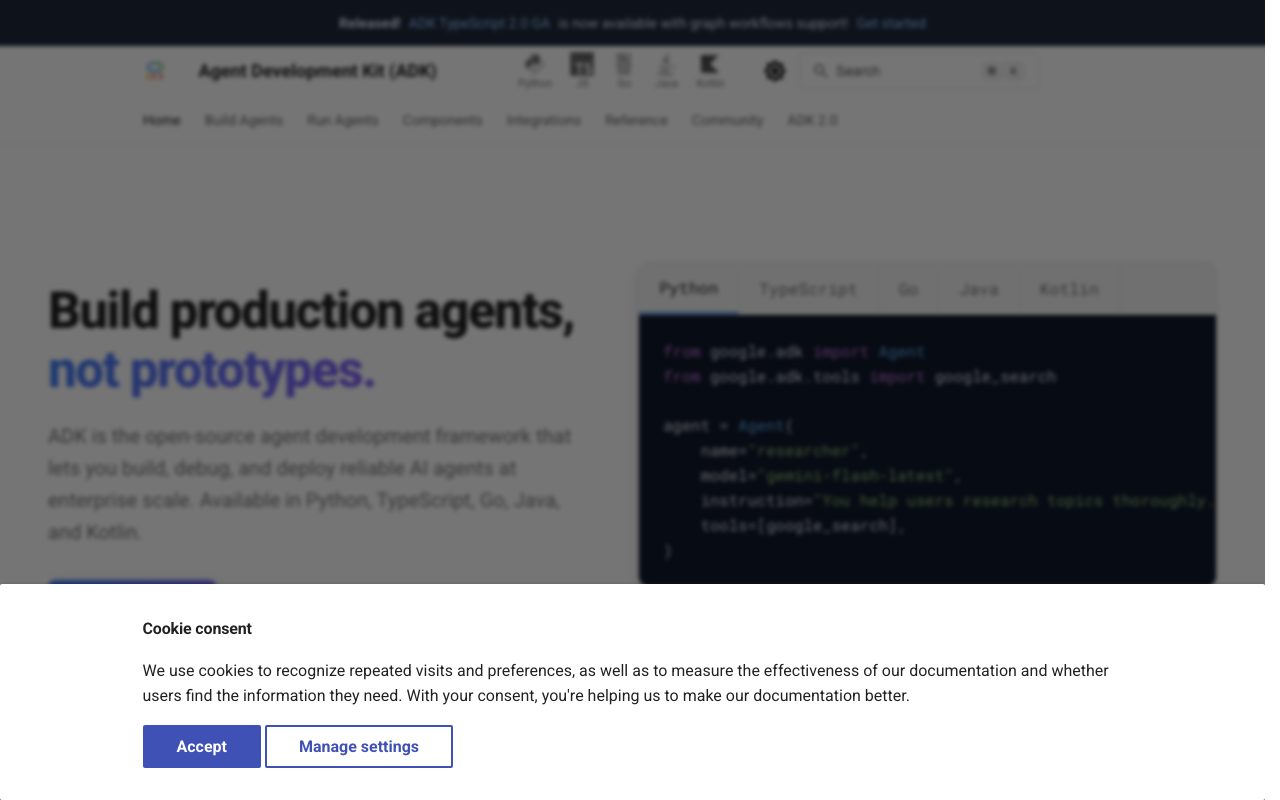
Google Agent Development Kit (ADK) is an open-source framework across Python, TypeScript, Go, Java, and Kotlin for creating, testing, and scaling production AI agents.
Google Agent Development Kit (ADK) is an enterprise-oriented, open-source framework designed to help software engineers transition from conversational prototypes to robust, production-grade agent systems. ADK provides idiomatic SDKs for five major languages: Python, TypeScript, Go, Java, and Kotlin. The framework introduces structured Graph Workflows that blend deterministic execution logic with generative AI reasoning, allowing teams to construct explicit execution paths, data handling mechanisms, dynamic workflows, and human-in-the-loop checkpoints. It natively supports multi-agent patterns, including sequential workflows, loop execution, parallel tasks, agent routing, and collaborative agent teams. ADK is model-agnostic, supporting Google Gemini and Gemma alongside external models including Claude, OpenAI, and self-hosted engines like Ollama, vLLM, LiteLLM, and LiteRT-LM. Context management is structured like source code rather than raw string concatenation: ADK actively filters irrelevant events, summarizes past conversational turns, lazy-loads artifacts, and tracks token consumption. Additionally, ADK features native tool calling via custom functions, OpenAPI specifications, and the Model Context Protocol (MCP), alongside the Agent-to-Agent (A2A) protocol, live multimodal/voice agent runtimes, and one-command deployments to Google Cloud Run and GKE.
ADK delivers first-party SDK support across five programming languages (Python, TypeScript, Go, Java, Kotlin) with built-in graph workflows, native MCP and Agent-to-Agent (A2A) protocols, intelligent token-conserving context compression, and direct Google Cloud Run/GKE deployment pathways.
Product capabilities
Key features
Multi-Language Support
Provides first-class idiomatic libraries for Python, TypeScript, Go, Java, and Kotlin with matching agent abstractions.
Graph Workflows
Orchestrates complex multi-step tasks using structured graph architectures that combine deterministic code execution paths, dynamic routing, and human-in-the-loop input.
Multi-Agent Collaboration
Includes templates for sequential workflows, loop execution, parallel operations, agent routing, and collaborative agent teams.
Advanced Context Management
Treats session state, memory, tool outputs, and artifacts as structured views, automatically filtering obsolete events and summarizing earlier turns to prevent context window overflow.
Tooling and Protocols
Integrates external tools through Python/TS functions, OpenAPI specifications, Model Context Protocol (MCP), and Google Search Grounding.
A2A (Agent-to-Agent) Protocol
Enables standardized exposing and consuming of agent capabilities across distributed systems in Python, Go, Java, and Kotlin.
Live and Voice Agents
Supports real-time conversational agents handling audio and video streams, event-driven sessions, and low-latency interaction.
Agents CLI and Observability
Offers a command-line interface for scaffolding and AI-assisted agent development, alongside logging, metric collection, and Cloud Trace observability.
Workflow
How Google Agent Development Kit works
- Install the ADK package for Python, TypeScript, Go, Java, or Kotlin using standard package managers.
- Define agents by configuring models, system instructions, and tools such as function calling, MCP servers, or Google Search grounding.
- Compose deterministic logic and multi-agent coordination using Graph Workflows, sequential pipelines, loops, or parallel execution templates.
- Test and debug agents locally via the visual builder, web interface, or Agents CLI.
- Deploy containerized agent runtimes locally, on independent infrastructure, or directly to Google Cloud Run and GKE.
Practical fit
Who should use Google Agent Development Kit?
Deterministic Multi-Agent Systems
Structuring complex enterprise workflows where specialized agents coordinate sequentially or in parallel with human validation steps.
Enterprise Cloud Deployment
Running containerized agents at scale on Google Cloud Run or GKE with integrated authentication, tracing, and health monitoring.
Real-Time Voice and Multimodal Applications
Developing bidirectional voice and video agents with streaming sessions, custom tool calling, and live context management.
Cross-Platform Agent Integration
Exposing and consuming modular agent services across diverse technology stacks using the open Agent-to-Agent (A2A) protocol and MCP.
Editorial assessment
Pros and limitations
Where it is strong
- Native SDKs across Python, TypeScript, Go, Java, and Kotlin.
- Completely free and open-source under a permissive software license.
- Graph workflows provide structured execution paths with human intervention support.
- Sophisticated context and session management with rewind capabilities and compression.
- Extensive protocol compatibility including Model Context Protocol (MCP) and A2A.
Where to be careful
- Requires programming experience and developer environment configuration.
- Hosted infrastructure and model inference costs must be managed independently.
Commercial context
Google Agent Development Kit pricing
At the review date of 2026-09-08, Google Agent Development Kit is open-source software provided free of charge under a permissive license. Infrastructure hosting on Google Cloud Run, GKE, or model inference API calls (via Gemini, OpenAI, Claude, or self-hosted servers) incur separate infrastructure or provider costs.
Pricing, limits, taxes, model access, and regional availability can change. Verify the purchase-critical details on the official pricing page linked under Sources.
Transparent ranking
Why Google Agent Development Kit scores 79.8
Each factor is scored on a 100-point scale, then combined using the public ToolsRank weights. Engagement and momentum stay at a neutral baseline until measured signals exist, so no tool can gain or lose position from numbers nobody recorded.
Compatibility
Languages, platforms, and integrations
Languages
- Python
- TypeScript
- Go
- Java
- Kotlin
Platforms
- Web
- Self-Hosted
- Linux
- macOS
- Windows
Integrations & surfaces
- Google Cloud Run
- Google Kubernetes Engine (GKE)
- Gemini
- Gemma
- Claude
- OpenAI
- Ollama
- vLLM
- LiteLLM
- Apigee AI Gateway
- Google Search
Community
Reviews and questions
No approved member reviews yet. Editorial factors above are the only rating on this page.
Reviews and questions come from Google-signed members and are checked by an editor before they appear.
Frequently asked
Google Agent Development Kit FAQ
Is Google Agent Development Kit free to use?+
Yes. The Agent Development Kit is open-source software provided free of charge under a permissive license. However, any underlying language model API usage (such as Gemini, Claude, or OpenAI) or cloud hosting resources (such as Google Cloud Run or GKE) will incur costs according to your provider.
What programming languages are supported by ADK?+
ADK officially supports five programming languages: Python, TypeScript (JavaScript), Go, Java, and Kotlin.
Which AI models can be used with ADK?+
ADK works with virtually any generative AI model. It provides direct access to Google Gemini and Gemma, and supports adapters for external models including Claude, OpenAI, and local or self-hosted endpoints via Ollama, vLLM, LiteLLM, LiteRT-LM, and Apigee AI Gateway.
How does ADK handle context management?+
ADK structures context rather than concatenating text strings. It manages sessions, memory, tool outputs, and artifacts while automatically filtering irrelevant events, summarizing older conversation turns, lazy-loading artifacts, and tracking token counts to optimize efficiency and prevent context window overflow.
Can I build voice agents with ADK?+
Yes. ADK contains dedicated modules for building live and voice agents, including workflows for streaming audio and video, session handling, custom server creation, and real-time evaluation.
Where can ADK agents be deployed?+
ADK agents can be containerized and run on any infrastructure, or deployed using one-command workflows to Google Cloud services such as Cloud Run and Google Kubernetes Engine (GKE), inheriting built-in authentication and Cloud Trace observability.


