Direct answer
What is H2O.ai?
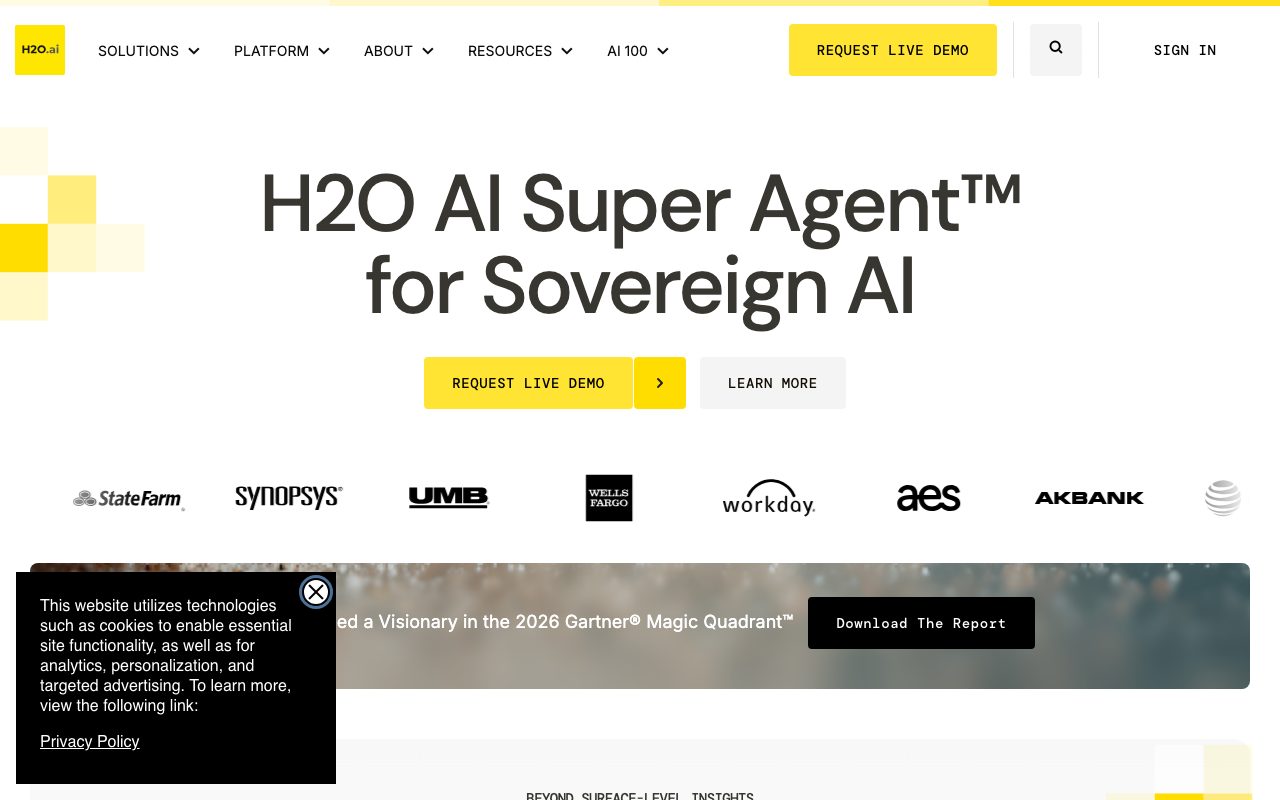
H2O.ai delivers a unified suite of predictive machine learning, automated feature engineering, and generative AI agents designed for secure, sovereign, and air-gapped enterprise environments.
H2O.ai is an enterprise artificial intelligence vendor that combines classical predictive machine learning with modern generative AI architectures. Its portfolio spans fully open-source software and commercial enterprise platforms. At its predictive core, H2O Driverless AI provides automated machine learning (AutoML) with automated feature engineering, model interpretability, and tabular data forecasting, while the open-source H2O-3 platform enables distributed, in-memory machine learning via Python and R interfaces. For generative AI workloads, H2O.ai offers h2oGPTe and H2O Enterprise LLM Studio. These platforms allow enterprises to deploy retrieval-augmented generation (RAG), fine-tune small and large language models without code, and run autonomous domain-specific agents. H2O also produces open-weight models, including the Danube3 small language model series and H2OVL Mississippi for document AI and optical character recognition. Designed specifically for highly regulated sectors such as banking, healthcare, and the public sector, H2O.ai supports multi-cloud VPC, on-premises, and air-gapped deployments. The system includes lifecycle management tools like H2O MLOps, H2O Feature Store, and H2O Wave—an open-source framework for assembling AI dashboards and applications in Python. Model risk management, governance, and evaluation tools (such as H2O Eval Studio and MRM) provide automated auditing and monitoring to support enterprise compliance standards.
Unlike cloud-dependent analytics services, H2O.ai converges automated tabular machine learning with generative language models that can run entirely on-premises, within private VPCs, or in fully air-gapped environments without exfiltrating customer training data.
Product capabilities
Key features
H2O Driverless AI
Automated machine learning engine that automates feature engineering, model selection, tuning, visualization, and machine learning interpretability.
h2oGPTe Enterprise Agent Platform
Enterprise generative AI system with multi-model support, cost controls, task automation, and integration into existing business applications.
H2O-3 Distributed ML
Apache-licensed, distributed in-memory machine learning platform accessible through Python, R, Scala, Spark, and web-based user interfaces.
H2O LLM Studio
No-code graphical interface for fine-tuning, evaluating, and distilling small language models (SLMs) and large language models on private datasets.
tabH2O Tabular Foundation Model
Predictive foundation model for tabular data that accepts CSV inputs and returns predictions without dedicated infrastructure setup or model training.
H2O Wave
Open-source low-code application framework for developing real-time AI dashboards and web applications directly in Python.
H2O MLOps and Feature Store
Enterprise infrastructure for tracking feature pipelines, managing model lifecycles, and monitoring models in production.
Air-Gapped and Sovereign Deployment
Support for fully offline, on-premises, FedRAMP, and private cloud VPC environments with strict controls against data exfiltration.
Practical fit
Who should use H2O.ai?
Fraud Detection and Anti-Scam Automation
Training predictive scoring and real-time inference models to detect fraudulent transactions and scam activity in banking workflows.
Call Center Operations and Document Search
Deploying conversational AI assistants and document search within secure environments to automate policy retrieval and support ticket routing.
Tabular Demand Forecasting and Risk Modeling
Using Driverless AI to automatically engineer features and train explainable regression models for churn, demand forecasting, and credit risk.
Private Fine-Tuning of Small Language Models
Distilling and adapting open-weight language models like Danube3 on proprietary data without leaking intellectual property.
Editorial assessment
Pros and limitations
Where it is strong
- Comprehensive coverage spanning open-source libraries (H2O-3, Wave) to enterprise platforms (Driverless AI, h2oGPTe)
- Strong support for on-premises, private VPC, and air-gapped deployments in compliance-heavy industries
- Automated feature engineering and model interpretability tools built into predictive workflows
- Clear contractual data isolation policy stating customer data is not used to train shared AI models
Where to be careful
- Enterprise platforms lack transparent self-serve public pricing and require custom enterprise sales engagements
- Complex multi-product architecture can present a steep learning curve for smaller data teams
Commercial context
H2O.ai pricing
As of September 2026, H2O.ai provides open-source frameworks like H2O-3, H2O Wave, and Danube3 under Apache 2.0 licensing, while enterprise commercial platforms (including H2O Driverless AI, h2oGPTe, and H2O AI Cloud) require contacting sales for a custom quote or demonstration.
Pricing, limits, taxes, model access, and regional availability can change. Verify the purchase-critical details on the official pricing page linked under Sources.
Transparent ranking
Why H2O.ai scores 75.5
Each factor is scored on a 100-point scale, then combined using the public ToolsRank weights. Engagement and momentum stay at a neutral baseline until measured signals exist, so no tool can gain or lose position from numbers nobody recorded.
Compatibility
Languages, platforms, and integrations
Languages
- English
Integrations & surfaces
- Python
- R
- Apache Spark
- Hadoop
- Kubernetes
- Google Drive
- Microsoft SharePoint
- Slack
- Microsoft Teams
Community
Reviews and questions
No approved member reviews yet. Editorial factors above are the only rating on this page.
Reviews and questions come from Google-signed members and are checked by an editor before they appear.
Frequently asked
H2O.ai FAQ
Does H2O.ai offer open-source software?+
Yes. H2O.ai provides several Apache 2.0-licensed open-source components, including H2O-3 (a distributed machine learning platform for Python and R), H2O Wave (a Python application framework), Sparkling Water (Spark integration), and open-weight models such as Danube3.
Can H2O.ai platforms run in air-gapped environments?+
Yes. H2O.ai enterprise solutions, including h2oGPTe and H2O Driverless AI, are explicitly architected for deployment on-premises, in private cloud VPCs, and in air-gapped environments where external internet connectivity is restricted.
Does H2O.ai train foundation models on customer data?+
No. According to H2O.ai's privacy documentation, customer-provided input data, metadata, and model data are not used to train H2O.ai AI models unless explicitly agreed upon in writing by the customer.
What is the difference between H2O-3 and H2O Driverless AI?+
H2O-3 is a free, open-source distributed machine learning library requiring manual or semi-automated coding in Python, R, or Scala. H2O Driverless AI is a commercial enterprise AutoML platform that automates feature engineering, model selection, tuning, explainability visualizations, and documentation.
What programming languages are supported by H2O.ai?+
The platform primarily supports Python and R, with native API clients, code samples, and tutorials available for both. Scala is also supported through Sparkling Water integrations.