
Direct answer
What is Kiro?
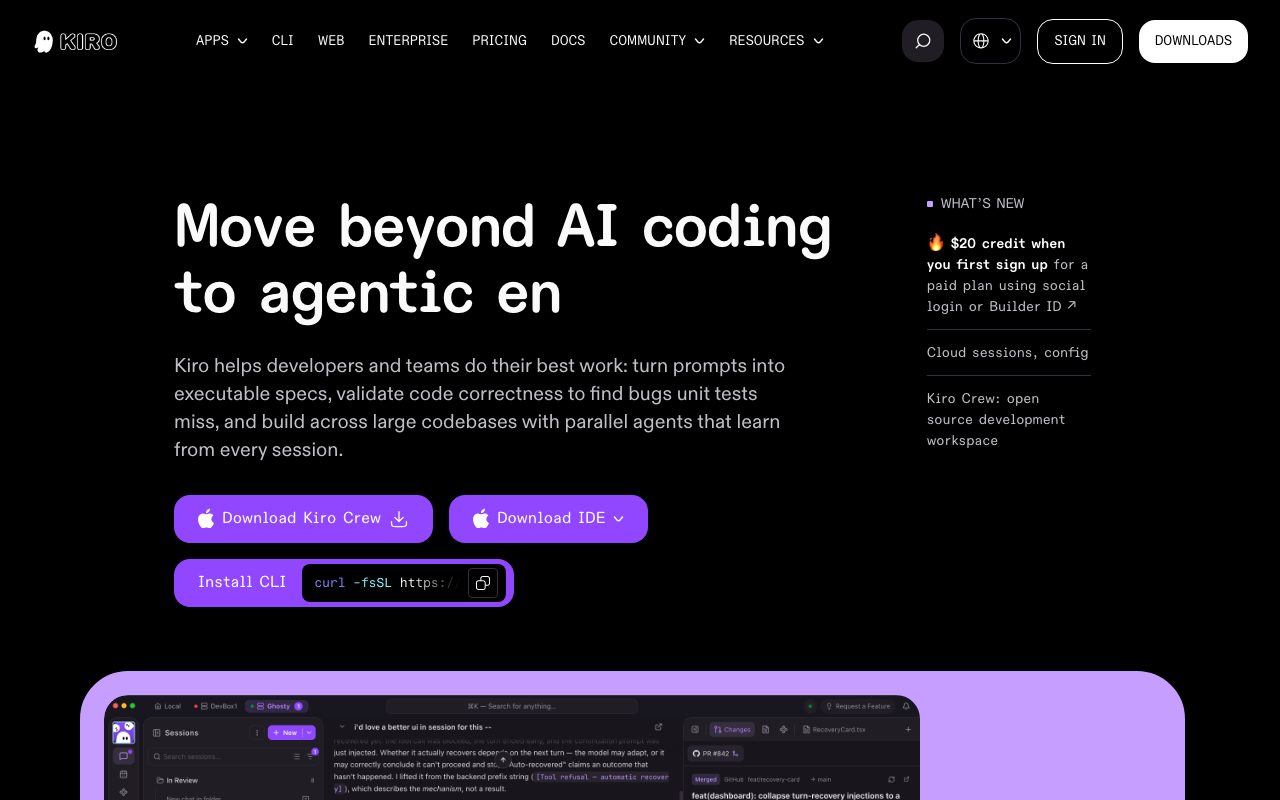
Kiro is an agentic engineering platform built and operated by AWS that turns prompts into structured specifications, runs parallel sub-agents across codebases, and verifies correctness with property-based testing.
Kiro is an agentic development tool designed to move beyond traditional conversational coding assistants by applying spec-driven development. Built and operated by AWS, it operates across four primary interfaces: an IDE based on Code OSS, a headless command-line interface, a browser-based web interface with isolated cloud sandboxes, and an open-source local workspace known as Kiro Crew. Rather than writing raw code directly from casual chat prompts, Kiro turns developer prompts into formal requirements (requirements.md), architectural and design specifications (design.md), and sequenced execution tasks (tasks.md). Implementation is driven by autonomous parallel agents and sub-agents that run concurrently in waves, adhering to directed acyclic graph (DAG) dependency orders. To ensure implementation code matches stated requirements, Kiro includes automated requirement analysis to identify gaps and contradictions, alongside property-based testing (generative fuzz testing) that validates invariant rules across random inputs rather than relying solely on example-based unit tests. The system supports major development models including Anthropic Claude and open-weight models via an Auto selector, and integrates with standard development tooling using the Agent Client Protocol (ACP), Model Context Protocol (MCP), and Open VSX extensions.
Unlike conversational code assistants that generate code directly from unstructured prompts, Kiro mandates formal spec artifacts (requirements, system design, and tasks), verifies logic with property-based fuzz testing, and runs parallel sub-agents in coordinated dependency waves.
Product capabilities
Key features
Spec-Driven Development
Transforms prompts into three structured markdown artifacts: requirements.md (user stories and acceptance criteria), design.md (technical architecture and sequence diagrams), and tasks.md (sequenced implementation tasks).
Property-Based Correctness Testing
Translates requirement invariants into property-based tests that generate hundreds of random inputs to expose edge cases that traditional example-based unit tests miss, with automated counter-example shrinking.
Parallel Sub-Agent Execution
Orchestrates sub-agents with isolated context windows, tools, and permissions to work simultaneously on task dependency graphs (DAGs) in sequential execution waves.
Multi-Surface Interfaces
Runs locally in an Open VSX-compatible IDE based on Code OSS, in terminals via the Kiro CLI, inside headless CI/CD workflows, in an open-source local workspace called Kiro Crew, and inside cloud web sandboxes.
Open Standards & Tooling Interoperability
Supports the Agent Client Protocol (ACP), Model Context Protocol (MCP), AGENTS.md, Skills.md, and imports VS Code settings and keybindings.
Enterprise Security and Administration
Operated by AWS with IAM and SSO authentication, IP indemnity, usage monitoring dashboards, AWS PrivateLink VPC endpoints, and governance policies.
Practical fit
Who should use Kiro?
Feature Implementation with Upfront Design
Draft feature requirements and architectural designs, review the generated implementation plan, and execute tasks across services concurrently.
Regression Prevention and Bug Fixing
Use Bugfix Specs to isolate current versus expected behavior, discover root causes, and run property-based tests to confirm fixes without breaking existing contracts.
Multi-File Codebase Refactoring
Delegate parallel refactoring assignments to isolated sub-agents that update services, middleware, and configuration files at the same time.
Headless PR Review and CI/CD Automation
Run the headless CLI in continuous integration environments to review pull requests, check requirement alignment, and correct bugs without opening an IDE.
Editorial assessment
Pros and limitations
Where it is strong
- Enforces clear documentation through requirements, architecture, and task files before code generation.
- Property-based testing surfaces subtle boundary bugs and automatically shrinks failures to minimal reproducing cases.
- Sub-agents operate in isolated contexts in parallel, accelerating large-scale tasks across repositories.
Where to be careful
- Property-based correctness testing is currently restricted to the local IDE and not yet available on web, CLI, or mobile interfaces.
- Upfront spec workflows introduce process overhead that may feel heavy for trivial one-line edits or quick experimentation.
- Full pricing breakdowns by credit tier are not displayed directly on the top-level product overview pages.
Commercial context
Kiro pricing
At the review date of 2026-09-08, the vendor operates a credit-based pricing model with no daily or weekly rate limits and pre-paid overages, accompanied by a $20 credit promotion on paid plan sign-ups. Kiro Crew is an open-source development workspace available for free. Specific tier costs and credit unit rates are not detailed on the reviewed overview pages and should be verified on the official pricing page.
Pricing, limits, taxes, model access, and regional availability can change. Verify the purchase-critical details on the official pricing page linked under Sources.
Transparent ranking
Why Kiro scores 73.3
Each factor is scored on a 100-point scale, then combined using the public ToolsRank weights. Engagement and momentum stay at a neutral baseline until measured signals exist, so no tool can gain or lose position from numbers nobody recorded.
Compatibility
Languages, platforms, and integrations
Languages
- Python
- TypeScript
- JavaScript
- Go
- Rust
- Java
Platforms
- macOS
- Linux
- Windows
- Web
- CLI
Integrations & surfaces
- GitHub
- GitLab
- AWS IAM
- Terraform
- Figma
- VS Code
Community
Reviews and questions
No approved member reviews yet. Editorial factors above are the only rating on this page.
Reviews and questions come from Google-signed members and are checked by an editor before they appear.
Frequently asked
Kiro FAQ
What is spec-driven development in Kiro?+
Spec-driven development is an engineering workflow where Kiro collaborates with you to generate explicit requirements (requirements.md), system architecture and sequence diagrams (design.md), and an actionable task list (tasks.md) before implementing code. This captures architectural decisions and allows agents to execute complex tasks with higher reliability.
How does Kiro's property-based testing differ from standard unit tests?+
Traditional unit tests evaluate specific concrete input examples. Kiro's property-based testing extracts invariant rules from your requirements and generates hundreds or thousands of randomized inputs to find edge cases. When a violation occurs, Kiro applies test shrinking to reduce the failing test case to its smallest reproducible input.
Do I need an AWS account to use Kiro?+
No. Although Kiro is built and operated by AWS, you do not need an AWS account. Developers can authenticate using GitHub, Google, or AWS Builder ID in addition to AWS IAM Identity Center.
How do sub-agents work in Kiro?+
The main agent can break tasks into directed acyclic graphs (DAGs) and spawn sub-agents with isolated conversation histories, context windows, and permissions. Independent sub-agent tasks run concurrently in waves, returning their completed outputs to the main orchestrator agent.
What is Kiro Crew?+
Kiro Crew is an open-source development workspace that runs on your local machine and operates continuously across sessions. It coordinates tools and workflows and can be downloaded freely from GitHub.