Direct answer
What is Langflow?
Langflow is a low-code canvas for designing, testing, and deploying multi-agent architectures and retrieval-augmented generation (RAG) pipelines with full Python customization.
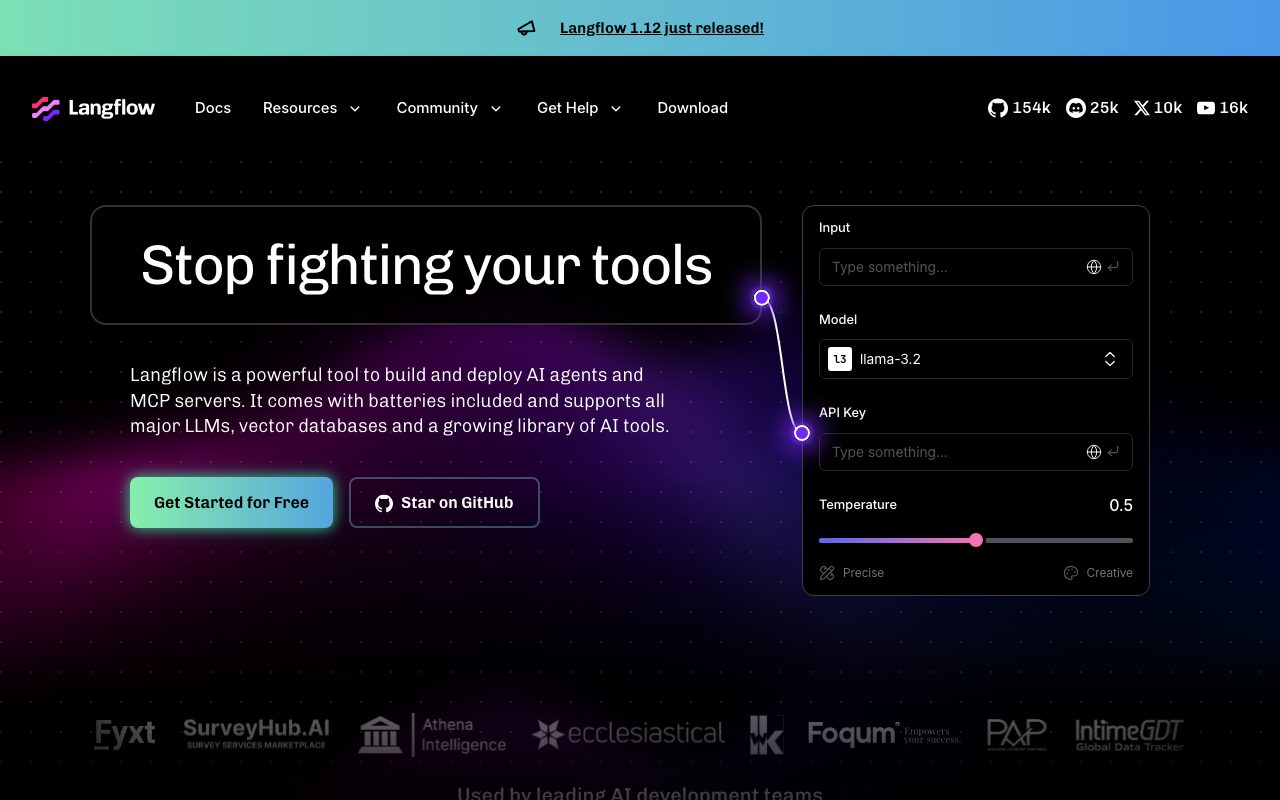
Langflow provides a visual environment for creating AI agents, MCP servers, and complex retrieval-augmented generation (RAG) pipelines. Developers can wire together language models, vector databases, custom tools, and control logic using a drag-and-drop canvas while retaining access to underlying Python code for fine-grained modifications. The platform supports a fleet of agents capable of using visual flow components as callable tools, and it enables exposing any finished flow as a consumable API. Langflow can be self-hosted via its open-source repository or deployed through a managed cloud environment.
Unlike closed-box builder tools, Langflow exposes full Python code under every component and allows developers to convert entire visual flows into callable APIs or MCP servers.
Product capabilities
Key features
Visual Flow Canvas
Drag-and-drop builder with visual state flows, modular blocks, and real-time execution controls for rapid iteration.
Code Extensibility with Python
Inspect and modify the underlying Python logic for custom components, transformations, and complex branching.
Multi-Agent Support
Orchestrate single agents or collaborative fleets that can call visual flow components as execution tools.
Flow as an API
Instantly convert authored visual workflows into production-ready API endpoints for external applications.
MCP Server Architecture
Build and deploy Model Context Protocol (MCP) servers alongside standard AI workflows.
Hybrid Deployment Options
Run the platform locally via open source or deploy projects to an enterprise-grade cloud environment.
Workflow
How Langflow works
- Choose from pre-built templates or drop LLM, prompt, and vector store blocks onto the canvas.
- Connect blocks visually to define data flow, tool access, and agent reasoning loops.
- Customize underlying Python functions directly inside component blocks if needed.
- Expose the completed flow as an API endpoint or MCP server for integration into your applications.
Practical fit
Who should use Langflow?
Agentic RAG Pipelines
Connect vector stores, embeddings, and foundation models visually to retrieve and synthesize document context.
Multi-Agent Tool Orchestration
Design autonomous agent swarms equipped with search tools, internal APIs, and custom Python execution blocks.
API Backend for AI Features
Prototype workflows in a graphical canvas and serve them directly into production applications via REST endpoints.
Editorial assessment
Pros and limitations
Where it is strong
- Open-source core allows self-hosting on local hardware or private cloud
- Exposes underlying Python scripts for custom component engineering
- Broad ecosystem integrations across leading vector databases and foundation models
- Converts authored flows directly into executable API endpoints
Where to be careful
- Requires understanding of AI architecture concepts like vector stores and token parameters
- Complex production monitoring and SLA pricing require contacting the vendor
Commercial context
Langflow pricing
As of September 2026, Langflow offers open-source self-hosting and a free cloud account option, alongside paid Professional Services and Premier Support. Specific commercial tier pricing is not published on the main page, so check the official website for current terms.
Pricing, limits, taxes, model access, and regional availability can change. Verify the purchase-critical details on the official pricing page linked under Sources.
Transparent ranking
Why Langflow scores 78.9
Each factor is scored on a 100-point scale, then combined using the public ToolsRank weights. Engagement and momentum stay at a neutral baseline until measured signals exist, so no tool can gain or lose position from numbers nobody recorded.
Compatibility
Languages, platforms, and integrations
Languages
- en
Platforms
- Web
- Self-Hosted
Integrations & surfaces
- OpenAI
- Anthropic
- LangChain
- Crew AI
- Ollama
- Groq
- Milvus
- Qdrant
- Pinecone
- Weaviate
- MongoDB
- Notion
Community
Reviews and questions
No approved member reviews yet. Editorial factors above are the only rating on this page.
Reviews and questions come from Google-signed members and are checked by an editor before they appear.
Frequently asked
Langflow FAQ
Can I use Langflow without writing code?+
Yes. Basic and intermediate flows can be constructed using pre-built components and drag-and-drop connectors. However, maximizing the platform often involves inspecting or editing Python logic within custom components.
Is Langflow open source?+
Yes. Langflow maintains an open-source repository on GitHub that can be installed locally or self-hosted in your own infrastructure.
How do I deploy a Langflow pipeline to production?+
Langflow allows you to expose flows as API endpoints. You can run them on your own self-hosted servers or utilize the managed cloud platform.
Which foundation models and vector databases are supported?+
Langflow integrates with major LLM providers including OpenAI, Anthropic, Meta, Mistral, and Groq, as well as vector stores such as Pinecone, Milvus, Weaviate, Qdrant, and Cassandra.
Record history
What changed in this dossier
- Sep 8, 2026 — Documented Langflow 1.12 release features, including agent fleets and MCP server generation.