
Direct answer
What is Mastra?
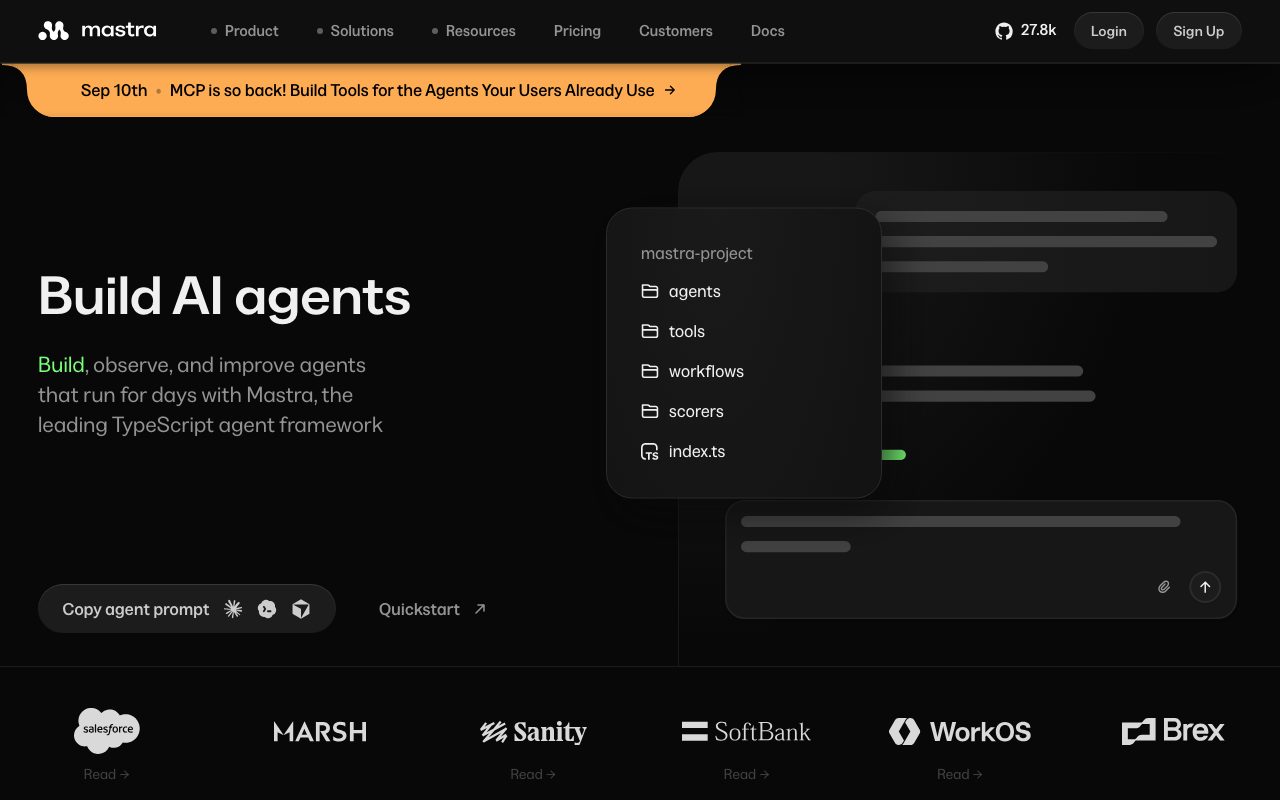
Mastra is a TypeScript framework for building AI agents and workflows with built-in memory, evaluation, and observability.
Mastra is an open-source development framework designed for engineering AI agents and autonomous workflows natively in TypeScript. Rather than relying on Python runtimes, it integrates directly into existing Node.js, Next.js, React, and Hono environments. The framework provides typed primitives for configuring agents, binding external tools via Zod validation schemas, and chaining graph-based deterministic workflows using methods like .then(), .branch(), and .parallel(). Mastra also includes working and observational memory to maintain conversational state across sessions, support for authoring Model Context Protocol (MCP) servers, and built-in tracing, metrics, and automated evals to debug and measure production performance.
Unlike Python-centric agent libraries or visual no-code builders, Mastra is purpose-built for TypeScript developers with type-safe agent definitions, graph-based workflow execution, local testing via Mastra Studio, and direct embedding into web stacks.
Product capabilities
Key features
Typed Agent Definitions
Define agents with explicit system instructions, runtime parameters, and model references using Mastra's unified provider/model interface.
Graph-Based Workflows
Compose multi-step agent processes with execution control using .then(), .branch(), and .parallel() constructs, complete with human-in-the-loop pauses.
Zod-Validated Tooling
Register custom tools using createTool() with strict Zod schema validation for inputs and outputs alongside execution context.
Observational & Semantic Memory
Persist conversation state and application context across sessions with thread-aware working memory and semantic recall.
Model Context Protocol (MCP) Support
Author MCP servers to expose agents, tools, and structured resources to external tools and protocol-compatible clients.
Mastra Studio & Local Dev Server
Run an interactive local UI at port 4111 to test, inspect, and iterate on agents, workflows, and tools before deployment.
Integrated Observability & Evals
Trace model calls, tool executions, and latency metrics while running rule-based, statistical, or model-graded evaluation scorers.
Workflow
How Mastra works
- Install Mastra dependencies and initialise a new project via CLI using npm create mastra@latest.
- Define typed tools with createTool(), validating inputs and outputs through Zod schemas.
- Create agents by specifying system instructions, provider/model identifiers, and assigned tools.
- Chain complex multi-step tasks into executable graphs using createWorkflow() with branching and suspension support.
- Test agents and workflows locally using Mastra Studio UI at http://localhost:4111.
- Deploy agents as standalone endpoints or integrate them into existing Node.js, Next.js, or cloud infrastructure.
Practical fit
Who should use Mastra?
Internal Slack & Operations Bots
Build internal copilots and automated agents that triage issues, query databases, or execute workflows inside workplace messaging apps.
In-Product Customer Support
Embed conversational agents directly into SaaS applications to resolve user inquiries and trigger authenticated product actions.
Developer Platform & DevOps Automations
Create automated engineering agents for reviewing pull requests, inspecting logs, running sandboxed tasks, and on-call automation.
Data Analysis & Natural-Language Querying
Connect agents to SQL databases, CSV files, or external APIs to return formatted reports and answers to end users.
Editorial assessment
Pros and limitations
Where it is strong
- Native TypeScript implementation with end-to-end type safety and Zod schema support
- Open-source core under the Apache 2.0 license with self-hosting options
- Comprehensive primitives for agents, graph workflows, memory, and observability in one library
- Connects to over 90 AI model providers through a unified routing interface without SDK bloat
- Local debugging and development UI provided out of the box via Mastra Studio
Where to be careful
- Requires professional software engineering experience; not suited for no-code builders
- TypeScript-only architecture offers no native support for teams operating exclusively in Python
- Managed cloud tier introduces volume-based overages on observability events and compute hours
Commercial context
Mastra pricing
As of September 2026, Mastra's core library is open source under Apache 2.0. The managed Mastra Platform offers a free Starter tier (100K observability events, 24 CPU hours), a Teams plan at $250 per month, and custom Enterprise pricing for cloud and self-hosted deployments. Users should verify current tiers and overage rates on the official pricing page.
| Plan | Price | What it includes |
|---|---|---|
| Self-Hosted Open Source | $0 / per month / self-hosted under Apache 2.0 license | |
| Platform Starter | $0 / per month / includes 100K observability events and 24 CPU hours | |
| Platform Teams | $250 / per month / includes 1M observability events, 250 CPU hours, and 6 months retention | |
| Platform Enterprise | Custom / annual / custom retention, RBAC, audit logs, and dedicated SLA |
Pricing, limits, taxes, model access, and regional availability can change. Verify the purchase-critical details on the official pricing page linked under Sources.
Transparent ranking
Why Mastra scores 75.2
Each factor is scored on a 100-point scale, then combined using the public ToolsRank weights. Engagement and momentum stay at a neutral baseline until measured signals exist, so no tool can gain or lose position from numbers nobody recorded.
Compatibility
Languages, platforms, and integrations
Languages
- TypeScript
- JavaScript
Platforms
- Web
- Node.js
- Self-Hosted
Integrations & surfaces
- OpenAI
- Anthropic
- Google Gemini
- xAI
- Next.js
- React
- Hono
- Express
- Fastify
- PostgreSQL
- LibSQL
- Slack
Community
Reviews and questions
No approved member reviews yet. Editorial factors above are the only rating on this page.
Reviews and questions come from Google-signed members and are checked by an editor before they appear.
Frequently asked
Mastra FAQ
What is Mastra?+
Mastra is an open-source TypeScript framework for building AI applications and autonomous agents. It provides typed agents, graph-based workflows, memory, workspaces, and observability tooling, allowing developers to embed AI capabilities into frontend and backend applications or run standalone services.
Is Mastra an agent builder or a code framework?+
Mastra is a code-first TypeScript framework rather than a visual no-code builder. Developers define agents, configure tools, and write multi-step execution graphs directly in code using Node.js or TypeScript.
Which AI models does Mastra support?+
Mastra features a built-in model router supporting over 90 providers via a standard provider/model string format (such as openai/gpt-5.6-sol, anthropic/claude-sonnet-4-6, and google/gemini-2.5-flash), automatically utilizing environment variables for authentication.
How are Mastra applications deployed?+
Mastra apps can run on any Node.js-compatible environment, be integrated into frameworks like Next.js, Express, or Hono, or deployed via automated deployers for platforms such as Vercel, Netlify, and Cloudflare. Teams can also use the managed Mastra Cloud platform.
Is Mastra open source?+
Yes, Mastra's core framework is open-source software published under the Apache 2.0 license. Advanced enterprise features and managed platform capabilities are licensed under enterprise terms.
Record history
What changed in this dossier
- Sep 7, 2026 — Added remote filesystem support for Mastra agents.
- Sep 3, 2026 — Introduced sandbox lifecycle controls including persistence and background processes.
- Sep 2, 2026 — Added sandbox computer use capabilities.
- Sep 1, 2026 — Launched harness channels supporting Slack, WhatsApp, iMessage, and Discord.