Direct answer
What is OpenAI Agents SDK?
OpenAI Agents SDK is an open-source Python library for building multi-agent systems using core primitives like Agents, Handoffs, and Guardrails, with built-in sandbox execution and realtime voice support.
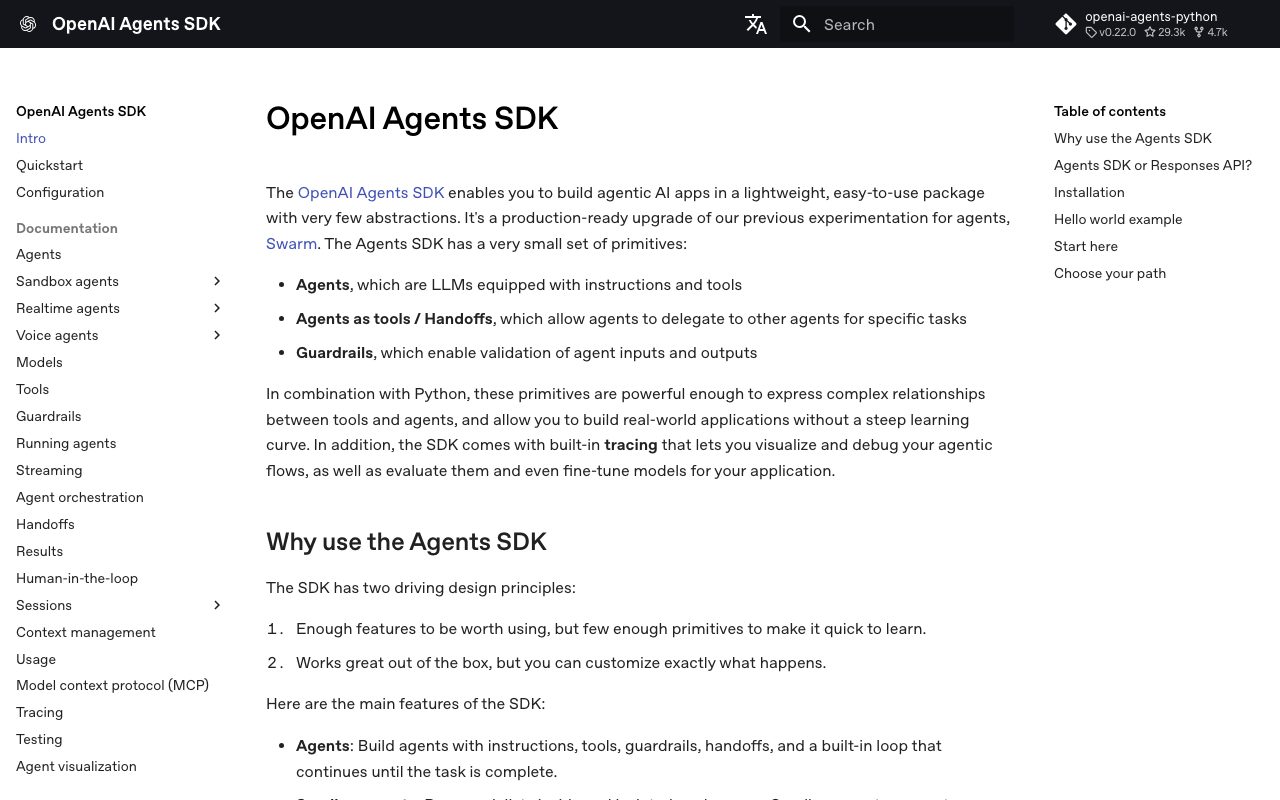
The OpenAI Agents SDK is an open-source, production-ready framework developed as an upgrade to OpenAI's experimental Swarm project. Built with minimal abstractions, it provides a Python-first approach to building multi-agent workflows without requiring specialized orchestration syntax. The framework revolves around three primary primitives: Agents (language models equipped with instructions and tools), Handoffs (delegation mechanisms that allow agents to call other agents as tools), and Guardrails (concurrent validation logic for inputs and outputs). Developers orchestrate agents using standard Python control structures, retaining control over runtime loops, intermediate states, and execution paths. Beyond basic text agents, the SDK includes native support for Sandbox agents capable of running tasks inside isolated environments (such as Docker or local Unix sandboxes) with manifest-defined workspaces and resumable sessions. It also provides dedicated modules for Realtime agents using gpt-realtime-2.1 with interruption handling, and modular voice pipelines combining speech-to-text, agent execution, and text-to-speech. Built-in session state adapters support backends like SQLite, SQLAlchemy, Redis, and MongoDB, alongside Model Context Protocol (MCP) tool integration and native tracing for debugging and evaluation.
Unlike monolithic orchestration frameworks, the Agents SDK focuses on minimal primitives—Agents, Handoffs, and Guardrails—relying on standard Python control flow while offering native support for sandboxed workspaces, MCP tools, and realtime voice models.
Product capabilities
Key features
Minimal Core Primitives
Structures workflows around three simple concepts: Agents (instructions and tools), Handoffs (agent-to-agent delegation), and Guardrails (parallel safety and input/output checks).
Sandbox Agents
Executes coding or document tasks in isolated environments using Docker or local sandboxes, supporting manifest-defined files, skills, and resumable sessions.
Realtime & Voice Pipelines
Builds speech agents using gpt-realtime-2.1 with automatic interruption detection, or modular voice pipelines combining speech-to-text, agent logic, and text-to-speech.
Function Tools & MCP Support
Turns standard Python functions into tools with Pydantic-powered schema generation, and exposes remote Model Context Protocol (MCP) tools to agents directly.
Persistent Session Storage
Manages conversational and stateful working context across turns using interchangeable session backends including SQLAlchemy, SQLite, Redis, MongoDB, and Dapr.
Built-in Tracing & Human-in-the-Loop
Provides native instrumentation to inspect, debug, and monitor workflows, with integrated hooks for human approval and integration with OpenAI evaluation tooling.
Practical fit
Who should use OpenAI Agents SDK?
Multi-Agent Task Delegation
Route incoming customer or system requests through a triage agent that delegates specialized subtasks to domain-specific agents via handoffs.
Sandboxed Code Execution
Run coding agents in Docker or local sandbox environments to edit files, inspect repositories, and execute commands safely.
Low-Latency Realtime Voice Bots
Deploy conversational voice assistants utilizing gpt-realtime-2.1 with automatic speech interruption handling and context management.
Remote Tool Integration via MCP
Expose internal tools and external systems to agents using standardized Model Context Protocol (MCP) server connectors alongside native Python functions.
Editorial assessment
Pros and limitations
Where it is strong
- Lightweight design with few abstractions, using standard Python control flow rather than complex custom DAGs.
- Native support for sandboxed workspaces, Docker execution, and resumable agent sessions.
- Built-in support for Realtime agents (gpt-realtime-2.1) and voice STT/TTS pipelines.
- Native Model Context Protocol (MCP) integration for connecting remote tools.
Where to be careful
- Requires Python development experience; lacks a no-code visual canvas or drag-and-drop builder.
- Primarily tailored for OpenAI models and APIs, though third-party adapters (LiteLLM, Any-LLM) are supported.
Commercial context
OpenAI Agents SDK pricing
At the review date (September 2026), the OpenAI Agents SDK is a free open-source Python library installed via pip. Underlying model inference, voice processing, and external API calls require separate API keys and incur standard OpenAI or third-party usage costs. Check official OpenAI API pricing for token rates.
Pricing, limits, taxes, model access, and regional availability can change. Verify the purchase-critical details on the official pricing page linked under Sources.
Transparent ranking
Why OpenAI Agents SDK scores 73.1
Each factor is scored on a 100-point scale, then combined using the public ToolsRank weights. Engagement and momentum stay at a neutral baseline until measured signals exist, so no tool can gain or lose position from numbers nobody recorded.
Compatibility
Languages, platforms, and integrations
Languages
- Python
Integrations & surfaces
- OpenAI API
- Model Context Protocol (MCP)
- Docker
- SQLite
- SQLAlchemy
- Redis
- MongoDB
- Dapr
- LiteLLM
Community
Reviews and questions
No approved member reviews yet. Editorial factors above are the only rating on this page.
Reviews and questions come from Google-signed members and are checked by an editor before they appear.
Frequently asked
OpenAI Agents SDK FAQ
What is the OpenAI Agents SDK?+
The OpenAI Agents SDK is an open-source Python library designed to build multi-agent applications with minimal abstractions, offering primitives for agents, handoffs, guardrails, sandboxing, and realtime voice.
How does the Agents SDK relate to OpenAI Swarm?+
The Agents SDK is the official, production-ready evolution of OpenAI's experimental Swarm framework, providing a sturdier foundation with session persistence, sandboxes, tracing, and voice capabilities.
When should I use the Agents SDK versus the raw Responses API?+
Use the Responses API directly when you want to handle the conversation loop, tool execution, and state management yourself for short-lived calls. Use the Agents SDK when you need managed turn loops, tool dispatch, guardrails, agent handoffs, sandboxes, or session persistence.
Can the Agents SDK be used with non-OpenAI models?+
Yes. While OpenAI models are the default via the Responses and Chat Completions APIs, the documentation outlines third-party adapters including Any-LLM and LiteLLM providers.