
Direct answer
What is OpenRouter?
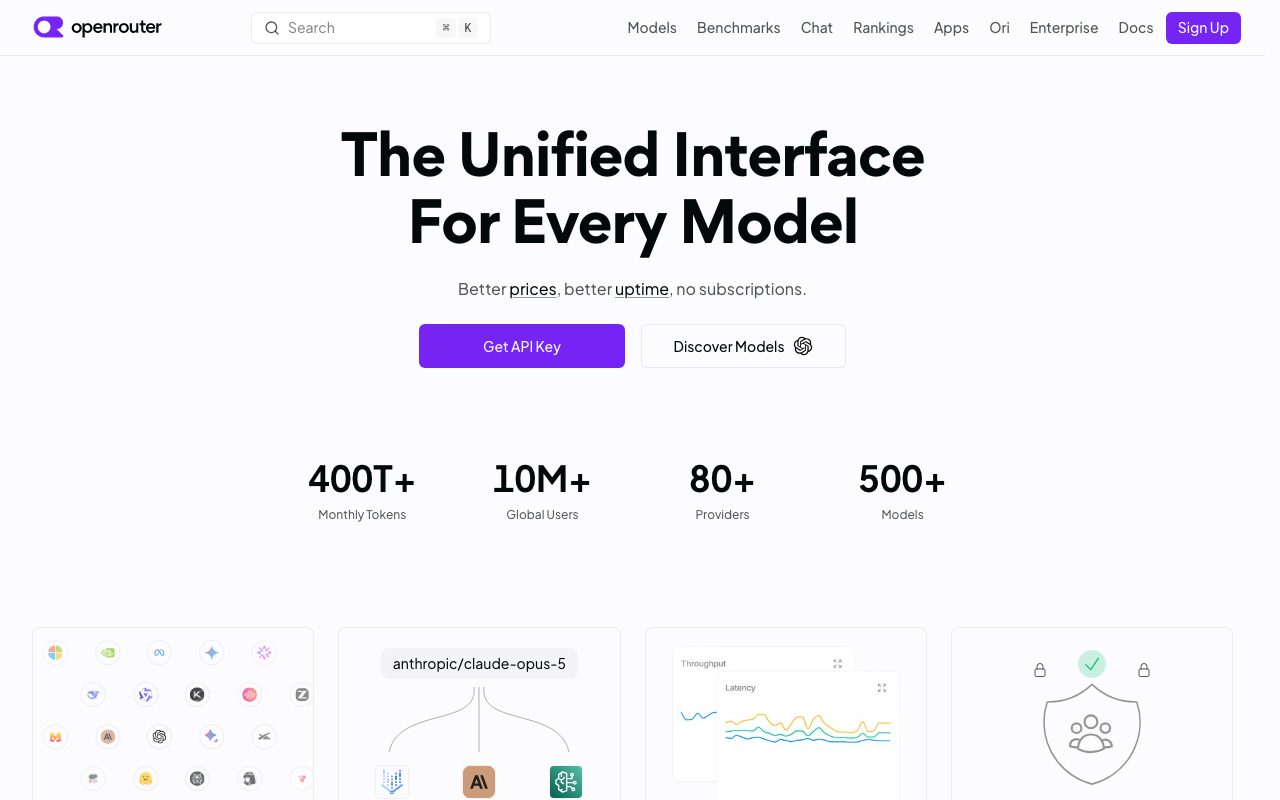
OpenRouter provides a unified, OpenAI-compatible API to interact with over 500 AI models across 80+ providers, featuring automated fallbacks, real-time latency routing, and edge execution.
OpenRouter is an AI model aggregator and routing gateway designed to simplify how developers call language, code, vision, audio, and video models. Rather than managing separate SDKs, authentication tokens, and billing accounts for dozens of proprietary and open-weight AI providers, developers make calls through a single endpoint compatible with the standard OpenAI chat completions format. The platform monitors provider availability, response latency, and error rates in real time. It uses this intelligence to route prompts dynamically to optimal providers and trigger automatic fallbacks if an endpoint degrades or fails. OpenRouter also offers custom data policies to restrict prompt routing to trusted providers, model aliases that always resolve to the newest releases, an Agent SDK for structured tool calling, and a remote Model Context Protocol (MCP) server for live model querying directly within AI-assisted code editors.
A single OpenAI-compatible endpoint that unifies 500+ models from 80+ providers with automated failover routing, no subscriptions, and edge-based execution.
Product capabilities
Key features
Unified API & OpenAI Compatibility
Send standard requests to a single chat completions endpoint or use the OpenAI SDK as a drop-in replacement.
Real-Time Uptime Optimization & Fallbacks
Continuously tracks provider latency and error rates to route requests dynamically and execute automatic failover when endpoints fail.
Agent SDK & Tool Use
Provides native primitives for multi-turn conversation loops, automated tool execution, and state management via callModel.
Dynamic Model Aliases
Supports alias slugs such as ~openai/gpt-latest to ensure applications automatically point to the newest flagship versions without code updates.
Custom Data Policies
Enforces fine-grained organizational rules to restrict prompt transmission only to vetted and compliant providers.
Remote MCP Server
Connects directly to AI coding environments like Cursor and Claude Code to provide live model stats, pricing, and balances.
Practical fit
Who should use OpenRouter?
Multi-Provider Model Fallbacks
Maintain uninterrupted application uptime by failing over to secondary providers when a primary model provider experiences downtime.
Model Evaluation & Benchmarking
Compare performance, cost, and latency across hundreds of models through one shared API key and schema.
AI Agent Tool Calling
Build autonomous agents using the Agent SDK to execute dynamic tools, process outputs, and handle multi-turn loops.
Editorial assessment
Pros and limitations
Where it is strong
- Direct drop-in compatibility with the OpenAI SDK and REST conventions
- Automated model and provider failover without custom fallback architecture
- No monthly subscriptions; usage is paid via shared prepaid credits
- Access to over 500 multimodal and text models from 80+ providers
Where to be careful
- Adds an intermediary network dependency between the client application and inference hosts
- Requires understanding model routing parameters to enforce strict region or provider preferences
Commercial context
OpenRouter pricing
As of September 2026, OpenRouter operates with no recurring subscriptions, selling prepaid usage credits alongside free-tier model access. Exact per-token rates depend on the chosen model and provider; check the official pricing page for current rates.
Pricing, limits, taxes, model access, and regional availability can change. Verify the purchase-critical details on the official pricing page linked under Sources.
Transparent ranking
Why OpenRouter scores 78.1
Each factor is scored on a 100-point scale, then combined using the public ToolsRank weights. Engagement and momentum stay at a neutral baseline until measured signals exist, so no tool can gain or lose position from numbers nobody recorded.
Compatibility
Languages, platforms, and integrations
Languages
- English
Integrations & surfaces
- OpenAI SDK
- LangChain
- Vercel AI SDK
- Zapier
- Replit
- Cursor
- Claude Code
- PydanticAI
- Langfuse
- Mastra
- LiveKit
- Xcode
Community
Reviews and questions
No approved member reviews yet. Editorial factors above are the only rating on this page.
Reviews and questions come from Google-signed members and are checked by an editor before they appear.
Frequently asked
OpenRouter FAQ
How does OpenRouter handle provider downtime?+
OpenRouter tracks error rates, response times, and availability in real time across providers, automatically rerouting requests or applying configured model fallbacks when an endpoint goes down.
Can OpenRouter replace the standard OpenAI SDK endpoint?+
Yes. OpenRouter is fully OpenAI-compatible. Setting the baseURL to https://openrouter.ai/api/v1 allows developers to use existing OpenAI client libraries with an OpenRouter API key.
Are there subscription fees to use OpenRouter?+
No. OpenRouter operates without subscriptions. Users create an account and purchase credits that apply across any model or provider, alongside access to available free models.
What is the OpenRouter MCP server?+
It is a remote Model Context Protocol server hosted by OpenRouter that connects to coding assistants like Cursor and Claude Code, providing live data on model costs, availability, and credit balances.