
Direct answer
What is Pecan AI?
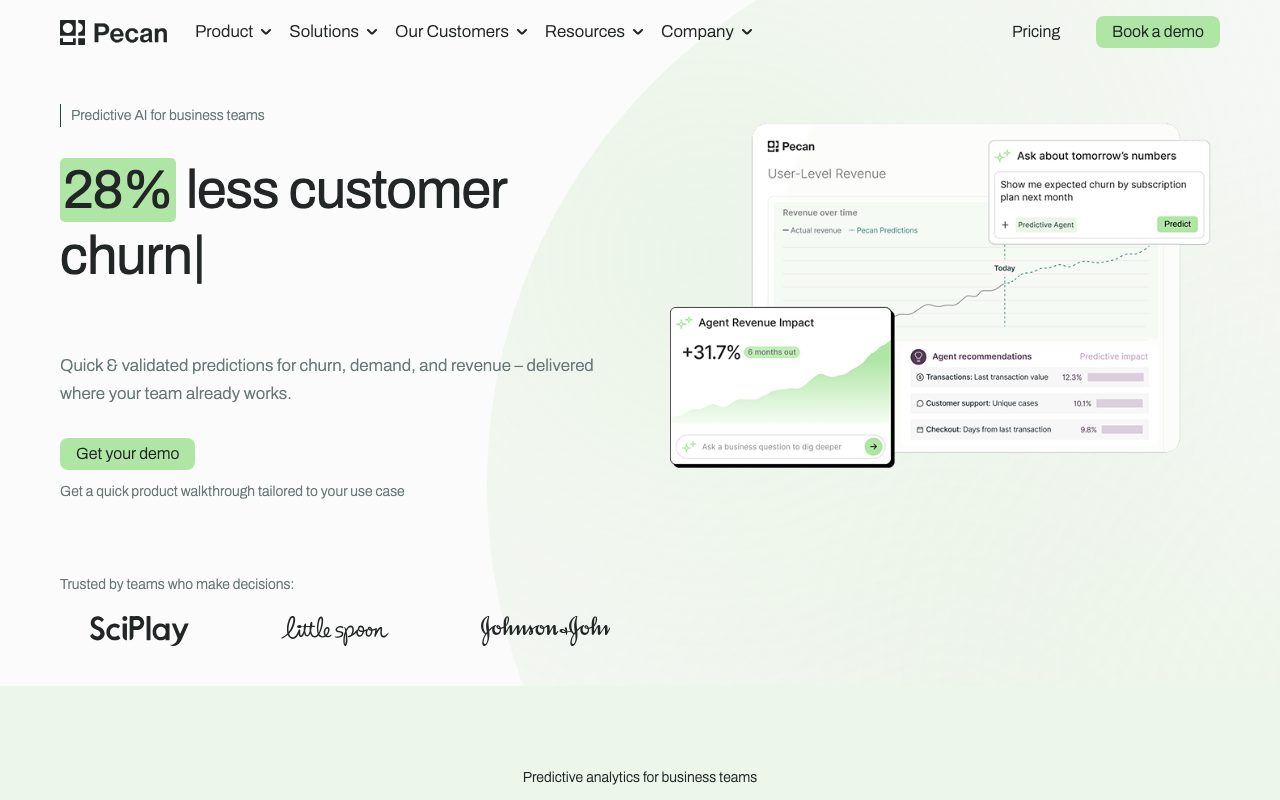
Pecan AI is a predictive analytics platform that uses an AI agent to automate data prep, feature engineering, and model validation for business and BI teams without manual data science code.
Pecan AI provides an automated predictive modeling platform designed specifically for business users, BI teams, and analysts. Rather than requiring teams to configure feature pipelines or write machine learning code, Pecan uses a conversational predictive agent to turn business questions into validated predictive models. It connects directly to enterprise data repositories—such as Snowflake, Databricks, BigQuery, and S3—and processes raw event-level transaction logs without requiring personally identifiable information (PII). The platform automates the primary stages of data preparation, model selection, validation, and explainability. It outputs performance benchmarks such as AUC, lift, and forecast error, while exposing the drivers behind predictions on transparent dashboards. Once trained, models can be scheduled to push predictions back into warehouses, CRMs like Salesforce and HubSpot, and marketing platforms. Use cases span churn prediction, customer lifetime value (LTV) calculation, early campaign ROAS forecasting, lead scoring, transaction fraud risk screening, and demand forecasting.
Pecan AI eliminates the data science bottleneck by pairing an automated modeling engine with an AI agent that accepts plain-English questions and directly automates data cleansing, feature engineering, and warehouse writes.
Product capabilities
Key features
Predictive AI Agent
Guides users from a business question to a deployed predictive model, automating data preparation, feature engineering, and SQL assistance.
Automated Model Validation & Benchmarks
Validates models against metrics including AUC, lift, and forecast error, showing the underlying drivers for each generated prediction.
Direct Warehouse & CRM Delivery
Schedules automated prediction batch delivery into cloud warehouses, databases, or CRMs like Salesforce and HubSpot.
Prediction Monitoring & Alerts
Provides real-time notifications covering model training status, data updates, and prediction generation progress.
Enterprise Security & Compliance
Complies with SOC 2 Type II, ISO 27001, and GDPR standards with encryption in transit and at rest, operating without mandatory PII.
Practical fit
Who should use Pecan AI?
Customer Churn & Retention
Flag accounts and subscribers displaying at-risk behavior patterns and engagement drop-offs to trigger preemptive outreach.
Campaign ROAS Prediction
Forecast 30-to-90-day campaign return on ad spend within 24 to 48 hours of launch to allocate marketing budgets efficiently.
Demand & Inventory Forecasting
Forecast inventory requirements across product categories using historical sales, trend shifts, and seasonal variations.
Lead Scoring & Prioritization
Score leads dynamically based on conversion likelihood using behavioral tracking signals and firmographic attributes.
Editorial assessment
Pros and limitations
Where it is strong
- Requires no machine learning coding or feature engineering expertise from analysts.
- Native connectors to major cloud warehouses (Snowflake, BigQuery, Databricks, Redshift).
- Exposes clear explainability metrics and prediction drivers for business confidence.
- Does not require PII to generate accurate predictive models.
Where to be careful
- Pricing is not transparently published and requires contacting sales for an annual contract.
- Prediction runs are restricted by plan-specific monthly batch limits on Starter and Team tiers.
- Relies on having substantial historical, event-level data available to train reliable models.
Commercial context
Pecan AI pricing
At the review date (2026-09-08), Pecan AI does not publish public pricing tiers; all plans (Starter, Team, Business) require contacting sales for an annual billing quote. Readers should verify current pricing directly with Pecan AI.
Pricing, limits, taxes, model access, and regional availability can change. Verify the purchase-critical details on the official pricing page linked under Sources.
Transparent ranking
Why Pecan AI scores 69.4
Each factor is scored on a 100-point scale, then combined using the public ToolsRank weights. Engagement and momentum stay at a neutral baseline until measured signals exist, so no tool can gain or lose position from numbers nobody recorded.
Compatibility
Languages, platforms, and integrations
Languages
- English
Integrations & surfaces
- Snowflake
- Databricks
- Google BigQuery
- Amazon Redshift
- Salesforce
- HubSpot
- Firebase
- Adjust
- AppsFlyer
- PostgreSQL
- MySQL
- AWS S3
Community
Reviews and questions
No approved member reviews yet. Editorial factors above are the only rating on this page.
Reviews and questions come from Google-signed members and are checked by an editor before they appear.
Frequently asked
Pecan AI FAQ
Do I need machine learning or coding experience to use Pecan AI?+
No. Pecan AI is designed for BI analysts and business teams. You define your business goal in plain language, and the automated agent handles data preparation, feature engineering, model selection, and training without requiring Python or ML coding.
What type of data does Pecan AI need?+
Pecan works best with historical, event-level tabular data stored in cloud warehouses like Snowflake, BigQuery, Databricks, or Redshift. It does not require personally identifiable information (PII) to build models.
How are predictions delivered to end users?+
Predictions can be scheduled to write directly back into cloud data warehouses, relational databases, business intelligence dashboards, or business platforms such as Salesforce and HubSpot via native integrations or APIs.
What plans and storage limits are available on Pecan AI?+
Pecan offers Starter, Team, and Business plans. Starter includes 2 monthly prediction batches and up to 500 million rows of storage; Team includes 10 batches and 2 billion rows; Business provides custom prediction batches and up to 5 billion rows. All plans are billed annually via sales engagement.