
Direct answer
What is Postman AI?
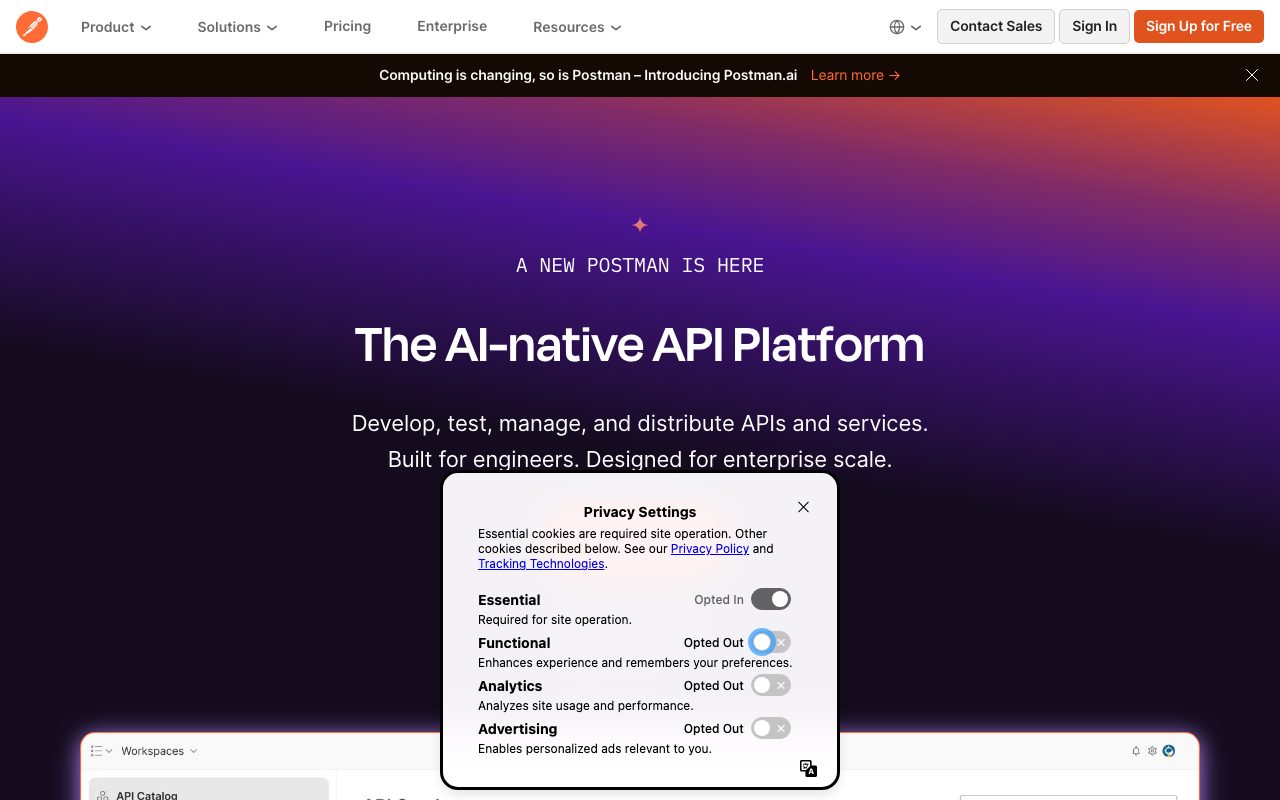
Postman AI brings autonomous agent workflows, Model Context Protocol (MCP) tooling, and automated test generation to Postman's API platform.
Postman AI embeds autonomous agent workflows and Model Context Protocol (MCP) capabilities directly into the Postman API development lifecycle. Known for request testing and collection management, the platform incorporates an AI Engineer and Agent Mode to build, validate, and maintain APIs automatically using existing service context. The system supports automated collection generation, unit test creation, multi-protocol execution, and synthetic flow authoring. With the native Postman MCP Server and MCP Client, teams can supply structured API context to external AI assistants or execute API actions within agentic loops. Built-in security layers—such as credential scanning prior to model transmission, PII redaction, and local-versus-cloud vaulting—are designed to prevent credential leakage into language models. Usage is structured around monthly AI credits across single-user and organizational tiers. Teams can scale from manual testing on local environments to automated regression suites, cloud performance testing, and multi-step monitoring in production.
Unlike standalone coding assistants, Postman AI operates directly against living API schemas, collections, runtime environments, and MCP infrastructure with enterprise credential guardrails.
Product capabilities
Key features
Agent Mode
Native AI capability to generate collections, update workflows, inspect responses, and write automated tests from plain-language instructions.
Postman MCP Server & Client
Provides API specifications, documentation, and operational context to external AI agents via the Model Context Protocol.
AI Unit Test Generator
Automatically produces functional test scripts and assertions based on endpoint schemas and observed HTTP responses.
Credential & PII Guardrails
Filters sensitive tokens and personal data before sending prompts or payloads to underlying large language models.
Automated Collection Runner
Executes multi-step, multi-protocol test runs locally or via CLI, with support for datasets and result exports.
API Catalog & Governance
Centralizes enterprise APIs, enforces design standards, and coordinates team-wide access control and workspace permissions.
Workflow
How Postman AI works
- Import or design API schemas and endpoints inside Postman workspaces.
- Use Agent Mode or the AI unit test generator to create assertions, documentation, and request chains.
- Run tests through Collection Runner or Postman CLI across local or CI/CD pipelines.
- Expose endpoints and documentation to external agents via the native Postman MCP Server.
Practical fit
Who should use Postman AI?
Automated API Test Generation
Engineers generate test suites, validate status codes, and verify JSON schemas without manually writing boiler-plate test scripts.
Agent Tool Context Delivery
Teams expose internal API catalogs to coding agents via the Model Context Protocol to execute verified operational actions.
API Workflow Orchestration
Developers build multi-step automated sequences using Postman Flows and AI credits to link microservices and cloud APIs.
Editorial assessment
Pros and limitations
Where it is strong
- 50 free AI credits provided monthly on the standard free plan
- Native support for Model Context Protocol (MCP) clients and servers
- Multi-layer secret scanning prevents sensitive keys from reaching AI models
- Smooth integration with existing Postman collections and developer environments
Where to be careful
- AI features and Flows consume monthly credit allotments with variable pay-as-you-go overages
- Enterprise SSO, advanced secret detection, and domain capture require paid add-ons
Commercial context
Postman AI pricing
Pricing is verified as of September 8, 2026. Billed annually, Solo starts at $9 per month, Team at $19 per user/month, and Enterprise at $49 per user/month, each with monthly AI credit allotments and optional pay-as-you-go overages. Check the official pricing page for current rates.
| Plan | Price | What it includes |
|---|---|---|
| Free | $0 |
|
| Solo | $9 per month (billed annually) |
|
| Team | $19 per user/month (billed annually) |
|
| Enterprise | $49 per user/month (billed annually) |
|
Pricing, limits, taxes, model access, and regional availability can change. Verify the purchase-critical details on the official pricing page linked under Sources.
Transparent ranking
Why Postman AI scores 75.4
Each factor is scored on a 100-point scale, then combined using the public ToolsRank weights. Engagement and momentum stay at a neutral baseline until measured signals exist, so no tool can gain or lose position from numbers nobody recorded.
Compatibility
Languages, platforms, and integrations
Languages
- English
- 日本語
Platforms
- Web
- Mac
- Windows
- Linux
Integrations & surfaces
- AWS
- VS Code
- Git
- Playwright
- Azure Key Vault
- AWS Secrets Manager
- HashiCorp Vault
- 1Password
- Okta
- Microsoft Entra ID
- Google Workspace
Community
Reviews and questions
No approved member reviews yet. Editorial factors above are the only rating on this page.
Reviews and questions come from Google-signed members and are checked by an editor before they appear.
Frequently asked
Postman AI FAQ
What is Postman AI Agent Mode?+
Agent Mode is Postman's native AI functionality designed to automate API lifecycle tasks, including drafting requests, generating and updating collections, writing unit tests, and building Flows.
Does Postman use customer data to train AI models?+
According to official documentation, Postman does not use customer data to train underlying LLMs, and credential scanning and PII redaction guardrails run before data reaches models.
How are AI features billed in Postman?+
Each tier includes a set monthly allowance: 50 credits on Free, 400 credits on Solo, 400 credits per user on Team, and 800 pooled credits per user on Enterprise. Overages are billed on a pay-as-you-go basis when enabled by billing administrators.
What is the Postman MCP Server?+
The Postman MCP Server allows external AI assistants and agents to consume API context, schemas, and endpoints formatted according to the open Model Context Protocol.