
Direct answer
What is Recall?
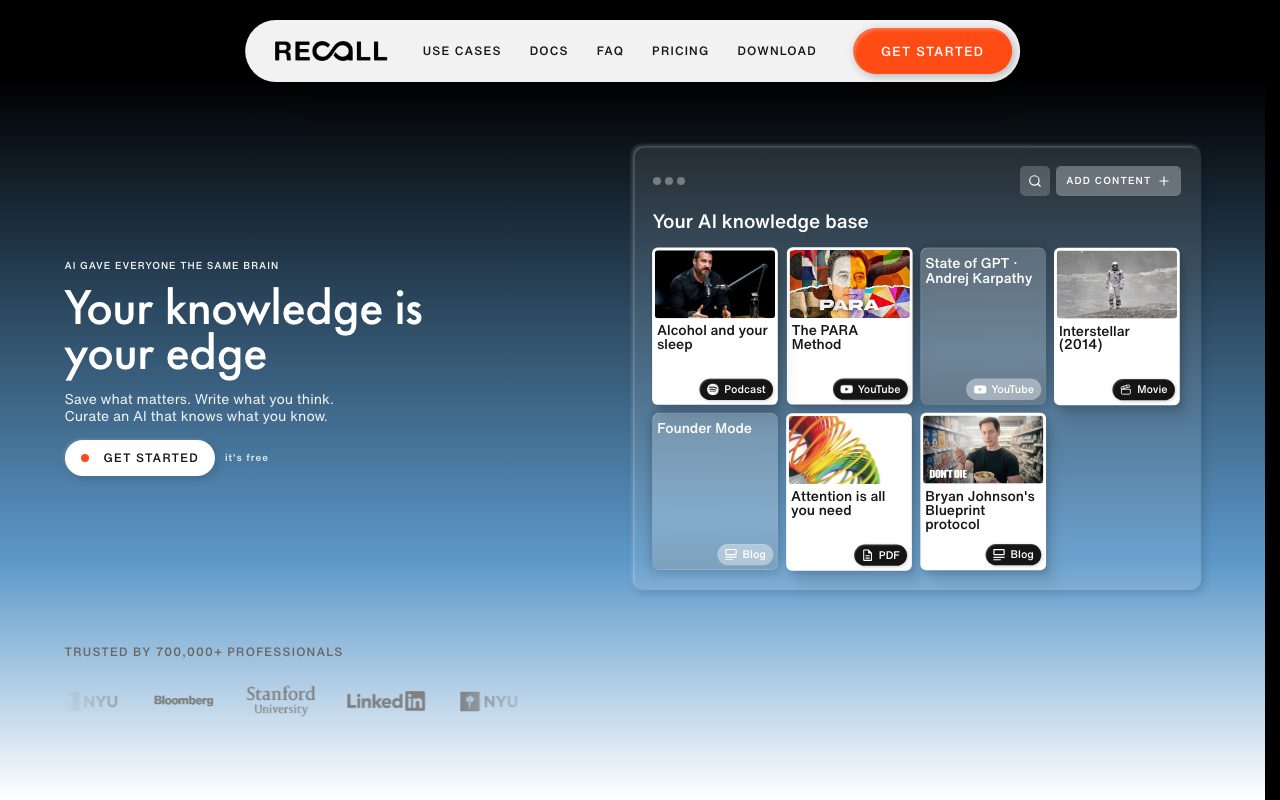
Recall is an AI-powered personal knowledge management app that captures web content, videos, podcasts, and personal notes, automatically generating summaries, organizing tags, and linking concepts in a visual knowledge graph.
Recall serves as an integrated personal knowledge base and second-brain application. Rather than requiring users to manually sort, tag, and link their reading lists, Recall extracts information directly from URLs, YouTube videos, podcasts, PDFs, and written notes. It condenses long-form material into concise or detailed summaries with timestamps, and automatically generates smart tags to file items into relevant categories. At the core of the service is an automated knowledge graph that detects conceptual links across saved materials. As users browse the web, an Augmented Browsing feature surfaces previously saved connections locally on the user device without transmitting web history. Users can interact with their library using conversational AI, querying either their saved cards, the live internet, or a combination of both. In addition to search and retrieval, the system generates custom quizzes on an automated spaced repetition schedule to improve information retention. Recall supports exports in Markdown format and provides API access alongside a Model Context Protocol (MCP) connector, allowing external assistants like ChatGPT to query saved content via read-only OAuth connections.
Unlike static bookmark managers or manual note apps, Recall automatically generates summaries, interlinks related ideas across multimedia sources in a dynamic knowledge graph, and provides spaced repetition quizzes and an MCP connector for external AI querying.
Product capabilities
Key features
Multimedia Summaries
Transforms articles, YouTube videos, podcasts, and PDFs into instant summaries with timestamps, offering both concise and detailed views.
Automated Knowledge Graph
Identifies conceptual relationships between saved items and personal notes, visualizing them within an interconnected graph.
Personal AI Chat
Enables conversational queries across saved knowledge, the open internet, or combined sources using frontier AI models.
Spaced Repetition Quizzes
Creates automated multiple-choice, matching, and short-form review quizzes scheduled to reinforce long-term memory retention.
Augmented Browsing
Runs local-first device processing to resurface related notes and past content as you browse external websites without storing browsing history.
Listen Mode
Converts saved written summaries into audio playback with customizable text-to-speech voices for mobile listening.
API and MCP Connectivity
Offers read-only Model Context Protocol integration and developer APIs to connect saved knowledge directly to external AI tools like ChatGPT.
Smart Tagging and Organization
Automatically organizes incoming content with context-aware tags that group related cards without manual folder sorting.
Workflow
How Recall works
- Capture web pages, YouTube links, podcasts, PDFs, or write original notes in the web or mobile app.
- Recall parses the input, generates an automated summary with timestamps, and assigns context-aware smart tags.
- The system links related ideas across your library to generate an interactive visual knowledge graph.
- Query your knowledge library via conversational AI, listen to audio summaries, or complete automated spaced-repetition quizzes.
Practical fit
Who should use Recall?
Podcast and Video Distillation
Saving multi-hour YouTube lectures and podcast episodes to quickly extract structured key takeaways, outlines, and timestamps.
Lifelong Study and Exam Preparation
Storing academic papers, books, and articles, then reviewing automated spaced repetition quizzes to retain critical domain knowledge.
Research Synthesis Across Diverse Sources
Interlinking web articles, personal notes, and PDFs within a searchable knowledge graph to discover non-obvious thematic connections.
Grounded Assistant Querying
Connecting external LLM environments to your curated library via MCP to draft content grounded in verified personal sources.
Editorial assessment
Pros and limitations
Where it is strong
- Supports varied media inputs including YouTube videos, podcasts, PDFs, articles, and rich-text notes
- Automates cross-linking and smart tagging without requiring manual wiki-link syntax
- Augmented browsing feature runs local-first without tracking or saving external browsing history to cloud servers
- Model Context Protocol (MCP) integration allows read-only access for third-party tools like ChatGPT
- Full data portability with Markdown export options
Where to be careful
- Free plan restricts AI summaries to 10 per month
- Advanced model selection and high-volume bulk actions require the higher-tier Max plan
- Focused on single-user personal knowledge rather than multi-user team workspaces
Commercial context
Recall pricing
Pricing verified as of September 2026. Billed annually, Plus is $10/month and Max is $38/month. A 20% student discount and 30-day refund policy are offered. Usage is subject to a fair-use policy.
| Plan | Price | What it includes |
|---|---|---|
| Free | $0 / forever |
Free forever without credit card requirement |
| Plus | $10 / month |
Billed yearly ($10 per month) |
| Max | $38 / month |
Billed yearly ($38 per month) |
Pricing, limits, taxes, model access, and regional availability can change. Verify the purchase-critical details on the official pricing page linked under Sources.
Transparent ranking
Why Recall scores 75.5
Each factor is scored on a 100-point scale, then combined using the public ToolsRank weights. Engagement and momentum stay at a neutral baseline until measured signals exist, so no tool can gain or lose position from numbers nobody recorded.
Compatibility
Languages, platforms, and integrations
Languages
- English
- Multi-language support
Platforms
- Web
- Chrome
- Safari
- Edge
- Firefox
- iOS
- Android
Integrations & surfaces
- ChatGPT
- OpenAI
- Claude
- Google Gemini
- Chrome
- Safari
- Firefox
- Microsoft Edge
Community
Reviews and questions
No approved member reviews yet. Editorial factors above are the only rating on this page.
Reviews and questions come from Google-signed members and are checked by an editor before they appear.
Frequently asked
Recall FAQ
What is included in the Recall Free plan?+
The Free plan provides unlimited saves for articles, videos, podcasts, and PDFs, unlimited block notes with tables and lists, visual knowledge graph linking, and API and MCP access. It includes 10 AI summaries per month.
Does Recall train AI models on user content?+
No. The vendor states in its privacy policy that user content is never used for advertising, profiling, or training AI models. Data is used solely to provide the knowledge base service.
How does Recall handle browser privacy with Augmented Browsing?+
Augmented Browsing operates on a local-first architecture. All processing takes place on the user device, meaning browsing activity and URLs are not sent to or stored on Recall servers.
Can I export my data from Recall?+
Yes. Recall supports data portability by allowing users to export their saved items and notes at any time in Markdown format.
What is the difference between Recall Plus and Recall Max?+
Plus includes unlimited AI summaries, smart tags, AI chat, Listen Mode, and spaced repetition quizzes, automatically selecting the best model for the job. Max adds frontier model selection (ChatGPT, Claude, Gemini), bulk AI actions for up to 100 items at once, and 1-on-1 onboarding.
Does Recall offer refunds or discounts?+
Recall provides a 30-day refund policy on paid plans contacted via support, along with a 20% discount for students who reach out from an academic email address.