Direct answer
What is Storm by Stanford?
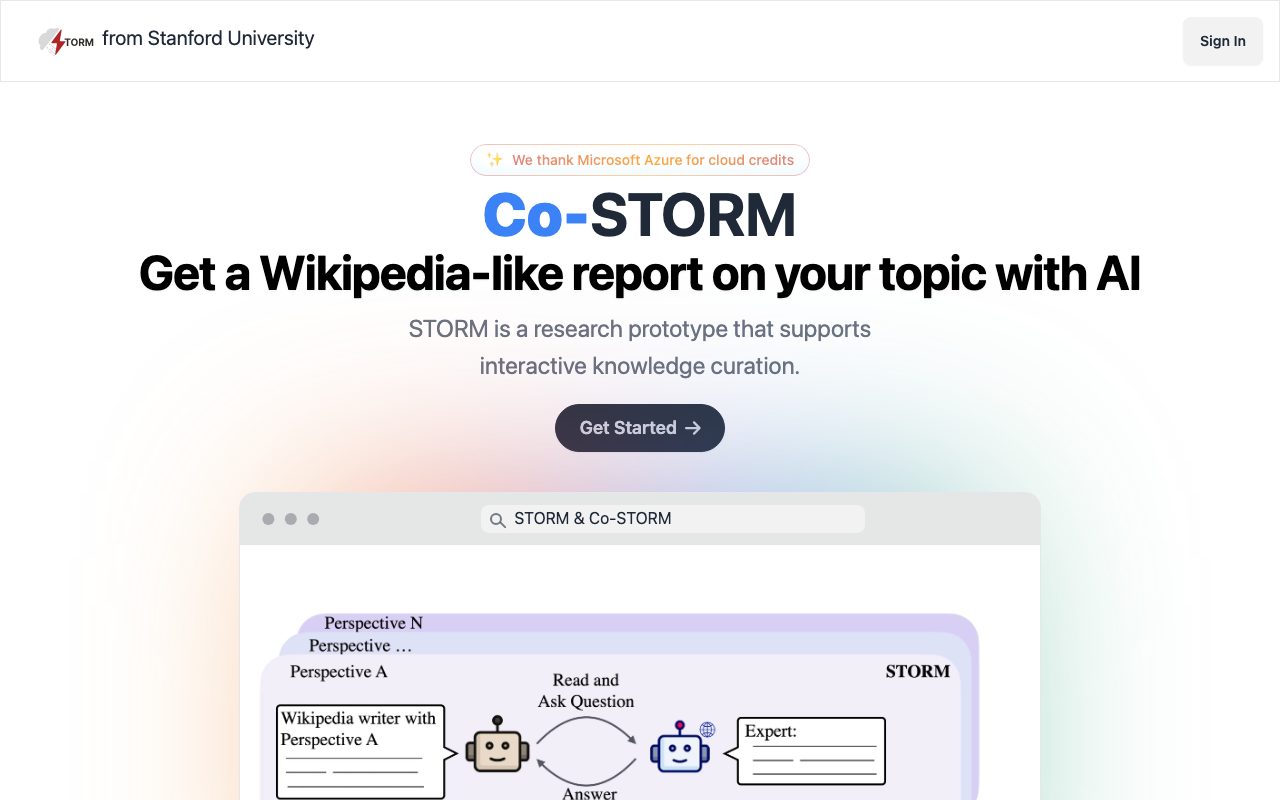
Developed by Stanford's Open Virtual Assistant Lab (OVAL), STORM is an AI research prototype that curates information across topics to produce structured, Wikipedia-like reports.
STORM (alongside Co-STORM) is an academic research system developed by the Stanford Open Virtual Assistant Lab (OVAL). Positioned as an experimental tool for interactive knowledge curation, it takes a user-supplied topic and autonomously collects, organizes, and synthesizes information into an extensive, Wikipedia-style briefing document. Because the platform operates as an active research project supported by cloud credits and open-source infrastructure, access is governed by strict research terms. User prompts, search intentions, feedback, and system interactions are logged for ongoing research and may be distributed under open licenses such as Creative Commons Attribution (CC-BY). Users are specifically advised not to submit confidential or personally identifiable information. While designed to structure unfamiliar subjects rapidly, the tool includes explicit warnings that outputs can contain factual errors or offensive material due to limited safety filtering. It serves primarily as a pre-writing aid and structured discovery engine rather than a definitive source of truth.
Unlike typical conversational search engines that return direct paragraph answers, STORM generates long-form, multi-section Wikipedia-style overview reports with citations and structured subheadings.
Product capabilities
Key features
Wikipedia-Style Report Generation
Transforms a single research prompt or subject into a multi-section document modeled after reference encyclopedia entries.
Interactive Knowledge Curation
Incorporates Co-STORM collaborative workflows to support interactive topic exploration and guided discovery.
User Topic & Intent Capture
Prompts users for search goals and context to steer retrieval toward the relevant scope of the inquiry.
Academic Research Logging
Operates within a formal research protocol that analyzes user interactions and system feedback to advance knowledge curation benchmarks.
Workflow
How Storm by Stanford works
- The user enters a research subject along with their inquiry objective.
- The underlying system autonomously searches, retrieves, and organizes topical information.
- STORM synthesizes the curated data into a multi-section, Wikipedia-like report for review.
Practical fit
Who should use Storm by Stanford?
Topic Briefing & Scoping
Generating a baseline outline and reference document when starting an inquiry into an unfamiliar academic or technical domain.
Literature & Overview Synthesis
Producing initial thematic breakdowns and related context before conducting deep manual literature reviews.
Editorial assessment
Pros and limitations
Where it is strong
- Produces structured, long-form encyclopedia-style reports rather than brief chat snippets
- Free public web preview hosted by an academic research lab
- Clear disclaimers regarding prototype limitations and model hallucinations
Where to be careful
- User queries and interactions are collected and potentially shared under CC-BY licensing
- Limited content safety controls, with explicit warnings that generated reports may make factual mistakes
- No enterprise privacy guarantees, team spaces, or commercial SLA support
Commercial context
Storm by Stanford pricing
At the review date, STORM is offered as a free academic research prototype by Stanford OVAL. There are no paid tiers or software fees listed on the official site. Check the official site for current availability.
Pricing, limits, taxes, model access, and regional availability can change. Verify the purchase-critical details on the official pricing page linked under Sources.
Transparent ranking
Why Storm by Stanford scores 66.9
Each factor is scored on a 100-point scale, then combined using the public ToolsRank weights. Engagement and momentum stay at a neutral baseline until measured signals exist, so no tool can gain or lose position from numbers nobody recorded.
Compatibility
Languages, platforms, and integrations
Languages
- English
Platforms
- Web
Integrations & surfaces
- Microsoft Azure
Community
Reviews and questions
No approved member reviews yet. Editorial factors above are the only rating on this page.
Reviews and questions come from Google-signed members and are checked by an editor before they appear.
Frequently asked
Storm by Stanford FAQ
What is STORM?+
STORM is a research prototype developed by the Stanford Open Virtual Assistant Lab (OVAL) that automatically curates knowledge to generate Wikipedia-like overview reports on specified subjects.
Is STORM free to use?+
Yes. At the time of review, STORM is available without charge as an experimental research preview supported by Stanford University and cloud credits from Microsoft Azure.
Can I use STORM for proprietary or confidential research?+
No. The terms of service require users to agree that inputs, topics, and interactions may be collected, studied, and released under open research licenses such as Creative Commons Attribution (CC-BY). Users must not submit personally identifiable or confidential information.
How reliable are the generated reports?+
Stanford OVAL explicitly warns that the system can make factual errors and has limited safety filtering. Reports should be treated as drafting aids and must be verified against primary sources.