Direct answer
What is Tabnine?
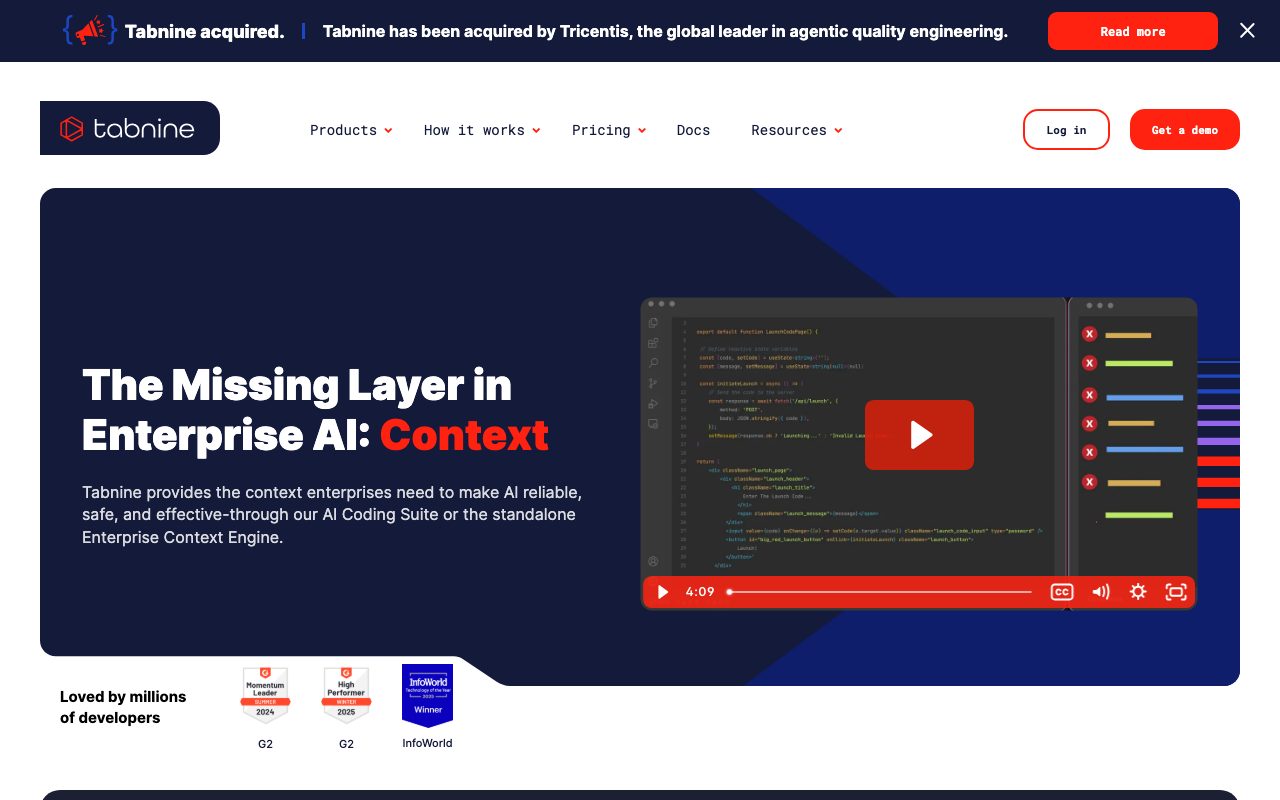
Tabnine is an enterprise-oriented AI coding assistant and agentic platform providing code completions, in-IDE chat, terminal agents, and on-premises or air-gapped deployment options.
Tabnine is an AI-powered software development assistant designed around strict data privacy and enterprise governance. It provides inline single-line and full-function code autocompletions, an interactive in-IDE chat covering every step of the software development lifecycle, and terminal-native agents for multi-step task execution. The platform offers two primary tiers alongside an Enterprise Context Engine. The base Code Assistant platform provides completions and chat compatible with leading models from providers such as Anthropic, OpenAI, Google, Meta, and Mistral. The Agentic Platform introduces autonomous agents extensible via Model Context Protocol (MCP), a command-line interface (CLI) for terminal workflows, and a context engine that connects to repositories across Bitbucket, GitHub, GitLab, and Perforce. A key focus is deployment flexibility and security governance. Tabnine supports SaaS, private VPC, on-premises, and completely air-gapped installations with zero code retention. Engineering administrators can enforce coaching guidelines, govern MCP tools, track usage analytics, restrict LLM access by user or team, and audit code provenance.
Tabnine distinguishes itself through enterprise control and air-gapped hosting: teams can deploy it on-premises or in disconnected environments, bring their own LLM endpoints, and enforce rigorous governance without sending code to third parties.
Product capabilities
Key features
Code completions & IDE chat
Generates current-line and multi-line suggestions directly in major IDEs alongside an interactive assistant supporting code generation, refactoring, and test creation.
Agentic CLI and workflows
Features a terminal-native AI agent and autonomous workflows capable of executing multi-step tasks, refactoring, and opening pull requests with optional human-in-the-loop oversight.
Model Context Protocol (MCP) tooling
Enables agents to interact with git operations, linters, testing frameworks, CI/CD systems, package managers, and external platforms like Jira and Confluence.
Tabnine Context Engine
Indexes codebase repositories across GitHub, GitLab, Bitbucket, and Perforce to build a continuous model of architecture, dependencies, and organizational standards.
Flexible deployment options
Deploys across multi-tenant SaaS, virtual private cloud (VPC), on-premises hardware, or fully air-gapped secure networks with zero data retention.
Governance and auditability
Provides team-level LLM access controls, token consumption thresholds, usage analytics, code generation provenance, and IP indemnification.
Practical fit
Who should use Tabnine?
Air-gapped and high-security coding
Deploying coding assistance on isolated internal servers without sending proprietary source code or prompts across external cloud networks.
Multi-step codebase refactoring
Using the Tabnine CLI and autonomous agents to update architectural patterns, replace structs, or implement interfaces across multiple files.
Test creation and code explanation
Generating unit tests, debugging runtime errors, and explaining unfamiliar legacy code within the developer's everyday IDE.
Cross-system context retrieval
Grounding developer queries and code suggestions against corporate repositories, Jira tickets, and Confluence documentation.
Editorial assessment
Pros and limitations
Where it is strong
- Supports on-premises, VPC, and fully air-gapped deployments with zero code retention.
- Brings model choice across Anthropic, OpenAI, Google, Meta, Mistral, or self-hosted LLMs.
- Context Engine supports Perforce P4 in addition to Git, GitHub, GitLab, and Bitbucket.
- Integrated terminal CLI and support for Model Context Protocol (MCP) tools.
Where to be careful
- No free individual tier listed on official pricing pages; subscriptions require annual billing.
- Using Tabnine-provided LLMs requires paying provider token costs plus an extra 5% handling fee.
- Context Engine standalone integration for third-party agents requires contacting sales.
Commercial context
Tabnine pricing
Pricing snapshot as of September 2026. Billed annually at $39/user/month for Code Assistant or $59/user/month for Agentic Platform. Unlimited usage applies when bringing your own LLM endpoint or on-prem model; Tabnine-provided LLM access incurs token costs plus a 5% handling fee. Verify current terms on the official pricing page.
| Plan | Price | What it includes |
|---|---|---|
| Tabnine Code Assistant | $39 per user / month / billed annually ($468/year per user billed annually, plus token quota fees if using Tabnine-managed models with 5% handling fee; unlimited if using own LLM endpoint or on-prem model). Included with annual subscription. | |
| The Tabnine Agentic Platform | $59 per user / month / billed annually ($708/year per user billed annually, plus token quota fees if using Tabnine-managed models with 5% handling fee; unlimited if using own LLM endpoint or on-prem model). Included with annual subscription. | |
| Enterprise Context Engine | Custom / Annual enterprise contract based on organization scope. Contact vendor for quotation. |
Pricing, limits, taxes, model access, and regional availability can change. Verify the purchase-critical details on the official pricing page linked under Sources.
Transparent ranking
Why Tabnine scores 72.5
Each factor is scored on a 100-point scale, then combined using the public ToolsRank weights. Engagement and momentum stay at a neutral baseline until measured signals exist, so no tool can gain or lose position from numbers nobody recorded.
Compatibility
Languages, platforms, and integrations
Languages
- English
Integrations & surfaces
- VS Code
- JetBrains IDEs
- PhpStorm
- GitHub
- GitLab
- Bitbucket
- Perforce P4
- Atlassian Jira
- Confluence
- Docker
Community
Reviews and questions
No approved member reviews yet. Editorial factors above are the only rating on this page.
Reviews and questions come from Google-signed members and are checked by an editor before they appear.
Frequently asked
Tabnine FAQ
What deployment models does Tabnine support?+
Tabnine supports standard SaaS, Virtual Private Cloud (VPC), on-premises enterprise hardware, and fully air-gapped disconnected environments.
Does Tabnine retain or train on user code?+
Tabnine operates under a zero code retention policy. Source code is not stored or shared with third parties, and it is not used to train shared foundation models.
How does LLM usage billing work?+
Usage is unlimited when deploying your own on-prem LLM or cloud LLM endpoint. If using Tabnine-provided LLM access, consumption is billed based on actual provider prices plus a 5% handling fee.
Which LLM models can developers select?+
Tabnine lets developers select from multiple frontier models, including LLMs from Anthropic, OpenAI, Google, Meta, and Mistral, as well as privately hosted models.
Can the Context Engine be used with other coding tools?+
Yes. According to Tabnine's Enterprise Context Engine documentation, it is agent-agnostic and compatible with third-party tools such as Cursor, GitHub Copilot, and Claude Code.