Direct answer
What is Tars?
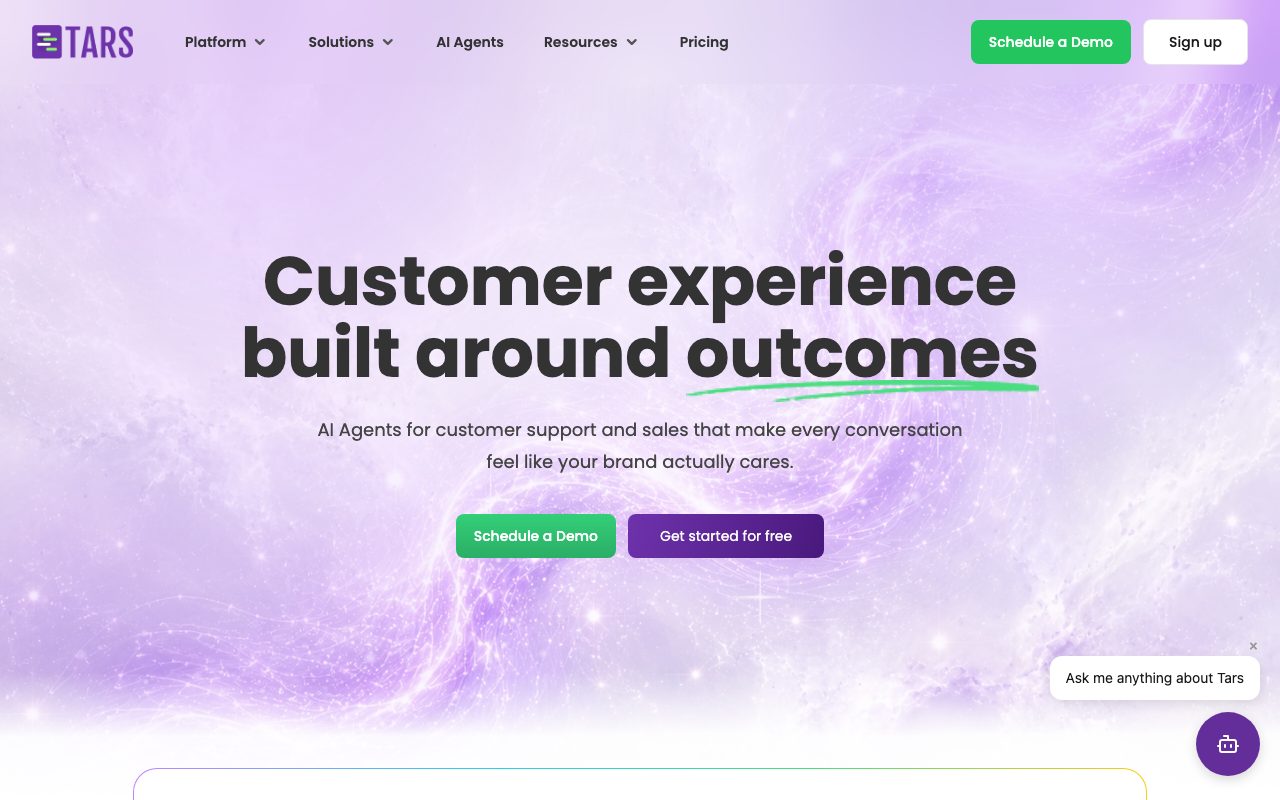
Tars is an AI agent platform that enables organizations to build, test, and deploy conversational customer service and sales agents across web, WhatsApp, and email using RAG and 700+ tool integrations.
Tars is an AI agent platform engineered to automate customer support and lead acquisition workflows without losing context across contact channels. Built around a closed loop of building, testing, deploying, analyzing, and improving, the platform allows teams to set agent instructions, connect authoritative knowledge, and wire up execution tools. The system's RAG engine ingests unstructured assets such as PDFs, website documentation, and Notion workspaces using semantic chunking, vector embeddings, and hybrid keyword-semantic retrieval. Chunks are re-ranked by relevance before generating responses, grounding answers in verified knowledge to limit hallucinations. Changes made to knowledge sources synchronize with active agents in real time. A primary focus of Tars is pre-deployment validation. Its AI Evaluation suite generates synthetic conversation datasets from connected sources and rates agent responses across Answer Accuracy, Context Relevance, and Answer Faithfulness. Teams can incorporate human feedback scores, review failed runs, and establish data-backed quality thresholds before deploying agents into production. Once live, agents operate across Web widgets, WhatsApp, and Email within a unified conversation thread. Using visual Tool Gambits, agents orchestrate actions across external systems—updating CRM records, checking inventory, booking appointments, or generating support tickets in real time.
Unlike conversational builders that rely on live trial-and-error, Tars incorporates an end-to-end evaluation suite that generates synthetic test sets to benchmark accuracy, relevance, and faithfulness against custom quality thresholds before deployment.
Product capabilities
Key features
Synthetic AI Evaluation Suite
Generates synthetic conversation datasets from your knowledge base to test edge cases, tool triggers, and guardrails, scoring results on accuracy, context relevance, and faithfulness.
Hybrid RAG Architecture
Performs vector similarity search combined with keyword matching, recency weighting, and chunk re-ranking, updating active agents automatically upon documentation changes.
700+ Tool Gambits
Integrates agents with external software like CRMs, databases, and payment processors with granular sub-tool permissions and custom REST API endpoint definitions.
Omnichannel Unified Memory
Maintains persistent conversation context across Web, WhatsApp, and Email so customer interactions continue without restarting across channels.
Failure Attribution & Analytics
Tracks topic clusters, sentiment analysis, and AI-CX quality scores, linking conversational failures back to the specific prompt or retrieval configuration that caused them.
Practical fit
Who should use Tars?
Customer Support Automation
Handles transactional support inquiries such as refund requests, return labeling, and ticket creation across messaging channels without agent intervention.
Inbound Lead Qualification
Interacts with after-hours website traffic, matches prospects to suitable products or plans, and automatically schedules consultations or meetings.
Citizen and Patient Service Navigation
Directs healthcare patients to specific facilities or logs municipal work orders for public service requests through conversational interfaces.
Editorial assessment
Pros and limitations
Where it is strong
- Built-in evaluation environment measures agent performance before exposing it to real users.
- Over 700 pre-configured tool connectors with granular sub-tool permission controls.
- Thread persistence preserves conversation history across Web, WhatsApp, and Email.
- Official compliance with GDPR, ISO, SOC 2, and HIPAA regulations.
Where to be careful
- Specific subscription tiers, message quotas, and enterprise pricing are not published on the site.
- No on-premises or open-source hosting options are available.
Commercial context
Tars pricing
As of September 2026, Tars provides a free starting option alongside direct enterprise sales and demo requests. Specific plan costs, seat limits, and usage tiers are not published on the reviewed pages and must be verified on the official website.
Pricing, limits, taxes, model access, and regional availability can change. Verify the purchase-critical details on the official pricing page linked under Sources.
Transparent ranking
Why Tars scores 72.1
Each factor is scored on a 100-point scale, then combined using the public ToolsRank weights. Engagement and momentum stay at a neutral baseline until measured signals exist, so no tool can gain or lose position from numbers nobody recorded.
Compatibility
Languages, platforms, and integrations
Languages
- English
- Multilingual
Integrations & surfaces
- Salesforce
- Stripe
- Airtable
- MaintainX
- Zapier
- Google Analytics
- Facebook Pixel
Community
Reviews and questions
No approved member reviews yet. Editorial factors above are the only rating on this page.
Reviews and questions come from Google-signed members and are checked by an editor before they appear.
Frequently asked
Tars FAQ
What channels does Tars support for agent deployment?+
Tars allows a single agent configuration to deploy across Web chat widgets, WhatsApp, and Email. The platform treats channel identity as metadata on the conversation, keeping the thread and context unbroken when users switch channels.
How does the AI Evaluation feature work?+
The platform analyzes your prompt instructions, knowledge base, and connected tools to generate synthetic test questions and edge cases. It scores outputs on Answer Accuracy, Context Relevance, and Answer Faithfulness, combining automated metrics with optional human ratings so teams can set deployment readiness thresholds.
Can Tars agents execute tasks in third-party systems?+
Yes. Tars provides drag-and-drop Tool Gambits supporting over 700 integrations (including Salesforce, Stripe, MaintainX, and Airtable), as well as custom API connectors. Administrators can select specific sub-tools to grant read, write, or update permissions.
What security and regulatory standards does Tars meet?+
Tars states compliance with GDPR, ISO standards, SOC 2, and HIPAA, with OAuth and encrypted API keys used for external tool connections.