Direct answer
What is Tavus?
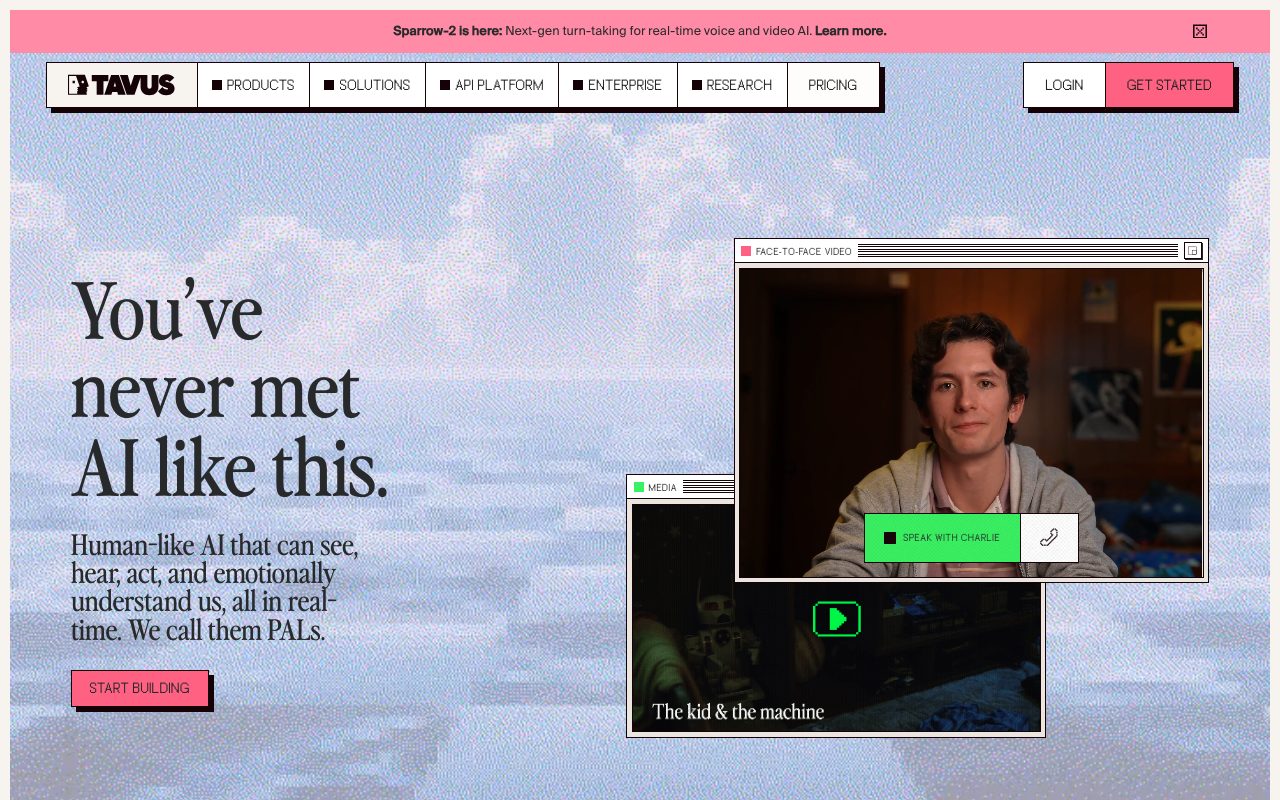
Tavus is a conversational video AI platform that combines photorealistic human rendering, multimodal perception, and low-latency turn-taking to deliver interactive video agents via APIs and no-code tools.
Tavus builds foundational technology for what it terms 'Human Computing', enabling machines to interact face-to-face through speech and visual presence in real time. The platform is anchored by three proprietary models: Phoenix-4, a Gaussian-diffusion rendering model that synthesizes facial expressions, emotions, and movement; Raven-1, a multimodal perception model that interprets facial cues, gaze, audio tone, and environmental context; and Sparrow-2, an intelligent turn-taking model designed to handle interruptions, prosody, and natural conversational flow in noisy environments. For builders, Tavus provides both the Conversational Video Interface (CVI) Developer API and a no-code PAL Maker. Through these tools, teams can configure digital agents (called PALs) equipped with retrieval-augmented generation (RAG) knowledge bases, function calling, persistent memory, and guardrails. Replicas can be chosen from stock human libraries or trained on a brief two-minute video of a real individual. In addition to real-time WebRTC streaming at 1080p and 24kHz audio, the platform supports asynchronous video generation, alpha-channel video cutouts, and live meetings across platforms like Zoom and Google Meet.
Unlike traditional avatar tools that generate static one-way video from a prompt or script, Tavus provides a full two-way conversational stack combining real-time face synthesis, computer vision perception, and low-latency turn-taking for live, interactive video calls.
Product capabilities
Key features
Phoenix-4 Real-Time Rendering
Generates photorealistic facial movements, dynamic emotional expressions, and full-face synthesis in real time using Gaussian diffusion.
Raven-1 Multimodal Perception
Enables digital agents to see and hear conversational partners, interpreting facial cues, emotional tone, gaze, and environment in real time.
Sparrow-2 Turn-Taking Architecture
Manages natural conversational flow by recognizing prosody, speaker identity, interruptions, and background noise to determine when to listen or speak.
Conversational Video Interface (CVI) APIs
Developer platform delivering end-to-end conversational pipelines including WebRTC streaming, ASR, TTS, transcription, and custom LLM routing.
Custom Replica Training
Creates personalized digital human replicas and custom voice models from as little as a two-minute training video upload.
Knowledge Bases and Persistent Memory
Equips agents with contextual knowledge via uploaded documents (PDF, CSV, TXT, PPTX) and provides persistent memory across repeat conversations.
No-Code PAL Maker
A visual interface allowing non-technical creators to configure, customize, and deploy interactive PAL agents with prompts and custom knowledge.
Practical fit
Who should use Tavus?
Automated Customer Support
Deploy visual agents that diagnose product defects via user camera streams, verify warranty documents, and handle troubleshooting calls.
Go-to-Market & Sales Outreach
Engage website visitors with face-to-face digital reps that answer product questions in real time and schedule qualification meetings.
Patient Intake & Healthcare Triage
Conduct conversational patient intake interviews at the patient's own pace, compiling structured summaries for clinical staff.
Interactive Learning & Roleplay Training
Provide dynamic, repeatable roleplaying sessions for employee onboarding, customer service drills, and language education.
Editorial assessment
Pros and limitations
Where it is strong
- Supports true two-way real-time conversational video streaming rather than just pre-rendered outputs
- Proprietary vision and turn-taking models (Raven-1 and Sparrow-2) handle natural interruptions and environmental context
- Flexible integration options including WebRTC APIs, LiveKit, Pipecat, Google Meet, and Zoom
- Custom replica creation requires minimal source footage (two minutes of video)
Where to be careful
- Usage costs can scale rapidly when streaming high volumes of real-time conversational video minutes
- Concurrent stream caps limit simultaneous active conversations on lower-tier developer plans
- Requires careful prompt guardrail configuration to prevent conversational hallucinations in client-facing deployments
Commercial context
Tavus pricing
Pricing snapshot as of September 2026. Tavus offers separate tiers for consumer PALs (starting at $0 to $50/month) and developer API platforms (ranging from free testing up to $975/month plus usage-based overage fees). Terms and usage caps should be verified on the official Tavus pricing page.
Pricing, limits, taxes, model access, and regional availability can change. Verify the purchase-critical details on the official pricing page linked under Sources.
Transparent ranking
Why Tavus scores 75.1
Each factor is scored on a 100-point scale, then combined using the public ToolsRank weights. Engagement and momentum stay at a neutral baseline until measured signals exist, so no tool can gain or lose position from numbers nobody recorded.
Compatibility
Languages, platforms, and integrations
Languages
- English
- Multilingual (supports 30+ to 42+ languages depending on plan)
Platforms
- Web
- API
Integrations & surfaces
- WebRTC
- Google Meet
- Zoom
- LiveKit
- Pipecat
- Google Workspace
- REST API
Community
Reviews and questions
No approved member reviews yet. Editorial factors above are the only rating on this page.
Reviews and questions come from Google-signed members and are checked by an editor before they appear.
Frequently asked
Tavus FAQ
What is the difference between Tavus PALs and traditional AI avatars?+
Traditional AI avatars are typically one-way render engines that convert text scripts into pre-recorded MP4 videos. Tavus PALs are two-way conversational agents equipped with real-time video rendering, computer vision perception, and turn-taking models, allowing them to see, hear, and converse live with users.
Can I train a custom digital replica of myself or a teammate?+
Yes. Tavus allows users to train hyperrealistic custom replicas and corresponding voice models using a two-minute video recording, subject to replica consent verification workflows.
Can I bring my own language model to Tavus?+
Yes. The Tavus CVI pipeline allows developers to integrate their own LLMs or select from fine-tuned options provided by Tavus, alongside custom tools and function calling.
How are real-time conversations billed?+
Conversational Video Interface minutes are allocated monthly according to the plan tier. Overages are billed on a pay-as-you-go basis per additional minute (rounded to 6-second increments), with each conversation incurring a 30-second minimum charge.
Does Tavus support transparent video backgrounds?+
Yes. Tavus supports alpha channel video streaming, which provides a human cutout with a transparent background for integration into customized user interfaces.