
Direct answer
What is Unstructured?
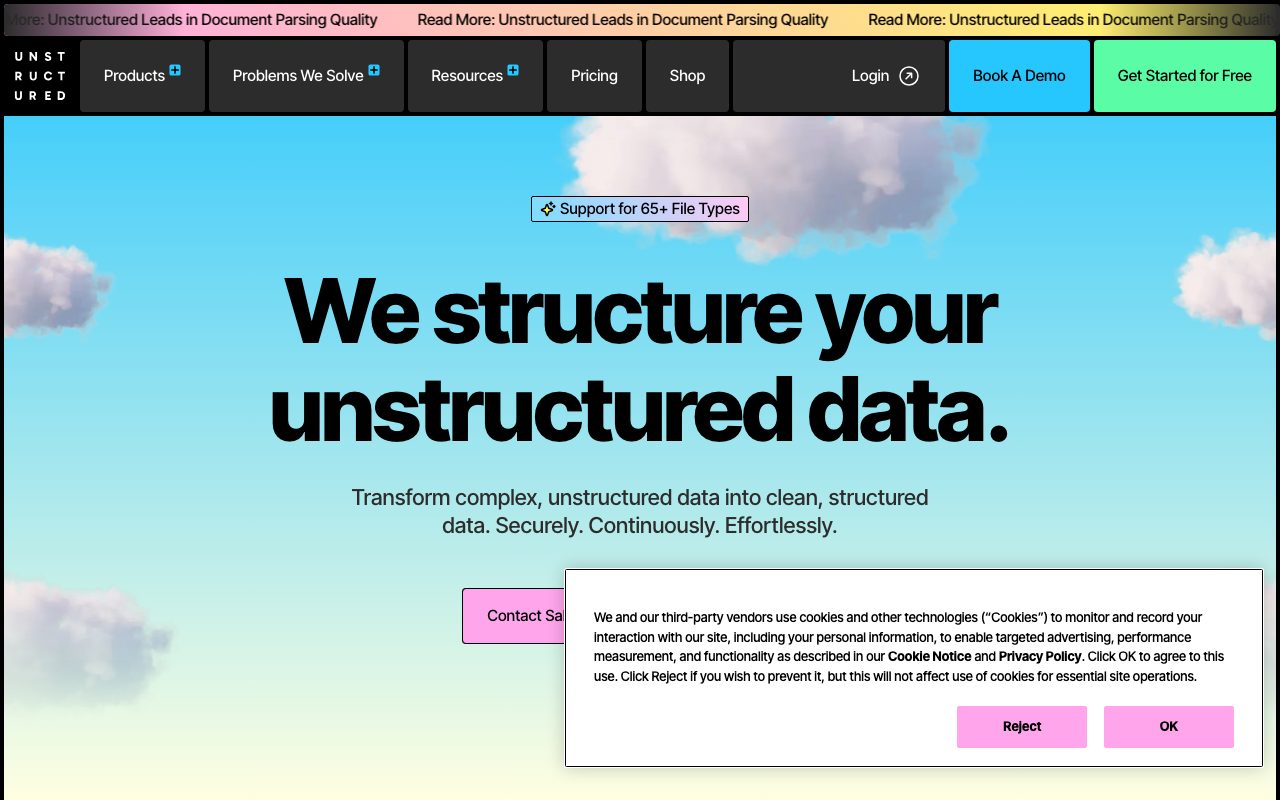
Unstructured is a document ingestion and transformation platform that extracts, partitions, enriches, and chunks messy enterprise documents into clean, structured data for LLM and vector pipelines.
Unstructured automates the ingestion and preprocessing required to make messy enterprise documents accessible to large language models. The platform handles over 50 document and image formats, including PDFs, Microsoft Office files, HTML, and scans, converting them into uniform structured elements. Its transformation pipeline provides specialized partitioning strategies (such as Fast, High-Res, and Vision Language Model workflows), layout intelligence to preserve document hierarchy and reading order, and table parsing that keeps rows, columns, and headers intact. Extracted elements can be enriched with optical character recognition (OCR), named entity recognition (NER), and image or table descriptions, and then chunked by character, title, page, or semantic similarity. Unstructured integrates with more than 40 source and destination connectors, enabling data engineering teams to ingest from systems like Amazon S3, Google Drive, SharePoint, and Salesforce, and output to vector databases such as Pinecone, Qdrant, Chroma, and Databricks. Deployment options range from multi-tenant SaaS to dedicated VPC instances across AWS, Azure, and GCP.
Unstructured provides specialized parsing and layout intelligence across 50+ document types with native partitioning, table structure preservation, enrichment, and over 40 enterprise connectors.
Product capabilities
Key features
Broad File Support
Parses more than 50 document and image file types, including PDF, DOCX, PPTX, HTML, MSG, and image formats like TIFF and PNG.
Layout Intelligence and OCR
Extracts text from scans, images, and handwriting while preserving visual hierarchy, section order, and layout context.
Structured Table Parsing
Retains row, column, header, and multi-page relationships to convert complex document tables directly into structured output or HTML.
Flexible Partitioning Strategies
Supports multiple transformation strategies, including Auto, Fast, High-Res, and Vision Language Model (VLM) processing.
Contextual Chunking
Splits documents into model-ready chunks by character, title, page, similarity, or contextual boundaries.
Metadata and Enrichment Pipeline
Applies named entity recognition, generative OCR, image descriptions, and schema evolution during processing.
40+ Connectors
Connects directly to sources like S3, Box, Google Drive, and SharePoint, and loads processed output into vector stores like Pinecone, Weaviate, and Milvus.
Enterprise Deployment Options
Deployable as multi-tenant SaaS, dedicated instance, or within a private VPC on AWS, Azure, or GCP with SOC 2 Type 2 and HIPAA compliance.
Practical fit
Who should use Unstructured?
Retrieval-Augmented Generation (RAG) Preprocessing
Ingest mixed repositories of internal documentation, manuals, and reports into vector databases with structured metadata and contextual chunking.
Financial Report Extraction
Extract complex multi-page financial tables, regulatory disclosures, and earnings reports without losing table cell alignments.
Legal and Insurance Form Parsing
Digitize and normalize ACORD forms, policy contracts, and dense legal filings for downstream search and automated review.
Continuous Pipeline Ingestion
Monitor cloud buckets or SharePoint folders with change detection intelligence to process updated documents incrementally.
Editorial assessment
Pros and limitations
Where it is strong
- Generous starter allocation of 10,000 free pages without requiring a credit card
- Broad format support covering over 50 file extensions
- High-accuracy table and layout parsing tailored for LLM chunking
- Dozens of native connectors for cloud storage, business apps, and vector databases
- Private VPC and dedicated deployment options for regulated environments
Where to be careful
- Primarily developer-focused; requires pipeline integration or API usage rather than a simple consumer interface
- Certain connectors and custom enrichment models require VPC or Business tier agreements
Commercial context
Unstructured pricing
Pricing as of review date (September 2026). Includes 10,000 free pages with no credit card required, followed by $0.015 per page on pay-as-you-go. Dedicated VPC and custom enterprise plans require sales contact. Verify current terms on the official pricing page.
| Plan | Price | What it includes |
|---|---|---|
| Free | $0 / initial credit limit of 10,000 pages with no credit card required | |
| Pay-As-You-Go | $0.015 / per page after the first 10,000 free pages | |
| Business | Custom / custom annual or dedicated billing based on deployment requirements |
Pricing, limits, taxes, model access, and regional availability can change. Verify the purchase-critical details on the official pricing page linked under Sources.
Transparent ranking
Why Unstructured scores 79.5
Each factor is scored on a 100-point scale, then combined using the public ToolsRank weights. Engagement and momentum stay at a neutral baseline until measured signals exist, so no tool can gain or lose position from numbers nobody recorded.
Compatibility
Languages, platforms, and integrations
Languages
- English
Platforms
- Web
- API
- AWS
- Azure
- GCP
Integrations & surfaces
- Amazon S3
- Google Cloud Storage
- Microsoft SharePoint
- Azure Blob Storage
- Pinecone
- Qdrant
- Weaviate
- Databricks
- Snowflake
- Elasticsearch
- Salesforce
- Box
Community
Reviews and questions
No approved member reviews yet. Editorial factors above are the only rating on this page.
Reviews and questions come from Google-signed members and are checked by an editor before they appear.
Frequently asked
Unstructured FAQ
What is Unstructured?+
Unstructured is a data processing platform designed to extract, partition, enrich, and chunk unstructured documents (such as PDFs, Word files, and images) into clean, structured data ready for LLMs and vector search engines.
How is Unstructured priced?+
Unstructured provides 10,000 free pages to get started with no credit card required. After the initial free pages, the pay-as-you-go plan costs $0.015 per page. Enterprise deployments in a dedicated instance or private VPC use custom pricing.
What document types can Unstructured process?+
Unstructured supports more than 50 document, image, and data formats, including PDF, DOCX, PPTX, XLSX, HTML, EML, MSG, CSV, TXT, EPUB, PNG, JPEG, and TIFF.
Can Unstructured run in private cloud environments?+
Yes. On the Business plan, Unstructured can be deployed as a dedicated cloud-hosted instance or inside an in-VPC environment on AWS, Azure, or Google Cloud Platform, as well as bare metal.
Does Unstructured handle OCR and image tables?+
Yes. The platform includes generative OCR and layout intelligence capable of capturing text from scans, handwriting, and complex multi-page tables while maintaining cell and hierarchy relationships.


