Direct answer
What is Vanna AI?
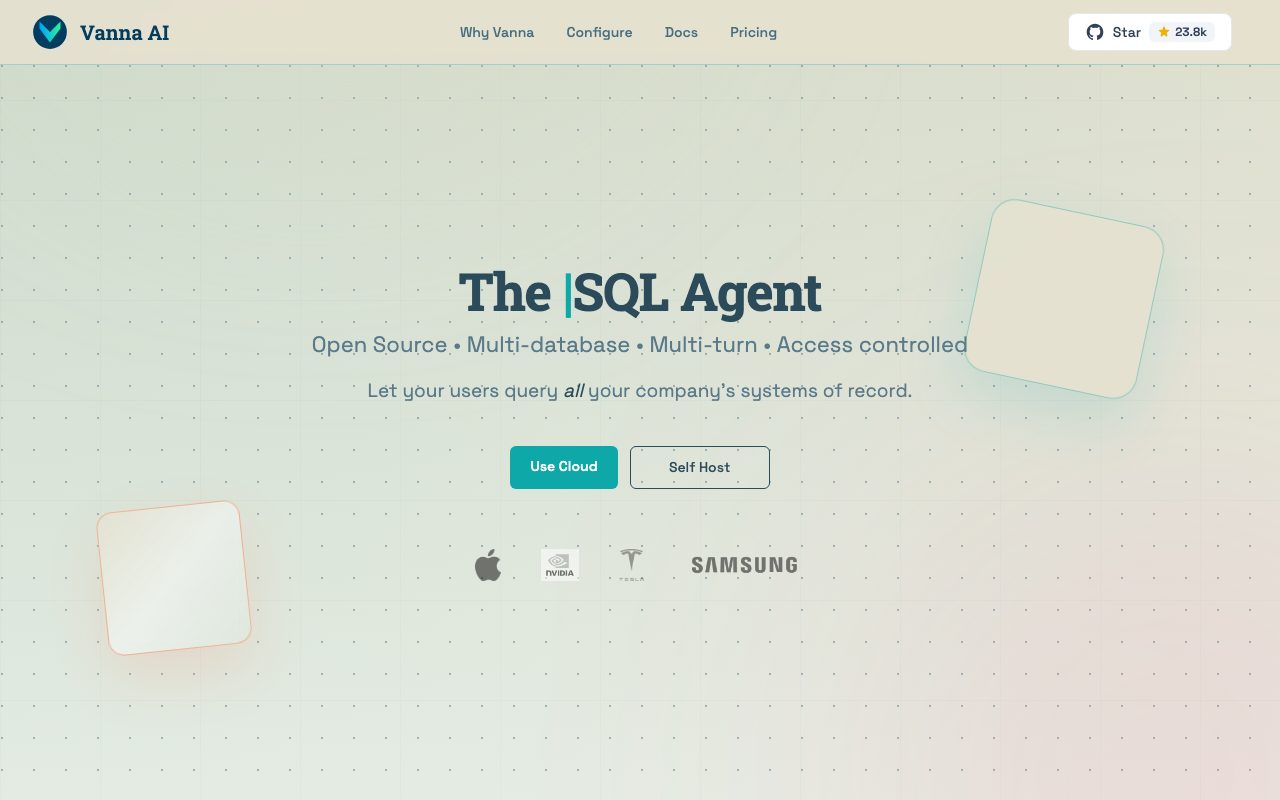
Vanna AI is an open-source, user-aware AI SQL agent framework that connects major language models to relational databases and data warehouses, using tool memory to learn schemas and business logic over time.
Vanna AI is a framework for developing text-to-SQL conversational agents across company data stores. Developed to bridge large language models and analytical systems of record, it enables end users to query databases in plain English without requiring manual SQL authoring. The framework supports self-hosting via Python ('pip install vanna') as well as managed cloud deployments. The core system connects LLM providers—including Anthropic, OpenAI, Google Gemini, and local Ollama instances—to database backends like PostgreSQL, MySQL, Snowflake, BigQuery, and SQLite. Vanna 2.0 incorporates a dual-path execution flow based on Tool Memory: novel prompts trigger investigative query execution and store successful patterns into memory, while recurring questions adapt known examples quickly. This architecture allows the agent to continuously learn schemas, joins, and custom organizational metrics without retraining the underlying language model. In addition to the open-source agent engine, Vanna offers governance and administrative capabilities across both OSS and cloud setups. These include role-level access controls, distributed tracing, audit logging, long-term conversation retention, file storage, and a vector-backed memory layer. Teams can run simple Colab demos with sample databases like Chinook, embed Vanna in internal web apps, or run it in enterprise VPCs.
Unlike static text-to-SQL prompt wrappers, Vanna operates as an access-controlled agent framework with Tool Memory, automatically retaining successful queries and tool usage patterns to improve accuracy over time across multiple database backends and LLM providers.
Product capabilities
Key features
Tool Memory and Continuous Learning
Saves successful SQL queries and tool usage to memory, automatically referencing past patterns to adapt to future questions without manual model training.
Pluggable LLM and Database Architecture
Works across LLM providers including Anthropic, OpenAI, Gemini, and local Ollama, connecting to PostgreSQL, MySQL, SQLite, Snowflake, BigQuery, and more.
User-Aware Access Controls
Enforces granular user permissions through the full query execution chain, ensuring end users can only view authorized database records.
Observability and Distributed Tracing
Delivers real-time execution metrics and tracing to track agent performance, query execution speed, and tool invocation failures.
Compliance Audit Logs
Tracks query activity, user sessions, and operational events for enterprise compliance and security verification.
Flexible Deployment Modes
Can be self-hosted via the Python open-source package, run in Google Colab, managed in Vanna Cloud, or deployed on-premises with SAML SSO.
Practical fit
Who should use Vanna AI?
Self-Serve Business Analytics
Enable non-technical colleagues to interrogate warehouse databases like Snowflake and BigQuery using conversational language.
Embedded Chatbot in Custom Applications
Integrate natural-language SQL generation and chart building directly into internal tools or SaaS applications via API and web UI.
Local-Only Data Exploration
Connect local models via Ollama to private SQLite or PostgreSQL databases for secure offline query generation without external API calls.
Editorial assessment
Pros and limitations
Where it is strong
- Open-source core available via Python packaging with zero vendor lock-in
- Broad support for major proprietary and local LLMs (Anthropic, OpenAI, Gemini, Ollama)
- Learns schema and query logic over time using persistent Tool Memory
- Granular user permissions and access controls built into the agent execution loop
Where to be careful
- Entry managed cloud tiers enforce strict daily throughput limits (e.g., 20 questions/day on Explorer)
- Requires technical setup, Python literacy, or database credential management
Commercial context
Vanna AI pricing
Pricing snapshot as of September 2026. Self-hosting the core Python framework is open source. Managed cloud plans start at $50/month for Explorer (20 queries/day) and $500/month for Team (300 queries/day). Annual billing offers a 20% discount. Contact the vendor to verify current terms.
| Plan | Price | What it includes |
|---|---|---|
| Explorer | $50 / month (billed monthly, 20% discount on annual billing in checkout or sales inquiry; limit resets every 24 hours; rate-limited when exceeded). Includes 20 questions/day, admin features, API, same day email support. | |
| Team | $500 / month (billed monthly, 20% discount on annual billing). Includes 300 questions/day, setup support, same day live support, and all Explorer features. | |
| Enterprise | Custom / custom (contract-based billing via sales consultation). Unlimited scale and questions, on-prem deployment, SAML SSO, admin user provisioning API, and custom integrations. |
Pricing, limits, taxes, model access, and regional availability can change. Verify the purchase-critical details on the official pricing page linked under Sources.
Transparent ranking
Why Vanna AI scores 74.6
Each factor is scored on a 100-point scale, then combined using the public ToolsRank weights. Engagement and momentum stay at a neutral baseline until measured signals exist, so no tool can gain or lose position from numbers nobody recorded.
Compatibility
Languages, platforms, and integrations
Languages
- English
Integrations & surfaces
- PostgreSQL
- MySQL
- SQLite
- Snowflake
- Google BigQuery
- OpenAI
- Anthropic
- Google Gemini
- Ollama
Community
Reviews and questions
No approved member reviews yet. Editorial factors above are the only rating on this page.
Reviews and questions come from Google-signed members and are checked by an editor before they appear.
Frequently asked
Vanna AI FAQ
What is Vanna AI?+
Vanna AI (version 2.0) is a user-aware AI SQL agent framework that connects language models to databases, allowing users to query data using natural language while enforcing permissions and learning from successful queries.
Can I use Vanna for free?+
Yes. Vanna offers an open-source core framework that can be self-hosted using Python via 'pip install vanna'. Paid plans are for managed cloud services and enterprise infrastructure.
What happens when daily question limits are reached on cloud plans?+
Daily question throughput limits reset every 24 hours. When limits are exceeded, requests are rate-limited until the next reset period, unless upgraded to a higher tier.
Which databases and LLMs are supported?+
Vanna supports databases including SQLite, PostgreSQL, MySQL, Snowflake, and Google BigQuery, alongside models from Anthropic, OpenAI, Google Gemini, and Ollama for local execution.