
Direct answer
What is Activepieces?
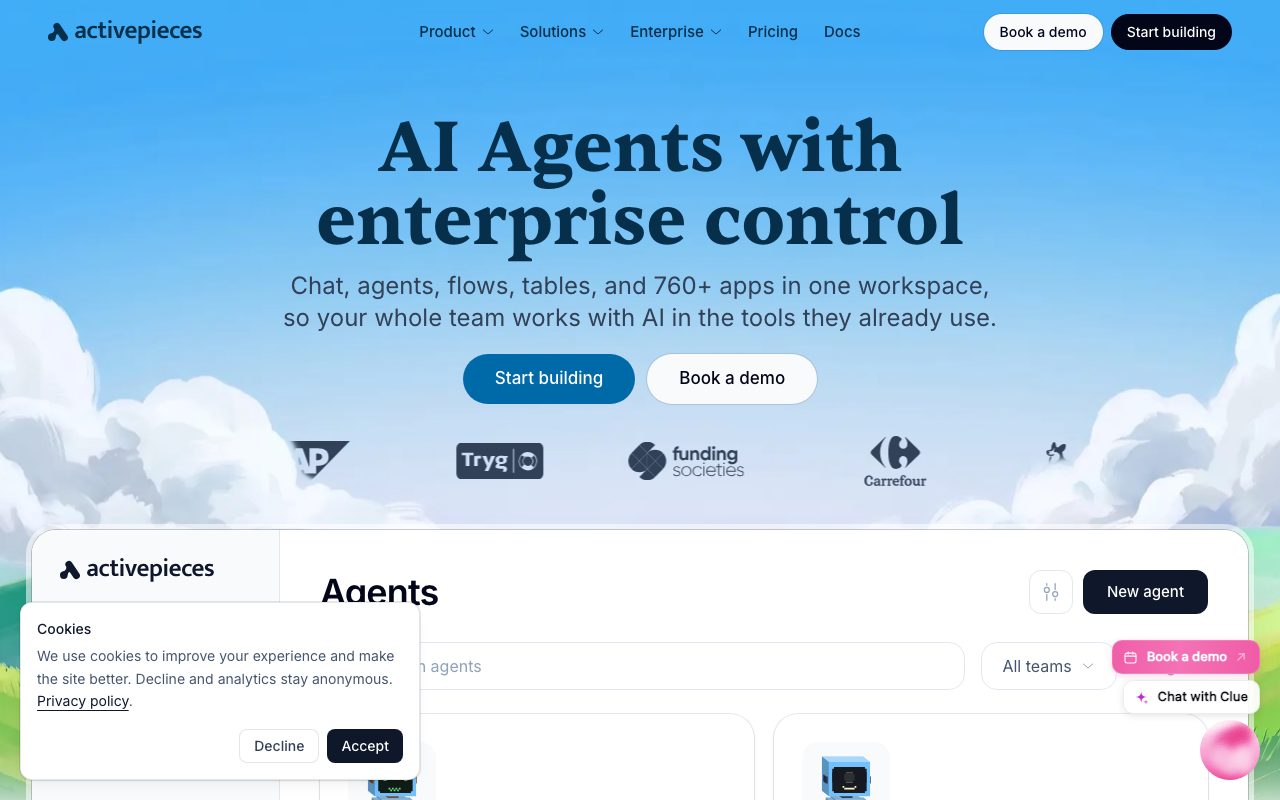
Activepieces is an open-source automation platform combining visual workflows, AI agents, chat-driven builders, and internal tables. It connects over 760 applications and can run on managed EU cloud, self-hosted Docker/Kubernetes clusters, or air-gapped infrastructure.
Activepieces offers a unified workspace for workflow automation and autonomous AI agents. At its core, the platform provides a visual canvas for chaining triggers and actions across more than 760 applications, supported by open-source MIT-licensed connectors called pieces. When complex logic exceeds standard connectors, users can write inline TypeScript or call arbitrary REST and GraphQL endpoints via a universal HTTP step. Beyond linear automations, Activepieces incorporates agentic capabilities. Autonomous agents can be assigned tasks in plain language, dynamically selecting tools and connected apps to complete assignments while checking in for human approval on high-risk operations. The platform also offers an MCP (Model Context Protocol) server, allowing external AI clients like Claude, Cursor, and Windsurf to trigger workflows and access connected tools. Built for organizational governance, the platform includes team-level workspaces, role-based access control, SSO/SCIM integration, secret manager connections (such as HashiCorp Vault, AWS Secrets Manager, and 1Password), and SIEM-compatible audit streaming. Deployment options include a Frankfurt-based EU cloud, on-premises deployment via Docker or Kubernetes, or an air-gapped setup operating entirely without outbound internet access.
Activepieces combines an MIT-licensed core with native Model Context Protocol (MCP) server support, allowing both self-hosted enterprise deployment (including air-gapped environments) and direct workflow invocation from external AI development environments like Claude and Cursor.
Product capabilities
Key features
Visual Flow Builder
Connect triggers, branching, loops, retries, waitpoints, and subflows across 760+ applications, with the option to drop into TypeScript for complex custom logic.
Autonomous AI Agents
Deploy agents that accept goals in plain language, choose from connected tools autonomously, and pause for human confirmation when handling sensitive actions.
Chat-to-Workflow Generator
Generate and revise workflow drafts by describing requirements in natural language through an embedded chat interface.
MCP Server Integration
Expose automations and tools as an MCP endpoint compatible with external developer tools and agents such as Claude, Cursor, and Windsurf.
Built-In Tables and Knowledge Base
Store operational records in relational tables and ground agents with searchable internal documentation.
Enterprise Security and Isolation
Keep secrets safe with vault integrations, run workflows in sandboxed isolates, and stream full audit logs to external SIEM systems.
White-Label Embed SDK
Embed the complete workflow builder, tables, and connection managers inside SaaS products under custom branding.
Practical fit
Who should use Activepieces?
Automated Document and Invoice Triage
Extract invoices from incoming emails, match line items against purchase orders, and flag payments for human review before updating accounting systems.
Inbound Lead Scoring and Enrichment
Trigger enrichment on demo requests, calculate scores, update CRM records, and ping sales representatives in team chat channels.
Developer Workflow Assistance via MCP
Expose internal tools and database queries through the Activepieces MCP server so coding assistants in Cursor or Claude can trigger production tasks securely.
Sovereign and Air-Gapped Automation
Run automation workflows and private LLM endpoints inside isolated corporate networks without allowing outbound internet connections.
Editorial assessment
Pros and limitations
Where it is strong
- Open-source MIT core allows auditing, modification, and self-hosting without licensing fees for basic automation.
- Native support for Model Context Protocol (MCP) bridges automations directly into IDEs and LLM clients.
- Comprehensive hosting choices: EU-managed cloud, self-hosted Docker/Kubernetes, or fully air-gapped environments.
- Credentials stay masked and can be fetched directly at runtime from external secret vaults like HashiCorp Vault or AWS Secrets Manager.
Where to be careful
- AI actions and model calls consume extra credits unless bringing custom provider API keys.
- Advanced team governance features like SSO, SCIM, and project isolation require higher-tier paid plans.
Commercial context
Activepieces pricing
At the review date (September 2026), Activepieces offers a permanent free tier with 100 daily credits, a Plus plan at $16/month billed annually with 10,000 monthly credits, a Team plan at $166/month billed annually with 50,000 credits, and custom Ultimate enterprise pricing. Cloud and self-hosted deployments share the same pricing structure. Check the vendor pricing page for current rates.
Pricing, limits, taxes, model access, and regional availability can change. Verify the purchase-critical details on the official pricing page linked under Sources.
Transparent ranking
Why Activepieces scores 75.8
Each factor is scored on a 100-point scale, then combined using the public ToolsRank weights. Engagement and momentum stay at a neutral baseline until measured signals exist, so no tool can gain or lose position from numbers nobody recorded.
Compatibility
Languages, platforms, and integrations
Languages
- English
Integrations & surfaces
- OpenAI
- Anthropic
- Google Gemini
- AWS Bedrock
- Slack
- HubSpot
- Stripe
- Salesforce
- GitHub
- HashiCorp Vault
- Splunk
- PostgreSQL
Community
Reviews and questions
No approved member reviews yet. Editorial factors above are the only rating on this page.
Reviews and questions come from Google-signed members and are checked by an editor before they appear.
Frequently asked
Activepieces FAQ
What is included in the Activepieces free plan?+
The free plan grants 100 credits per day, unlimited flows, access to flows, agents, tables, and MCP integration for a single user without requiring a credit card. Unused credits do not roll over, and runs pause until the next day once the daily limit is exhausted.
How do credits work across flows and AI steps?+
A standard workflow run consumes one credit regardless of the number of non-AI steps. When using managed AI steps, fast models consume 2 credits, smart models 10 credits, and frontier models 20 credits, while agentic steps use 1 credit each. Connecting your own provider API keys on paid plans reduces AI steps to 1 credit per execution.
Can Activepieces be hosted on private infrastructure?+
Yes. Activepieces can be deployed on self-managed infrastructure using Docker or Kubernetes. The vendor also supports air-gapped deployments where no outbound internet connectivity is permitted, allowing users to point agents at locally hosted, OpenAI-compatible model endpoints.
How are third-party credentials handled securely?+
Credentials are encrypted at rest with AES-256 and in transit via TLS. Saved credentials cannot be viewed again in the UI or retrieved via API exports. Agents reference connection names rather than secret values, and paid plans support pulling credentials directly at runtime from external vaults like HashiCorp Vault or AWS Secrets Manager.
What happens if a tool lacks a pre-built connector?+
Users can connect any system with an API using the built-in HTTP piece, which manages authentication and pagination. Additionally, because the connector framework is open-source TypeScript, teams can author and run custom pieces.