Direct answer
What is Airtable?
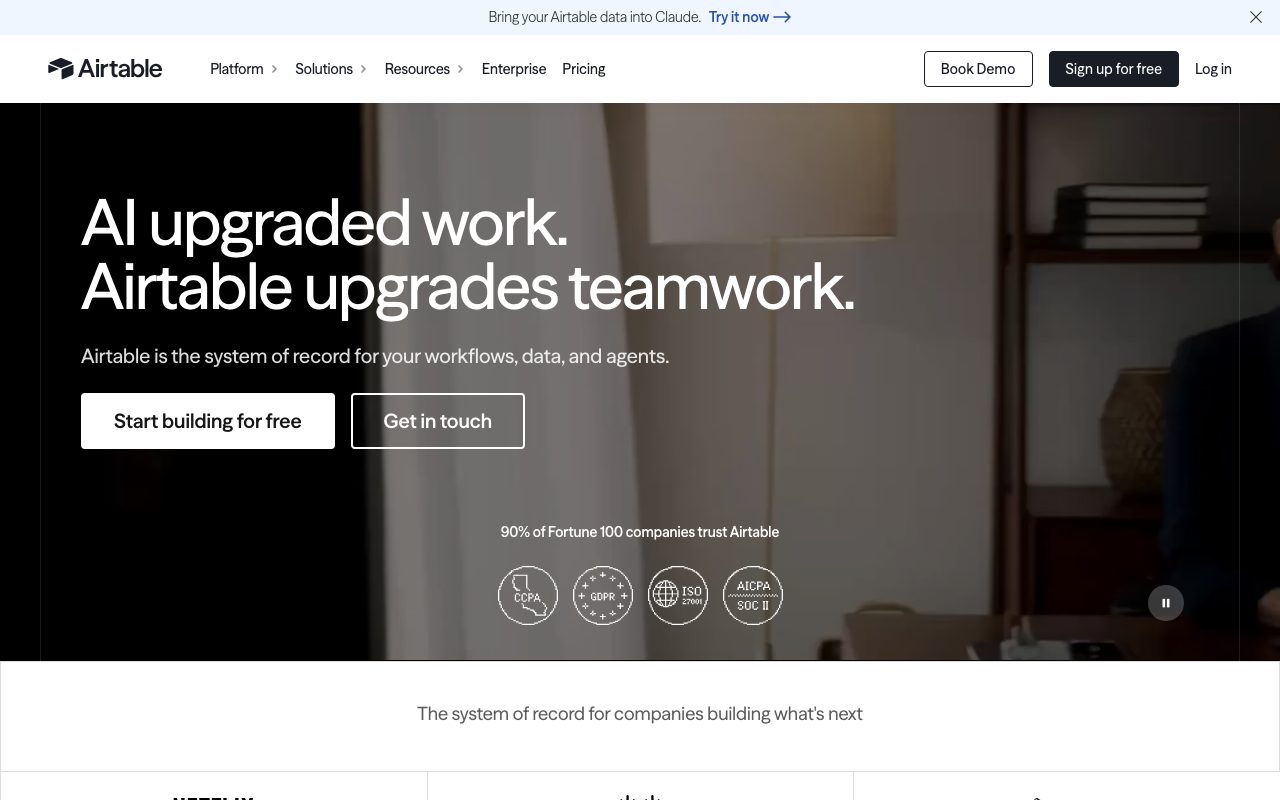
Airtable is a cloud-based relational database and app development platform that blends spreadsheet simplicity with database structure. It allows teams to create custom interfaces, automate cross-app workflows, and deploy native AI agents.
Airtable provides a collaborative platform combining relational databases, interface design, automated workflows, and embedded artificial intelligence. Rather than relying on rigid off-the-shelf software or static spreadsheets, teams can design tailored business applications using building blocks like custom views (Grid, Kanban, Calendar, and Gallery) and interactive Interfaces. The platform includes native automations that trigger actions across external services such as Slack, Google Drive, Zendesk, Salesforce, and Jira. For larger teams, Airtable offers enterprise data scaling through HyperDB, supporting datasets into hundreds of millions of records, alongside enterprise governance features like role-based access control, SSO/IDP sync, audit logging, and regional data residency. Recent additions incorporate Airtable AI and AI Agents directly into records and business processes. Users can summarize text, translate collateral, extract attributes, and trigger agentic operations across thousands of records. Airtable states that customer data is neither retained nor used to train third-party foundation models, which run within Airtable's AWS environment using models from OpenAI, Anthropic, Google, Meta, and others.
Unlike standard spreadsheets, Airtable provides true relational database architecture paired with a drag-and-drop interface builder and native AI agents capable of reasoning across hundreds of millions of records.
Product capabilities
Key features
Relational Databases
Connect related tables and records across workflows to create structured single sources of truth with rich field types.
AI App Building and Interfaces
Assemble drag-and-drop front-end interfaces and portals for teammates and external guests without writing code.
AI Agents and Embedded AI
Deploy AI agents across records to summarize text, categorize input, translate assets, and orchestrate automated actions.
Multi-Step Automations
Configure logic-based triggers and actions that sync data, send notifications, and execute tasks across integrated apps.
HyperDB Enterprise Scale
Scale operational datasets up to hundreds of millions of records with high-performance querying and organizational administration.
Enterprise Security and Governance
Manage access with fine-grained role-based permissions, IDP group syncing, data loss prevention, audit logs, and ISO/SOC 2/HIPAA compliance.
Practical fit
Who should use Airtable?
Marketing Campaign and Content Management
Plan creative production calendars, track multi-channel assets, and run automated localization checks across deliverables.
Product Operations and Roadmapping
Consolidate user feedback, prioritize product feature backlogs, and sync tickets automatically into development tools like Jira.
Event and Guest Coordination
Collect registrations through forms, personalize attendee communications via AI plays, and share restricted views with outside partners using portals.
Editorial assessment
Pros and limitations
Where it is strong
- Combines the visual ease of a spreadsheet with strict relational database capabilities.
- Native interface designer enables creation of customized internal tools for non-technical users.
- Integrated AI features leverage models from major providers without training models on customer data.
- Read-only collaborators and form respondents do not count against paid editor seats.
Where to be careful
- Per-seat pricing on Team and Business tiers can become expensive as editing teams expand.
- Hard caps on automation runs, API calls, and records require tier upgrades when reached.
Commercial context
Airtable pricing
Pricing verified as of September 2026. Paid plans are billed per seat with edit permissions, billed annually or monthly. Free access applies to read-only collaborators, form submitters, and share links.
| Plan | Price | What it includes |
|---|---|---|
| Free | $0 | Formulated for individual users and small teams with lightweight needs |
| Team | $20 / user/month (billed annually) | |
| Business | $45 / user/month (billed annually) | |
| Enterprise Scale | Custom | Contact sales for pricing and custom deployment needs |
Pricing, limits, taxes, model access, and regional availability can change. Verify the purchase-critical details on the official pricing page linked under Sources.
Transparent ranking
Why Airtable scores 75.7
Each factor is scored on a 100-point scale, then combined using the public ToolsRank weights. Engagement and momentum stay at a neutral baseline until measured signals exist, so no tool can gain or lose position from numbers nobody recorded.
Compatibility
Languages, platforms, and integrations
Languages
- English
Platforms
- Web
- iOS
- Android
- macOS
- Windows
Integrations & surfaces
- Slack
- Google Drive
- Salesforce
- Jira
- Zendesk
Community
Reviews and questions
No approved member reviews yet. Editorial factors above are the only rating on this page.
Reviews and questions come from Google-signed members and are checked by an editor before they appear.
Frequently asked
Airtable FAQ
How does Airtable charge for team members?+
Airtable charges per seat on paid plans based on users who hold edit permissions for at least one base in the workspace or organization. Read-only collaborators, users submitting forms, and public share-link viewers do not incur seat fees.
What happens when record or automation limits are exceeded?+
When record or attachment limits are reached, existing data remains accessible and is not deleted, but additional records or attachments cannot be added until the account upgrades. Automations and API operations stop running once their tier caps are hit.
Does Airtable use proprietary customer data to train AI models?+
No. According to Airtable's documentation, no customer data is retained or used to train third-party foundation AI models, and model workloads execute within Airtable's secure AWS cloud infrastructure.
What foundational AI models power Airtable AI?+
Airtable integrates models from leading AI providers including OpenAI, Anthropic (such as Claude), Google (Gemini), and Meta (Llama).