Direct answer
What is Anthropic Console?
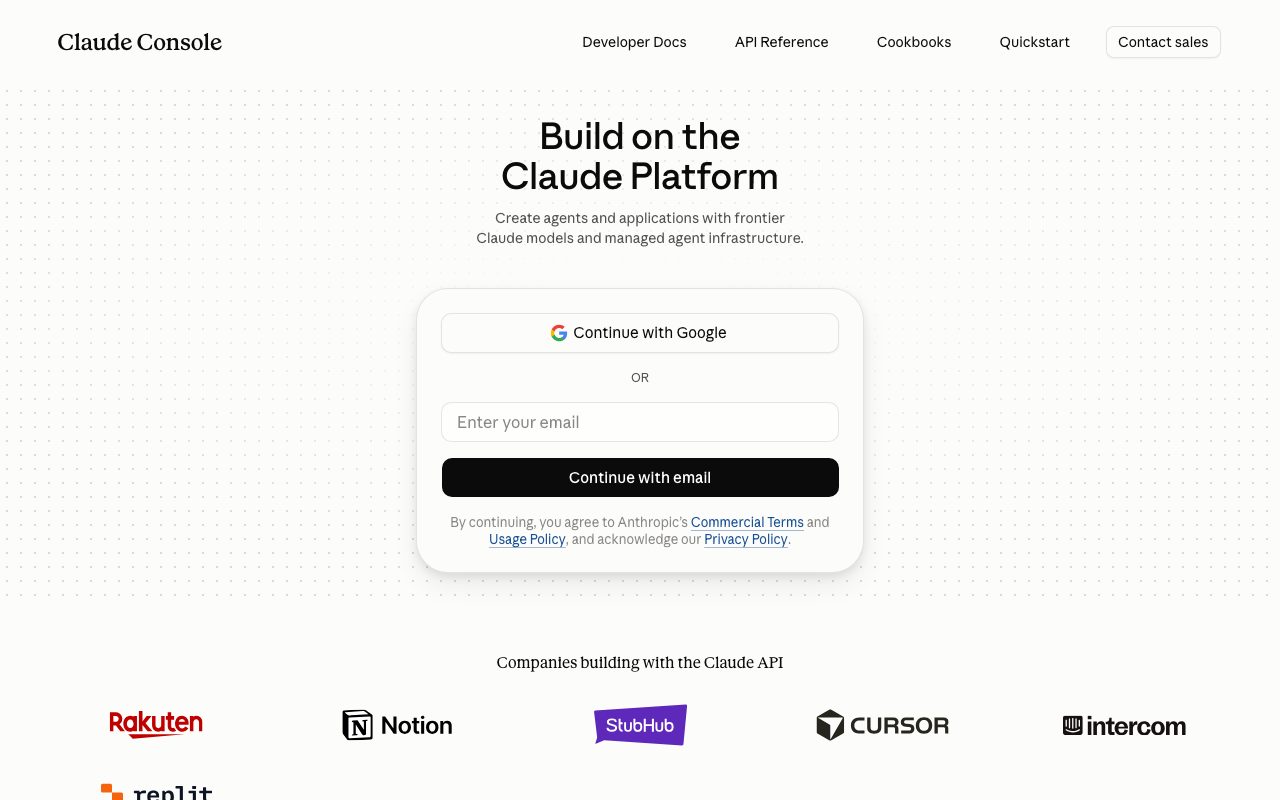
Anthropic Console provides developers with API keys, workspace management, an in-browser playground, and SDK access to frontier Claude models and managed agent infrastructure.
Anthropic Console serves as the developer gateway for building applications with the Claude model family. It supports programmatic access via the RESTful Messages API at api.anthropic.com or through managed agent infrastructure. Developers can generate API keys, configure Workload Identity Federation, organise team activity using workspaces, and manage spend and rate limits across usage tiers. The platform provides tools for testing and deployment, including an interactive playground, token counting, asynchronous batch processing with lower pricing, file uploads, and custom skills management. It also supports Claude Managed Agents in beta, offering stateful sessions in cloud sandboxes, persistent event history, and environment templates. Developers can integrate models directly or deploy Claude through major cloud providers including AWS (Bedrock and Claude Platform on AWS), Google Cloud Vertex AI, and Microsoft Foundry.
Direct access to frontier Claude models alongside first-party managed agent infrastructure, complete with persistent event sessions, sandboxed environments, prompt caching, and multi-cloud platform support.
Product capabilities
Key features
Messages API
Direct model endpoint for conversational turns, vision, system prompts, tool use, thinking, web search, and structured outputs.
Claude Managed Agents (Beta)
Deploys autonomous agents in stateful cloud sandboxes with persistent event history and environment templates via the Agents and Sessions APIs.
Interactive Playground
In-browser testing environment to evaluate prompts, test parameters, and inspect Claude model outputs before writing code.
Message Batches API
Asynchronous batch processing endpoint for large message volumes that provides a 50% cost reduction.
Workspaces and Administration
Team collaboration tooling with role-based access control, workspace isolation, rate limits, spend caps, and audit reporting.
Authentication & Federation
Supports standard API keys with configurable expiration alongside Workload Identity Federation for short-lived access tokens.
Token Counting API
Calculates token usage prior to sending requests to help developers manage spend and adhere to rate limits.
Multi-Cloud Availability
Enables deployment directly via Anthropic or through cloud integrations on Amazon Bedrock, Claude Platform on AWS, Google Cloud, and Microsoft Foundry.
Practical fit
Who should use Anthropic Console?
Agentic Coding & Software Workflows
Run complex multi-day reasoning, agentic coding tasks, and terminal workflows using models like Opus 5 or Fable 5.1.
Autonomous Agent Infrastructure
Host stateful agent sessions with environment sandboxes and tool execution loops using Claude Managed Agents.
Cost-Efficient Batch Processing
Process non-real-time evaluations, data extraction, or content classification at scale using the Message Batches API.
Enterprise Application Integration
Connect backend services via client SDKs in Python, TypeScript, Go, Java, or C# with strict workspace spend controls.
Editorial assessment
Pros and limitations
Where it is strong
- Comprehensive developer surface covering direct model APIs and managed agent infrastructure
- 50% discount available on asynchronous processing through Message Batches API
- Rich client SDK coverage across Python, TypeScript, Go, Java, Ruby, PHP, C#, and CLI
- Flexible deployment across Anthropic direct API, AWS, Google Cloud, and Microsoft Foundry
- Built-in governance features including Workload Identity Federation, workspaces, and spend limits
Where to be careful
- Requires software development expertise to build and integrate applications
- Key agent infrastructure components like Agents and Sessions APIs remain in beta
- Per-request size limits (32 MB standard, 20-30 MB on partner cloud providers) require attention when handling large payloads
Commercial context
Anthropic Console pricing
Usage is billed per request and token, organised into usage tiers with spend limits and rate limits. The Message Batches API offers a 50% cost reduction for asynchronous requests. Specific per-token rates for models are not detailed on the supplied pages; verify current pricing on the official pricing page.
Pricing, limits, taxes, model access, and regional availability can change. Verify the purchase-critical details on the official pricing page linked under Sources.
Transparent ranking
Why Anthropic Console scores 80.4
Each factor is scored on a 100-point scale, then combined using the public ToolsRank weights. Engagement and momentum stay at a neutral baseline until measured signals exist, so no tool can gain or lose position from numbers nobody recorded.
Compatibility
Languages, platforms, and integrations
Languages
- English
Integrations & surfaces
- Amazon Bedrock
- Google Cloud
- Microsoft Foundry
- Python SDK
- TypeScript SDK
- Go SDK
- Java SDK
- C# SDK
- Ruby SDK
- PHP SDK
Community
Reviews and questions
No approved member reviews yet. Editorial factors above are the only rating on this page.
Reviews and questions come from Google-signed members and are checked by an editor before they appear.
Frequently asked
Anthropic Console FAQ
What is Anthropic Console?+
Anthropic Console is the developer management platform for Anthropic's Claude API. It allows developers to generate API keys, test models in a web playground, set up workspaces, manage billing and rate limits, and access managed agent infrastructure.
Which models are available via the platform?+
The platform documentation highlights the Claude model family, including Fable 5.1 for demanding reasoning and multi-day research tasks, Opus 5 for complex agentic coding, Sonnet 5 for balanced speed and intelligence in everyday tasks, and Haiku 4.5 for high-volume, low-cost operations.
What is the difference between direct API access and cloud platforms?+
The direct Claude API is managed and billed directly through Anthropic, providing immediate access to the latest models and features. Alternatively, Claude can be deployed via Amazon Bedrock, Google Cloud, Claude Platform on AWS, and Microsoft Foundry to consolidate billing and integrate with existing cloud IAM policies.
What are Claude Managed Agents?+
Claude Managed Agents is a beta infrastructure offering that allows developers to deploy and manage autonomous agents in stateful cloud sandboxes with persistent event history and environment templates, rather than building custom agent runtime loops manually.
What are the request size limits for the API?+
Standard Messages, Token Counting, Sessions, Agents, and Environments requests have a maximum size limit of 32 MB. The Message Batches API allows up to 256 MB, while the Files API supports payloads up to 500 MB.