Direct answer
What is AssemblyAI?
AssemblyAI provides developer APIs for pre-recorded, streaming, and synchronous speech-to-text, audio intelligence, guardrails, and voice agent workflows across 99 languages.
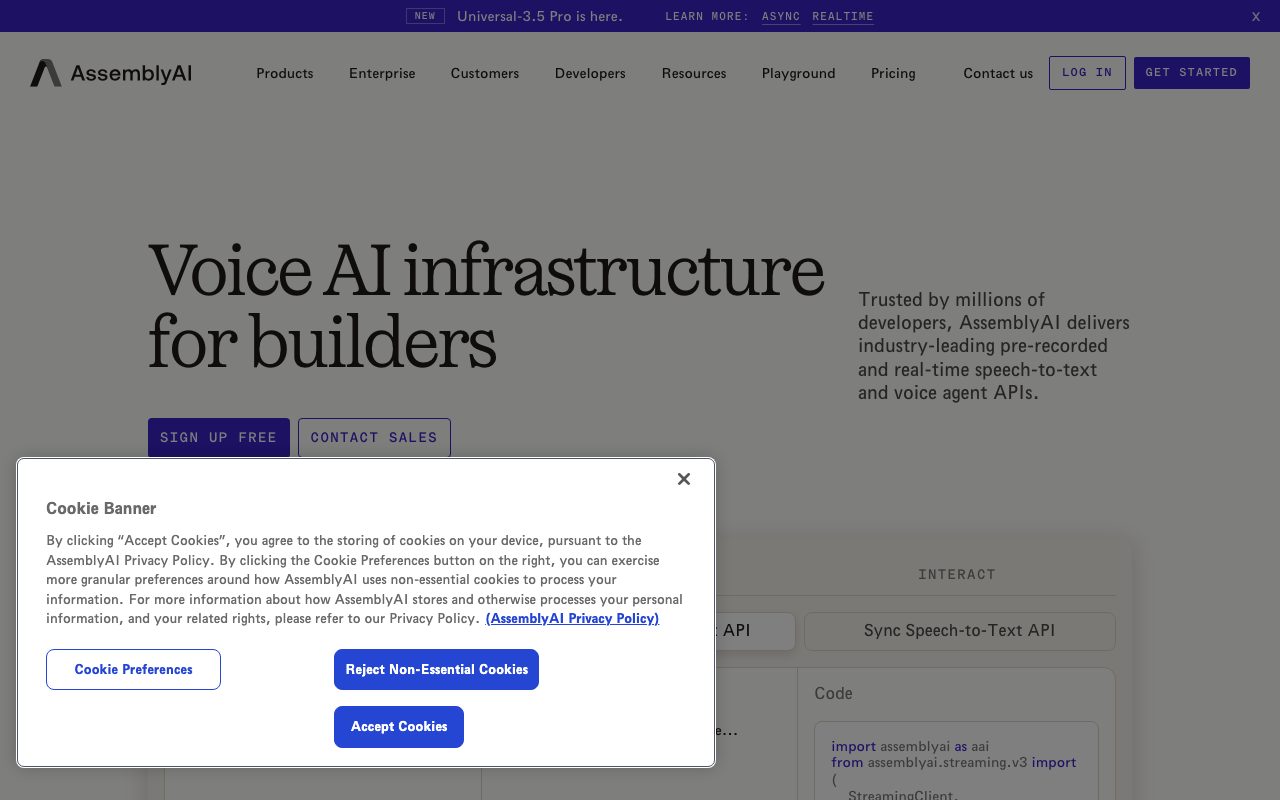
AssemblyAI is a voice AI infrastructure platform designed for developers embedding speech processing into applications. Powered by its Universal-3.5 Pro model family alongside earlier Universal models, the platform handles speech recognition through three distinct delivery patterns: pre-recorded batch processing in 99 languages, low-latency streaming transcription via WebSockets, and a synchronous HTTP endpoint that returns completed transcripts for short audio files in a single round trip without polling. Beyond raw transcription, the platform exposes a Speech Understanding API that extracts contextual data directly from audio. Capabilities include speaker diarization, named speaker identification, sentiment analysis, auto-chapters, summarization, entity detection, and a dedicated Medical Mode for clinical terminology. Guardrails enable developers to scrub personally identifiable information (PII) and apply content moderation directly to audio and transcripts before data reaches storage or language models. For real-time conversational applications, the platform features a Voice Agent API supporting full-duplex audio with turn detection and interruption handling. It also bundles an OpenAI-compatible LLM Gateway that routes prompts across more than 25 frontier models (including Claude, GPT, and Gemini) with automated fallback, zero markup, and zero data retention.
AssemblyAI integrates pre-recorded, real-time, and synchronous speech-to-text with inline audio intelligence, PII guardrails, voice agent orchestration, and an OpenAI-compatible multi-model LLM Gateway through a single API stack.
Product capabilities
Key features
Universal-3.5 Pro Speech-to-Text
Transcribes pre-recorded audio across 99 languages with natural language prompting, alongside real-time streaming speech recognition.
Synchronous STT API
Returns flagship-accuracy transcripts for short audio clips in a single HTTP response without polling or WebSocket session management.
Speech Understanding API
Extracts speaker diarization, named speaker identification, sentiment analysis, key phrases, auto-chapters, and summaries in a single call.
Voice Agent API
Powers conversational voice agents with streaming audio input and output, automated turn detection, and interruption handling.
Guardrails & PII Redaction
Automatically redacts sensitive personal data and applies inline content moderation to audio transcripts before logging or LLM handoff.
LLM Gateway
Provides an OpenAI-compatible endpoint routing to over 25 frontier models, featuring automated failover and zero data retention.
Practical fit
Who should use AssemblyAI?
Meeting Notetakers & Real-Time Assistants
Combine real-time or pre-recorded transcription with speaker identification and LLM Gateway summaries to capture meetings.
Sales Call Intelligence
Extract speaker diarization, sentiment analysis, and action items from customer calls to feed revenue intelligence pipelines.
Medical Scribing
Use Medical Mode entity detection and speaker labeling to convert clinical conversations into structured SOAP notes.
Interactive Voice Agents
Stream live microphone audio and receive synthesized agent responses with automated turn detection and interruption support.
Editorial assessment
Pros and limitations
Where it is strong
- Supports pre-recorded, real-time WebSocket, and single-request synchronous transcription modes.
- Integrated speech intelligence handles speaker diarization, sentiment, and summaries without extra pipeline tools.
- Built-in PII redaction and guardrails prevent sensitive data from reaching log systems or LLMs.
- Unified LLM Gateway routes across 25+ language models with automatic fallbacks and zero data retention.
Where to be careful
- Requires programming experience and integration into an application stack, offering no turnkey user application.
- Specific per-hour or per-minute dollar pricing rates are not published on the primary documentation and overview pages.
Commercial context
AssemblyAI pricing
At the review date (September 2026), AssemblyAI provides a free sign-up with access to a developer playground and API keys. The vendor states that usage scales without concurrency limits or forced commitments; specific per-hour prices are not published on the reviewed overview pages and should be verified on the official pricing page.
Pricing, limits, taxes, model access, and regional availability can change. Verify the purchase-critical details on the official pricing page linked under Sources.
Transparent ranking
Why AssemblyAI scores 76.5
Each factor is scored on a 100-point scale, then combined using the public ToolsRank weights. Engagement and momentum stay at a neutral baseline until measured signals exist, so no tool can gain or lose position from numbers nobody recorded.
Compatibility
Languages, platforms, and integrations
Languages
- English
- Spanish
- Portuguese
- French
- German
- Japanese
Integrations & surfaces
- Python SDK
- JavaScript SDK
- LiveKit
- Pipecat
- Cursor
- Claude Code
- GitHub Copilot
Community
Reviews and questions
No approved member reviews yet. Editorial factors above are the only rating on this page.
Reviews and questions come from Google-signed members and are checked by an editor before they appear.
Frequently asked
AssemblyAI FAQ
What is Universal-3.5 Pro?+
Universal-3.5 Pro is AssemblyAI's flagship speech-to-text model designed to handle real-world audio across pre-recorded and real-time streaming audio.
How does the Sync Speech-to-Text API work?+
The Sync STT API accepts a short audio file in a standard HTTP request and returns the completed transcript immediately in the same response, removing the need for polling or maintaining a persistent WebSocket connection.
How many languages are supported by AssemblyAI?+
AssemblyAI supports transcription across 99 languages for pre-recorded audio and offers translation capabilities into 86 languages.
What is the LLM Gateway?+
The LLM Gateway is an OpenAI-compatible routing endpoint that connects to more than 25 frontier language models with automatic failover, zero markup, and zero data retention.