
Direct answer
What is Kokoro TTS?
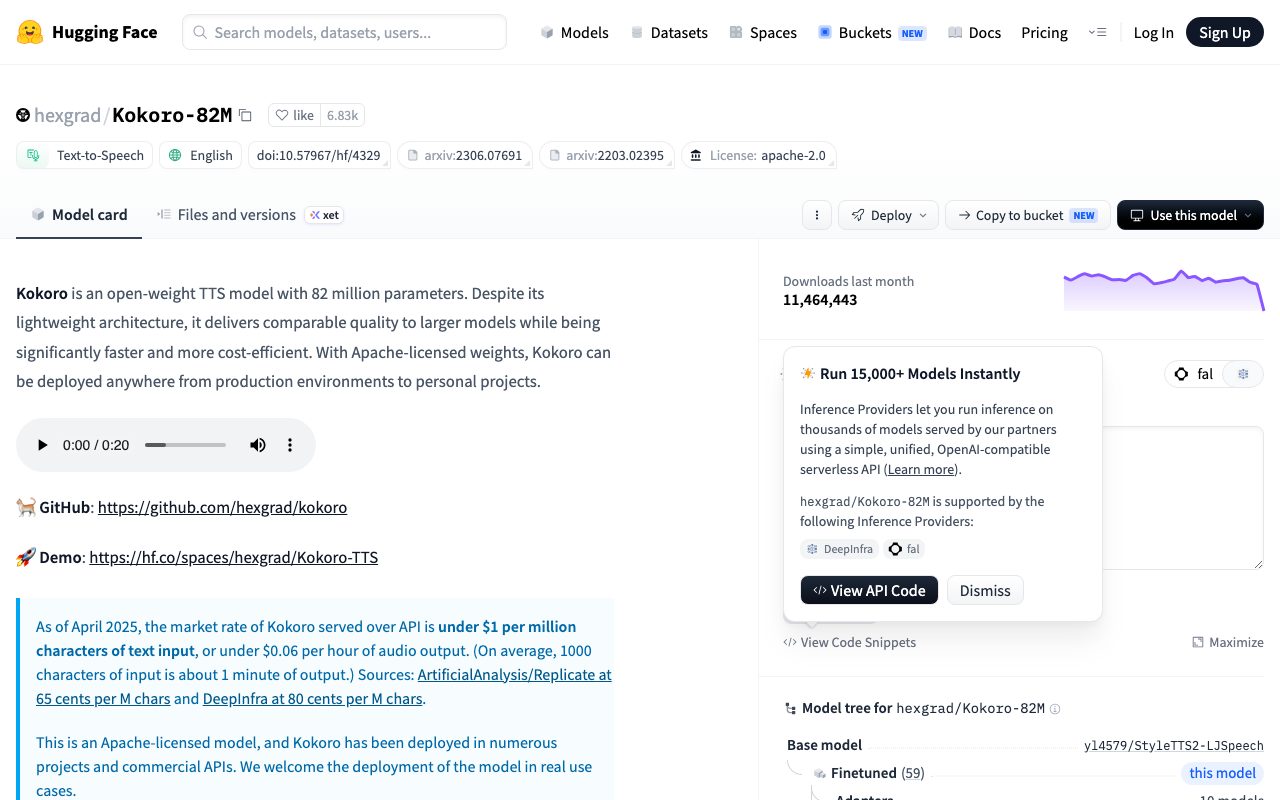
Kokoro TTS is an open-weight, 82-million-parameter speech synthesis model based on StyleTTS 2 and iSTFTNet. It provides high-speed, cost-effective audio generation for self-hosted and cloud applications.
Kokoro TTS (hexgrad/Kokoro-82M) is a compact text-to-speech model engineered for high efficiency without sacrificing speech naturalness. Operating with only 82 million parameters, the model leverages a decoder-only architecture based on StyleTTS 2 and iSTFTNet, omitting diffusion stages and encoder weights to achieve rapid generation and minimal compute overhead. Trained on a few hundred hours of permissive and non-copyrighted audio data alongside IPA phoneme labels, Kokoro v1.0 supports 8 languages and 54 voice styles. Text processing is assisted by the Misaki grapheme-to-phoneme (G2P) library and espeak-ng. Because the weights and architecture are released under the Apache 2.0 license, developers can integrate Kokoro locally in Python pipelines, embed it into edge devices and interactive applications, or deploy it through managed inference providers such as Fal AI, Replicate, and DeepInfra.
With only 82M parameters and a decoder-only architecture running on StyleTTS 2 and iSTFTNet, Kokoro achieves fast speech generation on modest hardware with full Apache 2.0 commercial licensing.
Product capabilities
Key features
Compact 82M Architecture
Decoder-only speech generation using StyleTTS 2 and iSTFTNet vocoding, avoiding heavy diffusion loops for rapid inference.
Multilingual and Multi-Voice Output
Version 1.0 supports 8 languages and 54 distinct voice profiles, trained on a diverse set of permissively licensed audio.
Apache 2.0 Permissive Weights
Open weights and codebase permit free personal experimentation, local deployment, and commercial hosting.
Misaki G2P Integration
Uses the Misaki grapheme-to-phoneme library and espeak-ng for accurate phonetic translation and pronunciation control.
Third-Party Provider Support
Integrates into serverless cloud hubs including Hugging Face Inference Providers, Fal AI, DeepInfra, and Replicate.
Practical fit
Who should use Kokoro TTS?
On-Device & Local Audio Generation
Run offline text-to-speech directly in Python notebooks or embedded systems using modest GPU or CPU memory.
Cost-Effective Speech APIs
Power real-time text-to-speech features in customer apps at minimal server expenditure compared to larger models.
Accessibility and Reading Assistants
Convert documents and long-form reading passages to natural sounding audio streams.
Editorial assessment
Pros and limitations
Where it is strong
- Lightweight footprint (82M parameters) runs smoothly with minimal compute
- Permissive Apache 2.0 license supports unrestricted commercial deployment
- Includes 54 voices and 8 languages as of v1.0
- Fast inference without diffusion bottlenecks
Where to be careful
- Requires technical setup, Python libraries, and system dependencies like espeak-ng for local execution
- No official end-user consumer dashboard or built-in voice-cloning workflow provided directly on the repo
Commercial context
Kokoro TTS pricing
At the review date, Kokoro weights and code are released under an Apache 2.0 license and free for self-hosting and commercial deployment. Cloud inference providers host it at third-party rates (noted on the model card at under $1 per million text characters).
Pricing, limits, taxes, model access, and regional availability can change. Verify the purchase-critical details on the official pricing page linked under Sources.
Transparent ranking
Why Kokoro TTS scores 79.2
Each factor is scored on a 100-point scale, then combined using the public ToolsRank weights. Engagement and momentum stay at a neutral baseline until measured signals exist, so no tool can gain or lose position from numbers nobody recorded.
Compatibility
Languages, platforms, and integrations
Languages
- English
Platforms
- Linux
- Windows
- macOS
Integrations & surfaces
- Python
- PyTorch
- Hugging Face Hub
- Fal AI
- DeepInfra
- Replicate
- Google Colab
Community
Reviews and questions
No approved member reviews yet. Editorial factors above are the only rating on this page.
Reviews and questions come from Google-signed members and are checked by an editor before they appear.
Frequently asked
Kokoro TTS FAQ
What license does Kokoro TTS use?+
Kokoro TTS weights and code are released under the Apache 2.0 license, allowing for both personal use and commercial deployments.
What is the parameter size and architecture of Kokoro?+
Kokoro has 82 million parameters. Its architecture is decoder-only, based on StyleTTS 2 and iSTFTNet, eliminating diffusion steps for faster inference.
What languages and voices are supported in Kokoro?+
According to the model card, version 1.0 supports 8 languages and 54 voices, trained on several hundred hours of permissive audio data.
Can Kokoro be run locally in Python?+
Yes. It can be installed using pip (requiring the kokoro package and soundfile) alongside system audio tools such as espeak-ng, and can run in PyTorch environments or Google Colab.
Is there an official standalone web app or subscription for Kokoro?+
No standalone consumer domain is owned by the project. The model card explicitly warns against third-party scam domains using 'kokoro' in their root name, noting the official resources are the Hugging Face model card, the official Hugging Face Space demo, and the GitHub repository.


