
Direct answer
What is Nanonets?
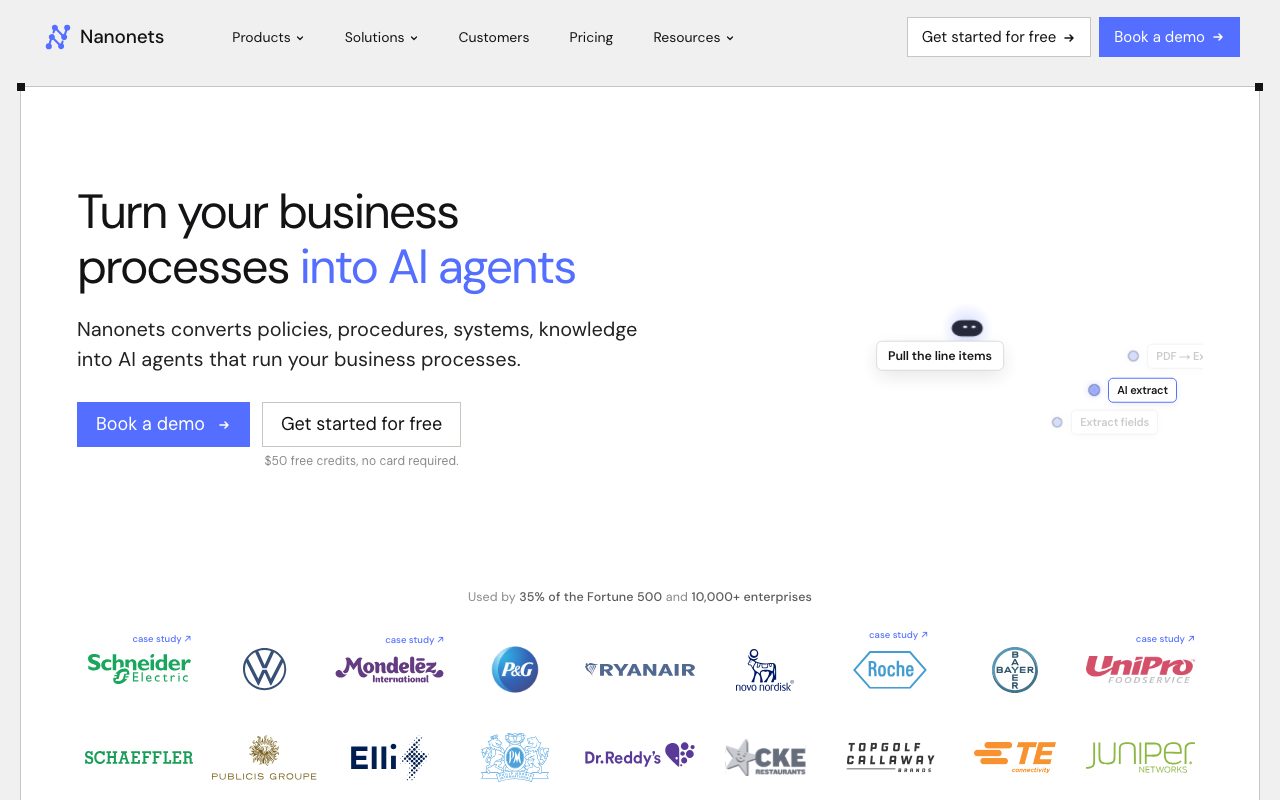
Nanonets transforms unstructured documents and institutional rules into autonomous AI agents for accounts payable, reconciliation, order management, and enterprise data processing.
Nanonets provides an intelligent automation platform that converts standard operating procedures, enterprise policies, and unstructured documents into production AI agents. Rather than functioning simply as a conversational assistant or basic OCR reader, it executes end-to-end operational workflows, reading incoming documents, validating them against business logic, and synchronizing outputs into core systems of record. The system runs on an underlying context graph named Trail, which parses uploaded documentation (PDF/DOCX SOPs, guidelines, and communication channels like Slack, Teams, and email) into traceable rules and precedent exceptions. Each agent action is evaluated against confidence scores, allowing straight-through touchless processing when certainty is high, while routing low-confidence exceptions or discrepancies to human reviewers via Slack, Teams, or email. Workflows are composed of granular blocks ranging from simple routing and data formatting to complex proprietary AI extraction (utilizing the vendor's OCR-3 model) and generative AI steps. Built-in enterprise governance includes role-based access control, SAML SSO/SCIM, detailed audit logging streaming to SIEM, data residency choices (US, EU, APAC), and deployment options including VPC, single-tenant cloud, and on-premises environments.
Nanonets combines its proprietary OCR-3 extraction model with a traceable context graph called Trail, which turns SOPs, policy files, and communication channels into auditable rulebooks that continuously learn from human feedback on exceptions.
Product capabilities
Key features
Trail Context Graph
Parses SOPs, policies, and conversational precedents from Slack or email into an auditable knowledge graph that directs agent decisions.
Nanonets OCR-3 Extraction
Proprietary intelligent document processing model designed for high-accuracy text and field extraction from unstructured documents.
Self-Learning Exception Loops
Uses confidence scores to trigger human-in-the-loop review, updating rulebooks and autonomy levels as operators resolve edge cases.
Enterprise Connectors & Agent Platforms
Connects to ERPs and external systems including SAP, NetSuite, QuickBooks, and Salesforce, or integrates via MCP server, REST, and GraphQL.
Granular Block-Based Execution
Executes workflow steps categorized as simple operations ($0.02/run), standard AI ($0.10/run), or complex AI ($0.30/run) with shared team credits.
Security & Private Deployment
Supports SOC 2 Type II, ISO 27001, HIPAA, GDPR, SAML SSO/SCIM, audit logging to SIEM, and private VPC or on-prem deployment.
Workflow
How Nanonets works
- Upload SOPs, policy documents, or connect messaging tools (Slack, Teams, email) to build the Trail context graph.
- Review, edit, and approve the extracted business rules and precedent escalation matrices.
- Deploy pre-built or custom AI agents to ingest files and run block-by-block data extraction and validation.
- Approve low-confidence exceptions via Slack or email; the agent incorporates corrections into its rulebook.
- Automatically export validated structured records directly to ERPs and databases like SAP, QuickBooks, or NetSuite.
Practical fit
Who should use Nanonets?
Touchless Accounts Payable
Ingest invoices across email and scans, extract line items, match against purchase orders in ERPs like NetSuite or SAP, and flag discrepancies.
Automated Order Processing
Extract sales orders from incoming PDFs, faxes, and EDI formats, validate item codes and pricing against master catalogs, and push to ERPs.
Claims Adjudication
Verify first-notice-of-loss claims against policy deductibles and uploaded evidence, auto-approving qualified items and routing complex edge cases.
Supplier Onboarding & Compliance
Check W-9s, insurance certificates, and banking details against company records to onboard vendors without manual chase cycles.
Editorial assessment
Pros and limitations
Where it is strong
- Auditable decision paths grounded in explicit business SOPs and precedent graphs
- Continuous learning loops that improve autonomous straight-through processing rates over time
- Flexible deployment options including multi-region cloud, VPC, and on-premises hosting
- Free starting credit allowance ($50) without requiring payment information upfront
Where to be careful
- Usage costs compound per block run, requiring careful workflow design to estimate per-document expense
- Requires well-documented business procedures and integration setup to achieve high automation rates
- Advanced enterprise features and specific ERP connectors require custom-quoted sales tiers
Commercial context
Nanonets pricing
As of September 2026, Nanonets offers $50 in free starting credits without requiring a credit card. Paid usage on the Starter tier starts at $100/month for 100 credits, billed per workflow block run ($0.02 to $0.30 per run depending on step complexity). Growth and Enterprise tiers require contacting sales. Verify pricing and current block costs on the official pricing page.
| Plan | Price | What it includes |
|---|---|---|
| Starter | $0 to start ($50 free credits), then $100 / month for 100 credits; block runs cost $0.02–$0.30 each thereafter | |
| Growth | Contact sales / custom volume pricing with credit sharing and up to 40% volume discounts | |
| Enterprise | Contact sales / custom contract with private cloud/on-prem deployment, SAML SSO/SCIM, and dedicated SLAs |
Pricing, limits, taxes, model access, and regional availability can change. Verify the purchase-critical details on the official pricing page linked under Sources.
Transparent ranking
Why Nanonets scores 73.4
Each factor is scored on a 100-point scale, then combined using the public ToolsRank weights. Engagement and momentum stay at a neutral baseline until measured signals exist, so no tool can gain or lose position from numbers nobody recorded.
Compatibility
Languages, platforms, and integrations
Languages
- English
Platforms
- Web
Integrations & surfaces
- SAP
- NetSuite
- QuickBooks
- Salesforce
- Slack
- Microsoft Teams
- Gmail
- Zoom
- AWS Bedrock
- Google Cloud Vertex AI
- Microsoft Copilot
- Okta
Community
Reviews and questions
No approved member reviews yet. Editorial factors above are the only rating on this page.
Reviews and questions come from Google-signed members and are checked by an editor before they appear.
Frequently asked
Nanonets FAQ
How does Nanonets calculate pricing and usage?+
Nanonets charges on a credit-based model determined by workflow blocks. Simple operations (routing, formatting, export) cost $0.02 per run, standard AI (classification, validation) costs $0.10 per run, and complex AI (data extraction, generative AI) costs $0.30 per run. A standard invoice workflow typically runs 4 to 6 blocks per document.
Is there a free trial available?+
Yes. Nanonets provides new accounts with $50 in free credits without requiring a credit card, allowing users to test document workflows before committing to paid tiers.
What is the Trail context graph?+
Trail is Nanonets' proprietary context graph engine. It ingests procedure documentation (such as PDF or DOCX SOPs) along with tribal communication from Slack, Teams, or email, converting them into explicit, traceable rules and exception nodes that AI agents follow during workflow execution.
How are edge cases and low-confidence decisions handled?+
Agents evaluate confidence scores on each task. When an edge case falls below designated confidence thresholds or triggers an escalation rule, the system routes the issue to human operators via channels like Slack, Teams, or email. The agent then learns from the operator's decision.
Can Nanonets be deployed on-premises or in a private cloud?+
Yes. Enterprise plans support private VPC deployments, single-tenant cloud configurations, and on-premises infrastructure, alongside geographic data residency options across the US, EU, and APAC.