Direct answer
What is Onyx?
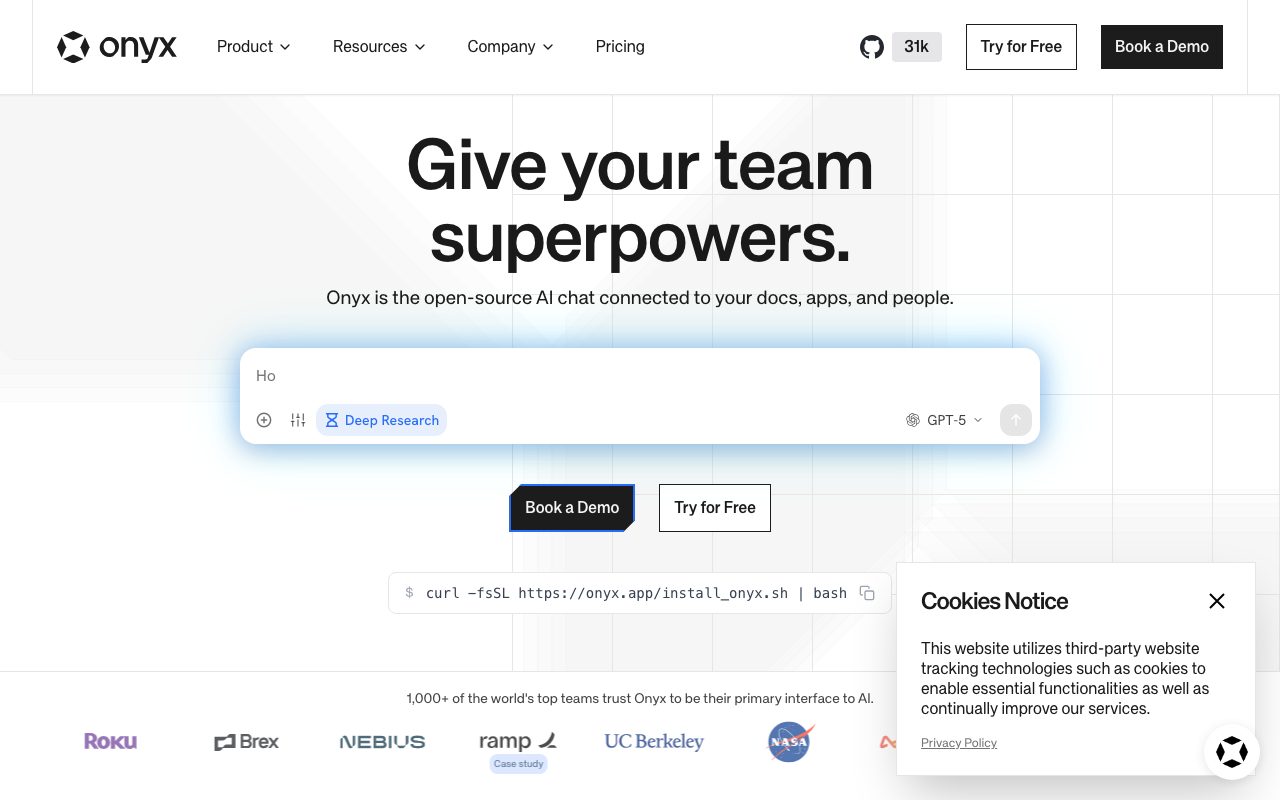
Onyx is an open-source enterprise search and assistant platform combining hybrid retrieval, knowledge graphs, and role-based access to index internal tools securely.
Onyx functions as a centralized AI search interface and conversational assistant for teams. Connecting to over 40 workplace applications, it synchronizes updates in real time while inheriting fine-grained permissions and role-based access controls (RBAC) to ensure employees only view documents they are authorized to access. Under the hood, Onyx uses a multi-stage retrieval architecture incorporating hybrid search, advanced retrieval-augmented generation (RAG), contextual retrieval, and LLM-assisted knowledge graphs to minimize hallucinations on internal documents. Beyond basic search queries, Onyx incorporates advanced chat capabilities including Deep Research, Model Context Protocol (MCP) actions, OpenAPI integrations, an integrated code interpreter, image generation, and web search. It is vendor-agnostic regarding underlying model providers, enabling organizations to switch or configure LLM endpoints to suit their privacy and capability requirements. Because the platform is open source, engineering teams can inspect the codebase, extend functionality via developer APIs and agent frameworks, or self-host the entire stack on their own infrastructure. For managed deployments, cloud tiers provide analytics, administrative dashboards, authentication integrations, and dedicated enterprise support.
Onyx combines open-source transparency and self-hosting flexibility with enterprise-grade permission inheritance across 40+ connectors, hybrid search, and knowledge graph RAG.
Product capabilities
Key features
Permission-Aware Search
Connects to workplace applications while continuously syncing updates and inheriting role-based access control rules.
Advanced RAG Architecture
Pairs hybrid search, contextual retrieval, and LLM knowledge graphs to produce cited answers grounded in internal documentation.
Tool Actions and MCP Support
Executes external workflows and custom agent tools using the Model Context Protocol (MCP) and OpenAPI standards.
Developer APIs and Agent Framework
Enables customization of agent behaviors, query expansion logic, and direct programmatic interaction through developer APIs.
Deep Research and Code Interpreter
Provides extended multi-step reasoning, integrated code interpretation, and live web search inside conversational threads.
Flexible Deployment Options
Can be self-hosted via an open-source script on private infrastructure or consumed as a fully managed cloud service.
Practical fit
Who should use Onyx?
Engineering Context Retrieval
Enables software developers to query internal wikis, documentation, and source code repositories for quick architectural answers.
Customer Support Enablement
Assists support teams in resolving user tickets accurately by surfacing verified product answers across historical tickets and manuals.
Sales and Field Intelligence
Provides account executives with rapid retrieval of past customer conversations, pricing sheets, and product release updates.
Enterprise Knowledge Discovery
Acts as an all-in-one unified search bar across fragmented SaaS tools while honoring strict permission boundaries.
Editorial assessment
Pros and limitations
Where it is strong
- Open-source codebase allows full auditing, self-hosting, and infrastructure transparency
- Inherits granular permissions and RBAC across more than 40 enterprise connectors
- Supports modern agent capabilities including MCP actions, code execution, and web search
Where to be careful
- Deploying and maintaining the self-hosted stack requires technical operations effort
- Managed Business plan requires annual billing commitment at $20 per user per month
Commercial context
Onyx pricing
Pricing reflects published Business plan rates billed annually as of September 2026. Self-hosting via open source is available, and an Enterprise tier requires contacting sales. Verify current terms on the official pricing page.
Pricing, limits, taxes, model access, and regional availability can change. Verify the purchase-critical details on the official pricing page linked under Sources.
Transparent ranking
Why Onyx scores 76.7
Each factor is scored on a 100-point scale, then combined using the public ToolsRank weights. Engagement and momentum stay at a neutral baseline until measured signals exist, so no tool can gain or lose position from numbers nobody recorded.
Compatibility
Languages, platforms, and integrations
Languages
- English
Integrations & surfaces
- Slack
- Google Workspace
- OIDC
- SAML
Community
Reviews and questions
No approved member reviews yet. Editorial factors above are the only rating on this page.
Reviews and questions come from Google-signed members and are checked by an editor before they appear.
Frequently asked
Onyx FAQ
What is Onyx?+
Onyx is an open-source enterprise search engine and conversational AI assistant designed to connect directly with workplace documents, applications, and team communications.
How does Onyx handle document permissions?+
Onyx enforces granular permissions and permission inheritance, ensuring search results and AI answers respect the role-based access controls established in the source applications.
Can Onyx be self-hosted?+
Yes. Onyx is open source and provides self-hosting installation guides and scripts to deploy directly on private infrastructure.
What models and LLM providers can be used with Onyx?+
Onyx features flexible configuration options allowing administrators to route queries to major commercial LLM providers or internal endpoints.
What is the difference between Business and Enterprise plans?+
The Business plan provides the core search and chat UI, 40+ app connectors, agent tools, and standard Google OAuth/RBAC. Enterprise adds on-premise deployment support, OIDC/SAML SSO, white-labelling, custom integrations, hook extensions, and dedicated enterprise SLAs.