
Direct answer
What is Swimm?
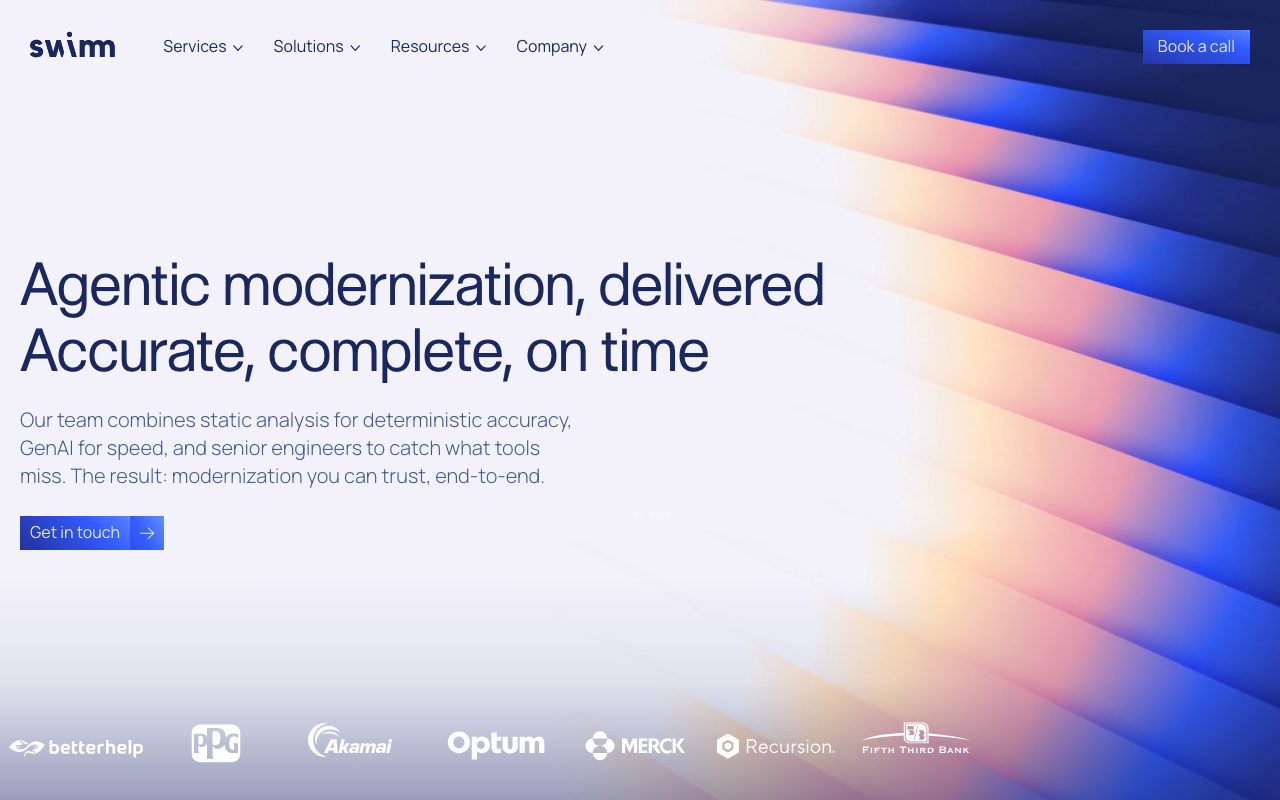
Swimm provides an agentic modernization platform that combines deterministic static analysis, generative AI, and human engineers to document, decouple, and migrate legacy enterprise software.
Swimm delivers code modernization and context infrastructure for complex enterprise codebases. Rather than relying solely on automated AI or conventional consulting, Swimm pairs a proprietary deterministic analysis engine with GenAI agents and senior engineering review. The deterministic engine scans code across repositories to trace entry points, dependencies, data flows, cross-repo connections, and dead code without relying on probabilistic guesswork. From this deterministic foundation, Swimm builds an agentic context layer that supports external coding assistants and autonomous agents, including GitHub Copilot, Cursor, Claude Code, internal company agents, and Model Context Protocol (MCP) servers. The platform serves legacy migrations—such as converting monolithic systems to microservices, migrating .NET or Java applications, and modernizing mainframes written in COBOL, JCL, and PL/I. Work is managed and delivered inside a unified customer workspace rather than through detached documentation files. Engagements follow a staged delivery structure starting with an Assessment, progressing through Specification and Modernization, and concluding with Enablement assets including test suites, architectural playbooks, and continuous knowledge bases. Swimm supports on-premises and air-gapped deployments, customer-managed LLMs, and maintains SOC 2 and ISO 27001 certifications.
Swimm grounds its AI agents and modernization workflows in deterministic static analysis and human engineer validation, avoiding unverified AI suggestions across complex legacy languages like COBOL, PL/I, Java, and .NET.
Product capabilities
Key features
Deterministic Code Analysis
Proprietary static engine maps cross-repository relationships, entry points, data flows, dependencies, and dead code to create a structured system model.
Agentic Context Layer
Builds and maintains validated system context queryable by MCP servers, GitHub Copilot, Cursor, Claude Code, and internal engineering agents.
Mainframe and Legacy Coverage
Analyzes legacy languages including COBOL, JCL, and PL/I alongside modern frameworks to extract business logic and decouple monolithic components.
Human SME Validation
Pairs AI execution with senior software engineers who review edge cases, inject unwritten tribal knowledge, and verify deliverables before handoff.
Live Customer Workspace
Centralizes engagement progress, multi-repo code mapping, active work plans, mapped findings, passing tests, and delivery artifacts in one interface.
Enterprise Security Controls
Provides SOC 2 and ISO 27001 compliance, customer-managed LLMs, and deployment options for on-premises and air-gapped environments.
Workflow
How Swimm works
- Assessment: Swimm evaluates the tech stack, scopes risks, and establishes criteria for modernization or context building.
- Deterministic Analysis: Proprietary engines parse multi-repo codebases to trace dependencies, entry points, and dead code.
- Specification: Engineers and AI agents extract system behavior, business logic, and test requirements.
- Modernization & Context Generation: Changes are executed or structured knowledge bases are created for AI tools and MCP servers.
- Enablement: Assets, playbooks, test suites, and live workspaces are handed off to the customer's team.
Practical fit
Who should use Swimm?
Monolith to Microservices Extraction
Extract embedded business logic from backend architectures to convert legacy monoliths into reusable, API-first microservices.
AI Tool Grounding
Feed deterministic architectural maps and extracted business logic to developer assistants like Cursor and Claude Code via MCP servers.
Mainframe & Legacy Migration
De-risk core system migrations from COBOL, PL/I, .NET, or Java legacy stacks into modern service layers with audit-ready documentation.
M&A Technical Due Diligence
Inspect newly acquired software assets, identify hidden architectural debt, map dead code, and accelerate post-acquisition technical integration.
Editorial assessment
Pros and limitations
Where it is strong
- Combines deterministic static analysis with GenAI to eliminate hallucinated code paths
- Native support for deep legacy enterprise environments like COBOL, JCL, and PL/I
- Deployable on-premises, in air-gapped environments, and with customer-controlled LLMs
- Provides MCP-compliant context layers for external tools like Cursor and Claude Code
Where to be careful
- No publicly listed self-serve pricing; requires sales engagement and custom scoping
- Heavyweight enterprise delivery model is excessive for smaller web applications and minor codebases
Commercial context
Swimm pricing
At the review date of 2026-09-08, Swimm delivers modernization engagements across four sequential stages (Assessment, Specification, Modernization, Enablement) with fixed pricing per stage. Specific dollar amounts are not listed on official pages and require booking a call.
Pricing, limits, taxes, model access, and regional availability can change. Verify the purchase-critical details on the official pricing page linked under Sources.
Transparent ranking
Why Swimm scores 73.5
Each factor is scored on a 100-point scale, then combined using the public ToolsRank weights. Engagement and momentum stay at a neutral baseline until measured signals exist, so no tool can gain or lose position from numbers nobody recorded.
Compatibility
Languages, platforms, and integrations
Languages
- English
Platforms
- Web
- Self-hosted / On-premise
Integrations & surfaces
- GitHub Copilot
- Cursor
- Claude Code
- Model Context Protocol (MCP)
- .NET
- Java
- COBOL
Community
Reviews and questions
No approved member reviews yet. Editorial factors above are the only rating on this page.
Reviews and questions come from Google-signed members and are checked by an editor before they appear.
Frequently asked
Swimm FAQ
What is Swimm?+
Swimm is a code analysis and modernization platform that combines deterministic static analysis, generative AI agents, and senior software engineers to help enterprises understand, document, and modernize legacy software systems.
How does Swimm integrate with AI coding assistants?+
Swimm generates a verified system understanding and context layer that can be queried by external AI tools, including Cursor, Claude Code, GitHub Copilot, internal company agents, and Model Context Protocol (MCP) servers.
Which programming languages and systems does Swimm support?+
Swimm supports modern languages as well as deep legacy stacks, explicitly listing coverage for COBOL, JCL, PL/I, Java, .NET, and microservices architectures across more than 100 million lines of analyzed code.
Can Swimm run in private or air-gapped infrastructure?+
Yes. Swimm provides on-premises deployment options, supports fully air-gapped environments, and allows enterprises to run customer-managed LLMs so data remains within company boundaries.
What is the structure of a Swimm engagement?+
Engagements are executed in four sequential stages: Assessment (tech stack snapshot and fit), Specification (extracting business logic and system behavior), Modernization (executing code migrations or API extractions), and Enablement (handing over test suites, playbooks, and knowledge bases).