
Direct answer
What is Cartesia?
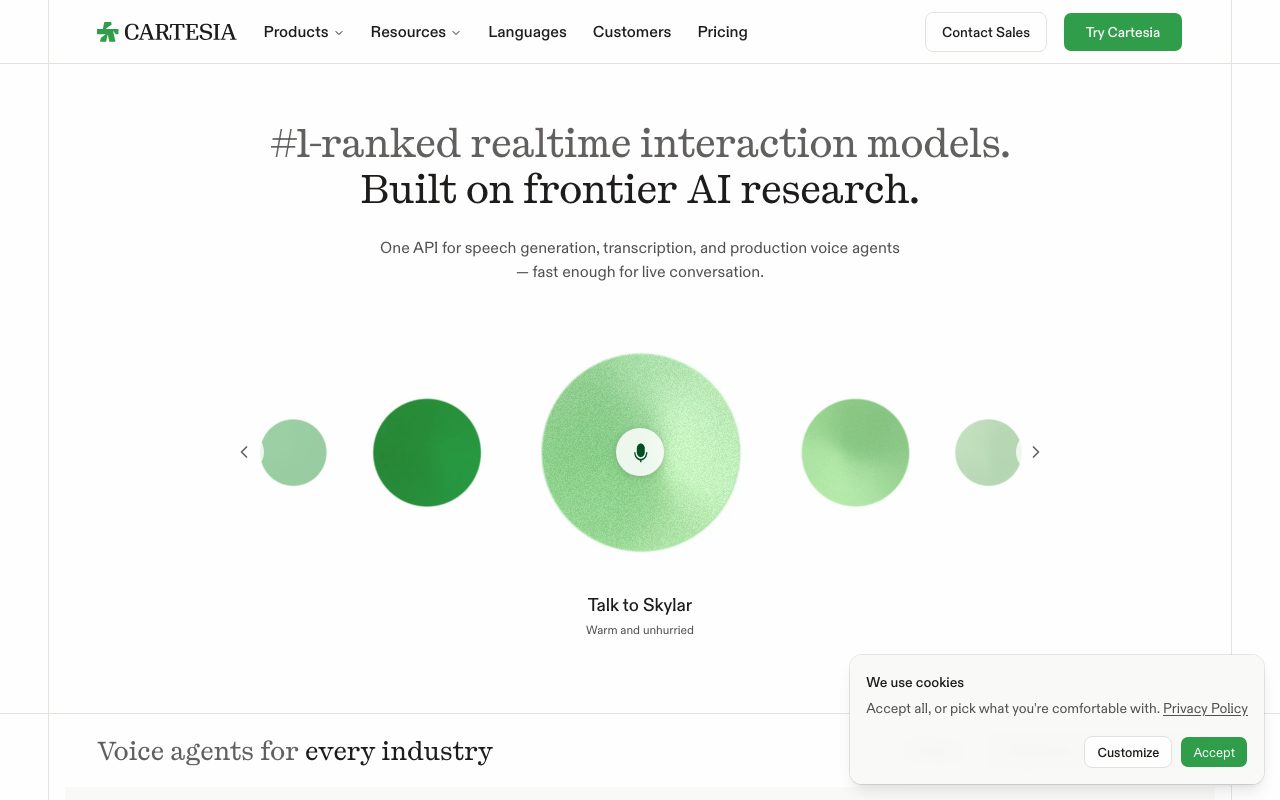
Cartesia is a voice intelligence platform providing low-latency text-to-speech (Sonic), streaming transcription (Ink), and managed voice agent infrastructure via API.
Cartesia provides an API and hosting platform for building real-time conversational voice products. Rather than relying solely on traditional transformer architectures, the vendor's models are built on State Space Models (SSMs), including Mamba and H-Nets, optimized for low latency, long-context reasoning, and operational efficiency at scale. The product suite comprises three core offerings: Sonic for ultra-fast text-to-speech synthesis, Ink for streaming speech-to-text transcription, and Managed Agents for assembling and serving conversational voice applications. For voice generation, the system supports instant and professional voice cloning, voice localization across accents, and audio streaming suitable for live dialogue. For telephony workflows, Managed Agents provide Cartesia-provisioned phone numbers, concurrent call handling, automated evaluations, and low-latency interaction loops designed for outbound and inbound calls. Deployments can be executed across regional cloud APIs, on-premises infrastructure, or on-device environments to meet latency constraints and regulatory data residency requirements.
Cartesia bases its speech generation and transcription on State Space Model (SSM) architectures such as Mamba, delivering streaming audio latencies engineered specifically for real-time, two-way conversational voice agents.
Product capabilities
Key features
Sonic Text-to-Speech
Streaming speech synthesis designed for low-latency conversational applications, supporting fine-grained audio controls and voice cloning.
Ink Speech-to-Text
A streaming audio transcription model engineered for high accuracy and fast processing during live customer interactions.
Managed Agents
A platform for assembling and running production voice agents with built-in concurrency management, evaluation tools, and telephony support.
Voice Cloning & Localization
Instant voice cloning on entry-level paid plans and professional voice cloning with cross-accent localization capabilities on higher tiers.
Flexible Deployment
Model serving available through regional cloud endpoints, on-premises infrastructure, or on-device runtimes to meet data residency and latency needs.
Telephony Integration
Direct support for Cartesia-provisioned phone numbers and concurrent inbound/outbound calls billed per minute.
Practical fit
Who should use Cartesia?
Interactive Customer Support Bots
Deploy low-latency voice agents that handle inbound inquiries and converse naturally with minimal turn-taking delay.
Fraud Detection and Verification Calls
Automate real-time outbound security calls to verify suspicious financial transactions using conversational voice agents.
Real-Time Streaming Transcription
Transcribe incoming user audio on the fly using the Ink streaming model to feed downstream reasoning components.
Branded Voice Generation and Dubbing
Synthesize voiceovers and localized voice clones with consistent character voices across international accents.
Editorial assessment
Pros and limitations
Where it is strong
- SSM-based architecture engineered specifically for low-latency live dialogue
- Comprehensive stack combining speech generation, transcription, and agent orchestration under one API
- Deployment flexibility across cloud, on-premise, and on-device environments
- Transparent usage-based pricing with a functional free tier for developer evaluation
Where to be careful
- Privacy terms explicitly state the service is designed for users in the United States only
- Requires technical API integration and developer implementation to deploy production workflows
- Commercial licensing and instant cloning require upgrading past the free tier
Commercial context
Cartesia pricing
At the review date (September 2026), Cartesia offers a Free tier with 20,000 credits and $1 of monthly agent credits. Paid tiers start at $5 per month (Pro) up to $299 per month (Scale), plus custom enterprise contracts. Telephony and per-minute voice agent surcharges apply. Confirm current rates on the official pricing page.
Pricing, limits, taxes, model access, and regional availability can change. Verify the purchase-critical details on the official pricing page linked under Sources.
Transparent ranking
Why Cartesia scores 74.5
Each factor is scored on a 100-point scale, then combined using the public ToolsRank weights. Engagement and momentum stay at a neutral baseline until measured signals exist, so no tool can gain or lose position from numbers nobody recorded.
Compatibility
Languages, platforms, and integrations
Languages
- English
Integrations & surfaces
- GitHub
Community
Reviews and questions
No approved member reviews yet. Editorial factors above are the only rating on this page.
Reviews and questions come from Google-signed members and are checked by an editor before they appear.
Frequently asked
Cartesia FAQ
What architecture powers Cartesia voice models?+
Cartesia models are built on State Space Models (SSMs), including Mamba and H-Nets, which the vendor developed to achieve lower latency, long-context reasoning, and compute efficiency compared to standard transformer-only stacks.
What is the difference between Sonic and Ink?+
Sonic is Cartesia's text-to-speech synthesis model designed for ultra-realistic streaming audio output, while Ink is the streaming speech-to-text model designed for low-latency transcription.
Does Cartesia offer phone numbers for voice agents?+
Yes. Cartesia provides provisioned phone numbers on paid plans (starting with 1 on Free, 3 on Pro, 5 on Startup, and 10 on Scale) along with per-minute telephony routing.
Can Cartesia models be deployed on-premise?+
Yes. In addition to managed regional cloud API endpoints, Cartesia supports on-premise and on-device deployment options for enterprise workloads requiring strict data residency and low latency.
Does Cartesia use customer input data to train models?+
According to its privacy policy, Cartesia may use submitted content to train and enhance its models, but users can opt out of certain training categories by submitting an online form.


