Direct answer
What is Deepgram?
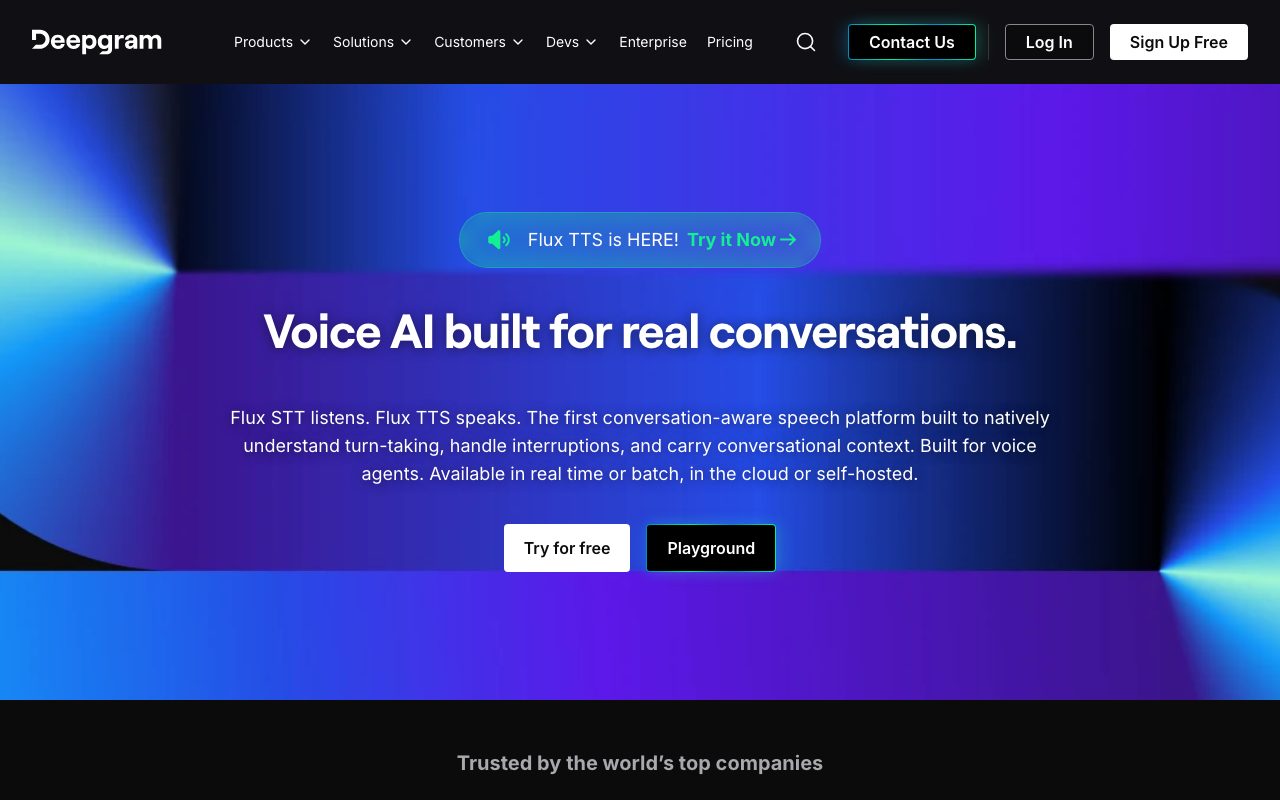
Deepgram provides an enterprise voice AI API suite that unifies real-time speech-to-text (STT), low-latency text-to-speech (TTS), audio intelligence, and unified voice agent orchestration across cloud and on-prem environments.
Deepgram is a developer-focused voice AI platform offering deep-learning APIs for speech recognition, voice synthesis, and conversational agents. Its core stack includes speech-to-text with real-time streaming and batch processing capabilities, alongside text-to-speech (including its Flux TTS model) engineered for live conversations with latencies as low as 80ms. Rather than forcing engineers to chain distinct vendors for transcription, language modeling, and voice generation, Deepgram provides a unified Voice Agent API. This endpoint combines speech-to-text, LLM orchestration, and speech synthesis in a single pipeline, decreasing end-to-end round-trip latency and engineering complexity. Deepgram also provides an Audio Intelligence API to extract structured insights from audio data. To accommodate varied enterprise data security mandates, Deepgram supports deployments both as a managed cloud service and in self-hosted environments. The platform is designed for scalable production workloads including contact center automation, speech analytics, medical transcription, and live voice assistants.
Deepgram unifies speech-to-text, LLM orchestration, and text-to-speech into a single Voice Agent API, reducing integration latency down to 80ms for TTS while supporting both cloud and self-hosted deployments.
Product capabilities
Key features
Flux Speech-to-Text (STT)
Provides real-time streaming and batch speech recognition built for conversational accuracy and interruption handling.
Flux Text-to-Speech (TTS)
Synthesizes expressive conversational audio with latency as low as 80ms, maintaining tone, expression, and context across turns.
Unified Voice Agent API
Consolidates speech recognition, LLM orchestration, and speech synthesis into a single API call to minimize pipeline latency.
Audio Intelligence API
Analyzes spoken conversations to surface insights and structured intelligence from raw audio inputs.
Flexible Deployment Options
Supports integration via public cloud APIs or on-premises self-hosted infrastructure for stringent enterprise compliance.
Practical fit
Who should use Deepgram?
Contact Center Automation
Power real-time call transcription, agent assist tools, and automated phone response agents.
Conversational Voice Agents
Deploy voice bots capable of natural turn-taking, fast responses, and dynamic interruption handling.
Podcast and Media Transcription
Convert recorded long-form speech into production-ready text using batch processing.
Medical Transcription
Transcribe clinical conversations and audio records under enterprise-grade data handling controls.
Editorial assessment
Pros and limitations
Where it is strong
- Offers a unified API covering STT, TTS, and conversational LLM orchestration
- TTS latency as low as 80ms for responsive voice interactions
- Supports both cloud API access and self-hosted deployments
- Provides an API playground and free testing access
Where to be careful
- Purely API and developer-centric; lacks an out-of-the-box non-technical consumer interface
- Detailed per-hour and tier rates require navigating beyond the main landing page
Commercial context
Deepgram pricing
At the review date (September 2026), Deepgram offers free sign-ups, a developer playground, and promotional free access to Flux TTS through September 12th (up to 45 concurrent streaming connections in the US and 5 in the EU/AU). Specific per-minute or character rates are not published on the reviewed homepage; verify current tiers on the official pricing page.
Pricing, limits, taxes, model access, and regional availability can change. Verify the purchase-critical details on the official pricing page linked under Sources.
Transparent ranking
Why Deepgram scores 75.6
Each factor is scored on a 100-point scale, then combined using the public ToolsRank weights. Engagement and momentum stay at a neutral baseline until measured signals exist, so no tool can gain or lose position from numbers nobody recorded.
Compatibility
Languages, platforms, and integrations
Languages
- English
Integrations & surfaces
- Amazon Connect
- Stripe
- GitHub
Community
Reviews and questions
No approved member reviews yet. Editorial factors above are the only rating on this page.
Reviews and questions come from Google-signed members and are checked by an editor before they appear.
Frequently asked
Deepgram FAQ
What is Deepgram's Voice Agent API?+
Deepgram's Voice Agent API is a unified interface that combines speech-to-text, LLM orchestration, and text-to-speech in one network connection, eliminating the need to stitch together separate services.
Can Deepgram be self-hosted?+
Yes. Deepgram offers self-hosted deployment options in addition to its managed cloud APIs, allowing organizations to run models in their own infrastructure for compliance and data sovereignty.
What is Flux TTS?+
Flux TTS is Deepgram's voice model designed for live conversations, delivering latencies as low as 80ms while maintaining conversational context, expression, and tone across speaking turns.
Does Deepgram offer a free tier or trial?+
Yes. Deepgram provides a free sign-up option with playground access, and has offered promotional access such as free concurrent streaming connections for Flux TTS.