
Direct answer
What is Relevance AI?
Relevance AI is a low-code platform for creating, testing, and chaining autonomous AI agents into multi-agent workforces with custom tools and enterprise evaluations.
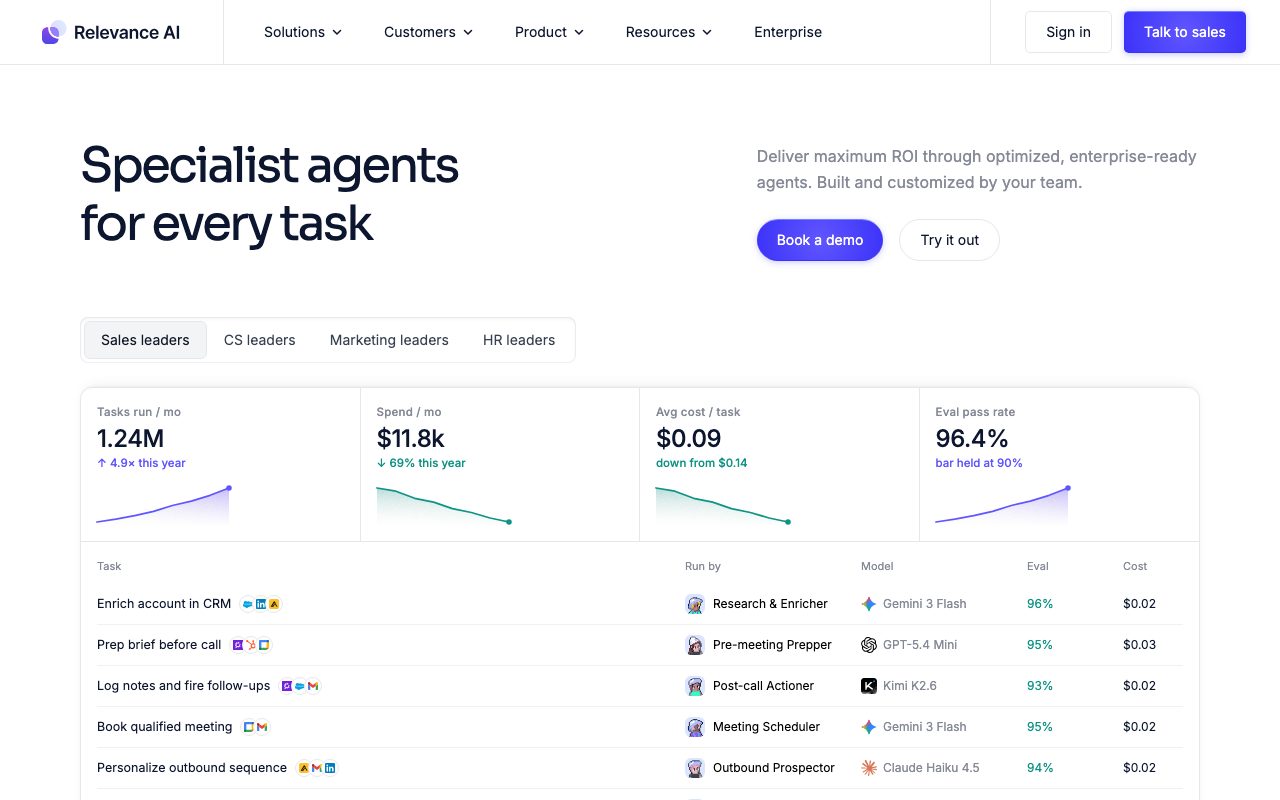
Relevance AI provides an enterprise platform designed to build, manage, and scale autonomous AI workforces. Rather than relying on static scripts or monolithic prompts, the platform allows teams to build specialized agents that handle defined business tasks such as prospect enrichment, meeting preparation, support triage, and pipeline roll-ups. Teams can construct agents visually from scratch, generate them using natural language prompts, or customize ready-made templates from the marketplace. Agents are equipped with modular tools that make API requests, search the web, execute code steps, or interact with external services like CRMs, databases, and messaging channels. Knowledge stores can be augmented with dynamic data synced from files, Notion, SharePoint, or Google Drive via built-in retrieval-augmented generation (RAG). Relevance AI includes built-in observability, model routing, and continuous evaluations (Evals). Users can benchmark agent performance across multiple frontier and lightweight language models (including Claude, Gemini, and GPT variants) to choose the lowest-cost model that satisfies quality bars. For technical teams, Relevance AI supports programmatic management through the Model Context Protocol (MCP), allowing developers to build, run, and debug agents directly inside developer tools like Claude Code and Cursor.
Relevance AI couples multi-agent workforce orchestration with live evaluation benchmarking and MCP integration, letting organizations measure accuracy and optimize model costs per task.
Product capabilities
Key features
Autonomous Agent Builder
Build single-task or multi-step AI agents using a visual builder, conversational prompts, or marketplace templates.
Workforce Orchestration
Connect specialized agents on a visual canvas to handle cross-functional workflows and automated handoffs.
Built-in Evals and Benchmarking
Sample live agent runs, monitor drift, and test prompts across multiple LLM providers to pick the lowest-cost model meeting quality thresholds.
No-Code Tool Builder
Equip agents with custom tools combining web scraping, code steps, LLM transformations, and third-party API calls.
Knowledge and RAG Integration
Ground agent responses in private documentation by syncing files, web sources, Notion, SharePoint, or Google Drive.
Model Context Protocol (MCP) Support
Create, test, run, and inspect agents programmatically from developer environments like Claude Code, Cursor, and VS Code.
Enterprise Governance and Guardrails
Manage deployments with role-based access controls, SOC 2 compliance, audit logs, human-in-the-loop approvals, and OTEL tracing exports.
Practical fit
Who should use Relevance AI?
Sales Prospecting and Meeting Preparation
Enrich inbound leads, draft personalized outreach sequences, and generate pre-call briefing dossiers for account executives.
Customer Support Automation and Triage
Resolve routine questions using connected knowledge bases and escalate complex issues directly to human representatives.
Operations and Data Processing
Automate recurring data extraction, pipeline forecast roll-ups, and scheduled reporting into Slack or spreadsheets.
Editorial assessment
Pros and limitations
Where it is strong
- Supports multi-agent workforce coordination with explicit handoffs between specialized agents
- Integrated evaluation tooling lets teams compare model performance against real run costs
- MCP server and plugin enable programmatic creation and debugging directly from AI coding environments
- Extensive enterprise guardrails including role-based access, approvals, and audit logging
Where to be careful
- Steeper learning curve than basic one-prompt chatbot builders
- Support SLAs for non-enterprise tiers are limited to business days during Sydney business hours
Commercial context
Relevance AI pricing
As of September 2026, the vendor offers a Free tier alongside paid Pro, Team, and Enterprise plans, with usage-based model consumption. Exact tier base pricing is not published on the reviewed pages and must be verified on the official pricing page.
Pricing, limits, taxes, model access, and regional availability can change. Verify the purchase-critical details on the official pricing page linked under Sources.
Transparent ranking
Why Relevance AI scores 74.8
Each factor is scored on a 100-point scale, then combined using the public ToolsRank weights. Engagement and momentum stay at a neutral baseline until measured signals exist, so no tool can gain or lose position from numbers nobody recorded.
Compatibility
Languages, platforms, and integrations
Languages
- English
Integrations & surfaces
- Slack
- Google Drive
- Google Sheets
- Gmail
- HubSpot
- Notion
- SharePoint
- Cursor
- Claude Code
- VS Code
Community
Reviews and questions
No approved member reviews yet. Editorial factors above are the only rating on this page.
Reviews and questions come from Google-signed members and are checked by an editor before they appear.
Frequently asked
Relevance AI FAQ
What is the difference between an Agent and a Workforce in Relevance AI?+
An Agent is an autonomous entity configured to perform a single focused task using instructions and connected tools. A Workforce connects multiple specialized agents on a visual canvas so they can collaborate, exchange data, and execute complex end-to-end workflows.
Can I build and manage Relevance AI agents from my terminal or IDE?+
Yes. Relevance AI supports the Model Context Protocol (MCP). Using clients like Claude Code, Cursor, or VS Code, builders can create agents, build tools, update instructions, execute tests, and analyze conversation logs without using the web UI.
How does model routing and evaluation work on the platform?+
Relevance AI includes an evaluation framework that runs test prompts across different LLMs (such as Claude, Gemini, and GPT models). It calculates an evaluation pass rate against your defined criteria so you can deploy the most cost-effective model that meets your quality standard.
What support options and SLAs are available?+
Relevance AI offers community support, an in-app AI support agent (Harley), and ticketed email support. First-response SLAs vary by plan: 1 business day for Enterprise, 2 business days for Team, and 3 business days for Pro, operating weekdays during Sydney hours (AEST/AEDT). Free plans do not have formal SLAs.